As a professional ABS Sheet Manufacturer, choosing the right supplier goes far beyond comparing prices. Global brand owners, wholesalers, and industrial manufacturers increasingly demand material consistency, processing reliability, compliance assurance, and long-term supply stability.
This in-depth guide explores ABS sheets from a manufacturing perspective, addressing material properties, production methods, application performance, and how to evaluate an OEM partner. It also fills critical information gaps commonly found in competitor content by adding practical selection insights, real-world application guidance, and OEM decision frameworks.
ABS (Acrylonitrile Butadiene Styrene) sheet is a thermoplastic polymer known for its balanced mechanical strength, impact resistance, and excellent processability.
Unlike commodity plastics, ABS sheets are widely used in value-added industrial and commercial products, where appearance, durability, and dimensional stability are all critical.
Core characteristics of ABS sheets include:
* High impact resistance, even at low temperatures
* Good surface hardness with smooth or textured finishes
* Excellent thermoforming and machining performance
* Stable electrical insulation properties
* Easy bonding, printing, and painting
These characteristics make ABS sheets a preferred material for manufacturers requiring both functional performance and visual consistency.
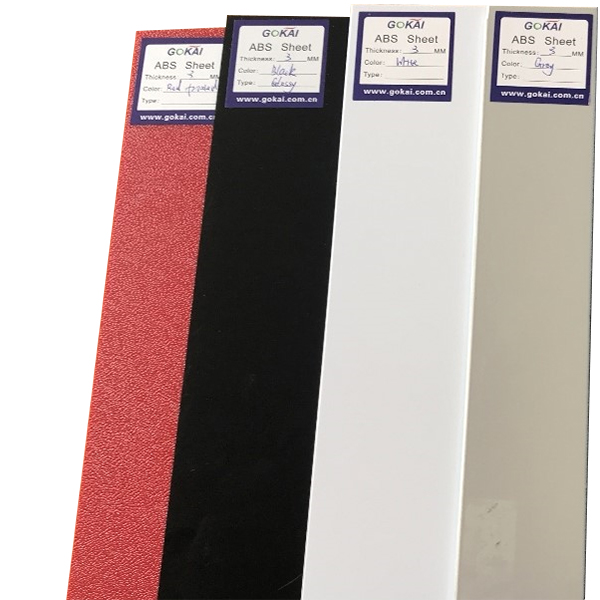
ABS sheets serve a wide range of industries due to their versatility and cost-performance balance.
* Indoor advertising panels
* Retail display backboards
* Exhibition booths and POP displays
* Interior trim panels
* Dashboard components
* Protective housings
* Wall cladding and decorative panels
* Furniture components
* Modular interior systems
* Equipment housings
* Protective covers
* Custom-formed enclosures
Compared with PVC or acrylic, ABS sheets offer a stronger balance between impact resistance and formability, making them ideal for structural and semi-structural applications.
Many competitor pages describe ABS sheets only at a surface level. As an experienced ABS Sheet Manufacturer, understanding the production process is essential to evaluating product quality.
High-quality ABS sheets start with virgin or controlled-grade ABS resin. Precise compounding ensures:
* Stable melt flow index (MFI)
* Consistent color dispersion
* Controlled impact and tensile strength
Additives such as UV stabilizers, flame retardants, or anti-static agents may be introduced depending on application needs.
The ABS resin compound is melted and extruded through precision dies to form sheets with:
* Uniform thickness
* Low internal stress
* Smooth or textured surfaces
Advanced calendering ensures flatness and dimensional stability, critical for thermoforming and CNC machining.
After cooling, sheets are cut to standard or customized dimensions. A professional ABS sheet manufacturer implements:
* Thickness tolerance control
* Surface defect inspection
* Mechanical property testing
This stage determines whether the ABS sheet performs reliably in downstream processing.

Understanding material differences helps buyers select the right solution.
| Property | ABS Sheet | PVC Foam Board | Acrylic Sheet |
|---|---|---|---|
| Impact Resistance | Excellent | Moderate | Low |
| Thermoformability | Excellent | Good | Limited |
| Surface Appearance | Good | Fair | Excellent |
| Machinability | Excellent | Good | Moderate |
| Cost Performance | Balanced | Economical | Higher |
ABS sheets are ideal when durability, forming flexibility, and structural performance are equally important.
Many competitor articles fail to address real-world manufacturing concerns. These factors significantly impact downstream success:
Poor-quality ABS sheets may warp or shrink after forming. Stable molecular structure and controlled cooling are essential.
For printing, painting, or laminating, surface energy consistency determines adhesion quality.
OEM buyers need repeatable performance, especially for long-term programs.
A qualified ABS Sheet Manufacturer designs production systems to control these variables, not just basic material specs.
China remains a global hub for ABS sheet production, but not all manufacturers are equal.
* In-house R&D and formulation control
* Modern extrusion lines with tight tolerances
* ISO-aligned quality management systems
* Export experience and compliance awareness
At Gokai, ABS sheets are developed alongside PVC foam boards and acrylic sheets, allowing cross-material expertise and application-based recommendations for OEM clients.
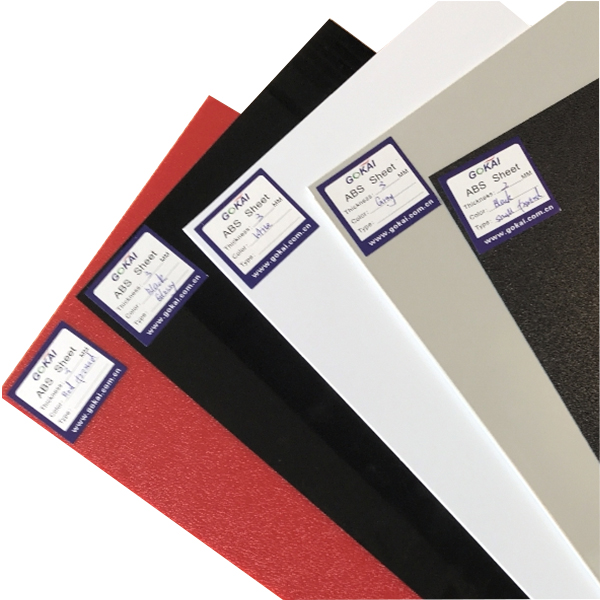
OEM buyers often require more than standard sheets.
Common customization options include:
* Thickness: from thin gauge to heavy-duty sheets
* Sheet size: standard or oversized formats
* Color matching based on Pantone or samples
* Surface finish: matte, glossy, textured
* Functional additives: UV resistance, flame retardancy
Customization capability reflects a manufacturer's engineering depth, not just production scale.
When evaluating suppliers, focus on total manufacturing capability, not just product samples.
1. Can the manufacturer maintain long-term formulation stability?
2. Do they offer technical support beyond sales communication?
3. Is quality control process-driven or inspection-only?
4. Can they scale production without sacrificing consistency?
Strategic OEM partnerships reduce costs, defects, and development cycles over time.
With a strong foundation in material R&D, extrusion manufacturing, and OEM supply, Gokai supports international clients seeking reliable ABS sheet solutions.
Key strengths include:
* Integrated material development capability
* Consistent quality across PVC, ABS, and acrylic product lines
* Custom-focused OEM manufacturing approach
* Export-oriented production standards
This combination allows buyers to source ABS sheets with confidence, even for complex or long-term programs.
Looking for a dependable ABS Sheet Manufacturer for OEM or wholesale supply?
Contact Gokai today to discuss material specifications, customization options, and long-term production solutions tailored to your market.
Q1: What thicknesses are commonly available for ABS sheets?
Most ABS sheets range from 0.5 mm to 10 mm, with custom thicknesses available for OEM projects.
Q2: Are ABS sheets suitable for outdoor use?
With proper UV stabilization, ABS sheets can be used in semi-outdoor or controlled exterior environments.
Q3: Can ABS sheets be thermoformed easily?
Yes. ABS offers excellent thermoforming behavior with minimal shrinkage when properly processed.
Q4: How do ABS sheets compare to PVC foam boards?
ABS sheets provide higher impact resistance and structural strength, while PVC foam boards focus on lightweight applications.
Q5: Can ABS sheets be customized for branding colors?
Yes. Professional ABS sheet manufacturers can match colors based on Pantone or physical samples.
This guide explains how to choose a reliable ABS Sheet Manufacturer, covering material properties, manufacturing processes, OEM customization, and quality standards. Learn why ABS sheets are ideal for industrial, signage, and OEM applications.

