Shanghai Gokai Industry Co,.Ltd.
Call Us: +86-18918606548
Call Us: +86-18918606548
- Product Name
- Product Keyword
- Product Model
- Product Summary
- Product Description
- Multi Field Search
Views: 266 Author: Gokai Publish Time: 2026-11-17 Origin: Site


Content Menu
● What Does Durability Mean for Custom PVC Foam Board?
● How Raw Material Quality Affects Panel Durability
>> PVC Resin and Formulation Consistency
>> Fillers: Evaluate the Result, Not Just the Ingredient
>> Stabilizers and Application-Specific Additives
● Why Foam Structure, Density, and Thickness Must Be Evaluated Together
>> Cell Uniformity and Surface Integrity
>> Density Is a Specification, Not a Quality Ranking
>> Thickness Variation Can Undermine Otherwise Good Material
● Environmental Conditions That Influence PVC Foam Board Service Life
>> Moisture Resistance Does Not Validate the Whole Assembly
>> Thermal Movement Requires Installation Allowance
>> Sunlight and Surface Color Affect Exposure
● Custom PVC Foam Board Manufacturing Controls That Matter
>> 1. Incoming Material Control
>> 2. Process Control During Extrusion
>> 3. Finished-Sheet Inspection and Packing
● A Practical Quality-Verification Plan for OEM Buyers
>> A Six-Step Sample Approval Workflow
● Turning "Good Quality" Feedback into Useful Evidence
● Comparing Total Cost Instead of Sheet Price
● Discuss Your Custom PVC Foam Board Requirements with Gokai
>> Does Higher Density Always Mean Better PVC Foam Board?
>> Can PVC Foam Board Be Used Outdoors?
>> Is PVC Foam Board Waterproof?
>> Why Can a PVC Foam Panel Warp After Installation?
>> What Should an OEM PVC Foam Board Specification Include?
>> Can Customer Feedback Prove Long-Term Durability?
In custom PVC foam board manufacturing, material quality influences how panels handle machining, moisture, temperature changes, and everyday use. For buyers sourcing OEM boards from Gokai, durability starts with the formulation—not simply the finished sheet's appearance.
A smooth surface can help a board make a good first impression. However, it does not reveal whether the core is consistent, fasteners will remain secure, or the panel will stay suitable for its intended environment.
My approach to evaluating a custom board is straightforward: define what it must withstand, then ask for evidence that the proposed material can meet those conditions. "Good quality" becomes commercially useful only when it translates into measurable requirements.

Durability is the ability to maintain acceptable performance throughout an intended application. It is not one universal property.
For printed displays, buyers may prioritize flatness, surface consistency, and resistance to handling damage. Furniture fabricators may place greater emphasis on machining quality, joint performance, and dimensional consistency.
Outdoor applications introduce additional concerns, including sunlight, temperature movement, wind loading, and fastening design.
A practical specification should therefore identify:
- Expected indoor or outdoor exposure.
- Panel dimensions, thickness, and support spacing.
- Applied loads and attachment methods.
- Required surface appearance and finishing process.
- Relevant safety requirements and acceptance tests.
PVC foam sheet should not automatically be treated as a structural building panel. Any load-bearing application requires appropriate engineering and application-specific evidence.
PVC resin provides the polymer matrix of the board. Its interaction with stabilizers, processing aids, fillers, and other ingredients influences the finished sheet.
The purchasing question is not simply, "Is the resin good?" A more useful question is, "How does the manufacturer keep the approved formulation consistent between production batches?"
Uncontrolled formulation changes can alter processing behavior and finished properties. Buyers should therefore request a documented material specification and an agreed process for approving significant changes.
Gokai's published company information describes virgin raw material use and standardized production. Buyers should confirm how those statements apply to the particular grade being quoted rather than assume every customized formulation is identical.
Mineral fillers can be part of a functional PVC formulation. Their presence alone does not prove poor quality.
What matters is the type, loading, dispersion, and compatibility of the filler within the complete formulation. A buyer should not accept either "filler-free" or "high-density" as a substitute for performance evidence.
Ask for bending, impact, and fabrication results relevant to the application. A heavier sheet is not automatically a tougher sheet, especially when competing products use different formulations.
Manufacturing exposes PVC to heat. Finished panels may also encounter elevated temperatures or sunlight during use.
Processing stability and outdoor weatherability are different requirements. A board that processes well is not necessarily suitable for prolonged exterior exposure.
For outdoor PVC foam board, request information about the proposed grade's weathering performance, permitted service conditions, color limitations, and installation requirements. Avoid accepting "UV-resistant" without a defined basis.
PVC foam board has a cellular structure that reduces weight compared with solid PVC.
Inspecting a freshly cut edge can reveal obvious voids, uneven foaming, or local irregularities. Surface inspection can identify pits, streaks, and inconsistent texture.
These checks are useful screening tools, but they do not replace laboratory testing. Two boards that look similar may perform differently during bending, routing, or fastening.
Request samples from normal production and inspect more than one location across each sheet.

Density expresses mass per unit volume. It affects panel weight and can relate to mechanical performance, but it does not independently establish suitability.
Comparisons are most meaningful when thickness, formulation, foam structure, and test conditions are comparable.
For example:
| Buyer priority | What to evaluate alongside density |
|---|---|
| Lightweight displays | Flatness, surface finish, handling strength |
| CNC-routed components | Edge quality, detail retention, tool compatibility |
| Furniture components | Joint design, fastening performance, sustained loading |
| Exterior signage | Weathering evidence, expansion allowance, fixing design |
Rather than requesting the highest available density, define the required performance and ask the supplier to recommend a documented grade.
An acceptable average thickness can hide thin areas near edges or across the sheet.
That variation matters when boards must fit channels, align with adjacent panels, or maintain consistent machining depth. It can also affect bending behavior.
Specify nominal thickness, allowable variation, and the measurement method. Agree where measurements will be taken and whether protective film is included.
Do not rely on a single measurement at one corner.
PVC foam sheet is commonly selected for moisture-resistant applications. However, measured water absorption depends on the particular grade and test conditions.
The finished installation also includes joints, adhesives, hardware, coatings, and supporting materials. These components may behave differently in wet environments.
For bathroom furniture or other humid settings, evaluate the complete assembly. Confirm adhesive compatibility, hardware selection, and any locations where water could collect.
A moisture-resistant panel does not make every cabinet design suitable for continuous wet exposure.
PVC foam panels expand and contract as temperature changes.
Brett Martin's Foamalux Calibre technical guide publishes a linear expansion coefficient of 0.068 mm per meter per degree Celsius for that specific product range.
Using that value illustratively, a 2-meter panel experiencing a 30°C temperature increase would expand approximately 4.08 mm.
That is enough movement to matter in a tightly restrained installation. The coefficient is not a verified Gokai specification; obtain the value for the actual supplied grade.
Clearances, oversized holes, washers, and support arrangements should follow the selected product's installation guidance.
Air temperature alone does not describe the conditions a panel experiences in sunlight.
The EX-Cel installation guide warns that dark-colored exterior material can absorb sufficient heat to exceed its stated temperature limit. Its recommendations apply to that product, but the purchasing lesson is broader: color and exposure belong in the specification.
For custom colored PVC foam board, disclose direct-sun exposure before approving the formulation. Do not assume an indoor decorative grade is appropriate outdoors.
A successful sample is valuable, but repeatable production is more important for recurring OEM orders.
From a buyer's perspective, three control stages deserve attention.
Ask how the manufacturer identifies and checks incoming resin and additives.
Relevant questions include whether materials are linked to supplier lots, how substitutions are approved, and what records remain available if a later issue requires investigation.
The objective is traceability, not paperwork for its own sake.
Foaming, extrusion, cooling, and handling must work together to produce consistent sheets.
Ask which product characteristics are monitored during production and what happens when measurements move outside agreed limits.
Useful checkpoints may include thickness distribution, density, appearance, and flatness. The exact control plan should match the product and the manufacturer's process.
Inspect finished boards for visible defects, dimensional conformity, and identification.
Export packaging should also be part of the discussion. Specify protective film where needed, corner protection, pallet support, and acceptable stacking arrangements.
Even a well-manufactured panel can arrive unsuitable for fabrication if transport damages its edges or surface.
The strongest procurement process combines laboratory evidence with fabrication trials.

| Verification item | What it helps establish | Important limitation |
|---|---|---|
| Thickness mapping | Dimensional consistency | Requires agreed measurement locations |
| Density measurement | Grade and weight consistency | Does not establish every mechanical property |
| Flexural testing | Bending strength and stiffness | Results depend on method and specimen conditions |
| Water-absorption testing | Moisture uptake under defined conditions | Does not validate a complete wet-area assembly |
| Machining trial | Compatibility with actual fabrication | Tooling and settings influence results |
| Fastening trial | Performance of the proposed connection | Must represent actual geometry and loading |
ASTM D790 provides methods for evaluating flexural properties of plastics. When reviewing a report, check the material identification, specimen dimensions, conditioning, and test conditions—not just the headline number.
A laboratory report should be traceable to the offered grade. Results from an unidentified sample provide limited support for a production order.
1. Define the intended application and likely failure modes.
2. Request the proposed grade's current technical information.
3. Agree dimensional tolerances and acceptance criteria.
4. Test samples using the intended cutting, printing, bonding, or fastening process.
5. Retain an approved reference sample and written specification.
6. Confirm how future batches will be checked against that specification.
A retained sample helps resolve appearance questions. Numerical requirements remain necessary for characteristics that cannot be judged reliably by sight.
Positive customer feedback is encouraging, but the phrase "good quality" does not explain what performed well.
For a stronger account, document the application, supplied specification, fabrication method, and observation period—with the customer's permission.
For example, ask whether the customer noticed cleaner routing, fewer rejected sheets, better surface consistency, or reliable fitting during assembly.
Do not convert a general compliment into an unsupported durability claim. A customer's satisfaction with indoor signage does not establish outdoor service life or furniture load capacity.
This distinction makes future purchasing decisions more informed and keeps product claims proportionate to the evidence.
A lower quotation can become expensive if boards require additional sorting, machining adjustments, or replacement.
Compare suppliers against the same specification and include:
- Material and freight costs.
- Fabrication yield and rejected components.
- Inspection and rework requirements.
- Packaging-related damage.
- Replacement handling and production disruption.
Also check whether quotations use the same thickness, density range, surface requirements, and packing method. Otherwise, an apparent price difference may reflect different products rather than better purchasing value.
The goal is repeatable performance at an acceptable total cost—not simply the cheapest sheet or the heaviest board.
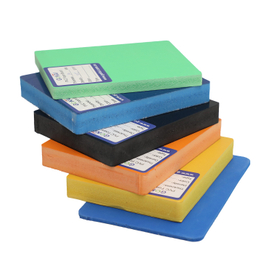
Gokai supplies PVC foam board and offers OEM customization. Its published information identifies customized sizes, thicknesses, and colors among the available options.
To make the discussion productive, send your intended application, drawings, exposure conditions, fabrication process, target dimensions, and estimated order quantity.
Ask Gokai to confirm the proposed grade, achievable tolerances, available test information, sample arrangements, and export packaging before production approval.
Start with an application-specific sample request. Approve the material against documented requirements, then use that specification as the basis for repeat orders.
No. Density should be evaluated alongside formulation, thickness, foam structure, and application requirements. It is useful for comparing consistent grades, but it is not a universal measure of toughness or durability.
Some grades are intended for exterior applications. Confirm weathering suitability, temperature limits, color restrictions, support requirements, and fastening guidance for the exact product. Indoor-grade performance should not be assumed to transfer outdoors.
PVC foam sheet is commonly used where moisture resistance matters. However, water-absorption results are grade-specific, and the complete installation includes joints and other materials. Avoid interpreting "waterproof" as approval for every immersion or wet-area application.
Possible contributors include thermal restraint, uneven heating, inadequate support, storage conditions, or manufacturing variation. Investigate both the panel and the installation rather than attributing the problem automatically to raw material quality.
Include dimensions, tolerances, density requirements, color, surface finish, intended exposure, fabrication needs, acceptance tests, packaging, and traceability. Identify any required regulatory or fire-performance documentation separately.
Not by itself. Feedback becomes more useful when linked to a known grade, application, operating conditions, and observation period. Combine it with relevant test results and production-quality records.
1. [Gokai — Company and Product Information]. Manufacturer-published information supporting the discussion of PVC foam board supply, virgin raw material statements, standardized production, and OEM/ODM customization. These are supplier statements, not independent verification. [gokaiplastic]
2. [Gokai — PVC Foam Board Product Category]. Product-family information and fabrication capabilities; project-specific properties should be confirmed for the quoted grade. [gokaiplastic]
3. [Brett Martin — Foamalux Calibre Technical Guide]. Source for the product-specific thermal expansion coefficient, movement considerations, and fixing guidance. Its values are not presented as Gokai specifications. [brettmartin]
4. [Instron — ASTM D790 Flexure Testing of Plastics]. Technical explanation of three-point flexural testing and the evaluation of plastic bending properties. [instron]
5. [EX-Cel — PVC Foam Sheet Installation Guide]. Product-specific guidance on thermal movement, fastening, temperature restrictions, and dark-colored exterior material. [wensco]
6. [RS — PVC Foam Technical Data Sheet]. Example of grade-specific reporting for density, water absorption, mechanical properties, and thermal characteristics; not a specification for all PVC foam boards. [docs.rs-online]