Shanghai Gokai Industry Co,.Ltd.
Call Us: +86-18918606548
Call Us: +86-18918606548
- Product Name
- Product Keyword
- Product Model
- Product Summary
- Product Description
- Multi Field Search
Views: 258 Author: Gokai Publish Time: 2026-11-09 Origin: Site


Content Menu
● What Creates the Surface of a PVC Laminated Foam Board?
● Why PVC Laminated Foam Boards Have Different Finishes on Each Side
>> 1. Only One Side Needs a Decorative Finish
>> 2. The Front and Back Serve Different Functions
>> 3. A Backing Layer Helps Manage Panel Balance
>> 4. Different Decorative Materials Produce Different Effects
>> 5. Protective Film Can Disguise the Real Finish
>> 6. Processing Variation Can Also Cause a Mismatch
● Is a Different Surface Finish Normal or a Quality Problem?
● Why Matching Appearance Does Not Guarantee Matching Performance
● How to Inspect PVC Laminated Foam Board Before Production
>> 1: Identify Side A and Side B
>> 2: Inspect the Cross-Section
>> 3: Compare Appearance Under Consistent Conditions
>> 4: Check Flatness and Dimensions
>> 5: Trial the Actual Fabrication Process
>> 6: Keep an Approved Reference Sample
● Can Different Finishes Increase Warping Risk?
● An Illustrative Cabinet-Door Decision
● How to Specify OEM PVC Laminated Foam Board Clearly
● Discuss Your Two-Sided Board Specification With Gokai
>> Is a PVC Laminated Foam Board Defective If Its Two Sides Look Different?
>> Can I Order the Same Finish on Both Sides?
>> Does Double-Sided Lamination Always Prevent Warping?
>> Can the Plain Reverse Be Printed or Bonded?
>> Should I Sand a Smooth Back Before Gluing?
>> Which Side Should Face Outward?
Some PVC laminated foam boards have different surface finishes on each side because they are designed with a decorative front and a functional back. One face may carry wood-grain film, high-pressure laminate, or another overlay, while the reverse remains plain, receives a simpler laminate, or uses a balancing layer. The difference is often intentional—not automatically a manufacturing defect.
However, an unexpected mismatch deserves investigation. The important question is not whether both sides look identical. It is whether each side matches the agreed specification and performs correctly in the finished application.
My recommendation when evaluating these boards is straightforward: assess the complete panel construction, not just its most attractive surface. Understanding asymmetry helps buyers distinguish practical product design from an unsuitable or incorrectly supplied board.

A PVC laminated foam board combines a foamed polyvinyl chloride substrate with an additional surface material. Gokai describes its laminated boards as lightweight sandwich panels using a PVC foam core and overlays such as PVC film or high-pressure laminate, commonly called HPL.
Three elements influence the finished appearance:
- Substrate: The underlying board affects smoothness, rigidity, and the support available for the overlay.
- Adhesive: The bonding system connects the decorative layer to the substrate.
- Surface material: The film or laminate determines much of the visible color, texture, and gloss.
A temporary protective film may also cover the decorative face. This removable layer is packaging protection, not necessarily the permanent finish.
Two sheets with the same printed pattern can therefore have different constructions—and different suitability for fabrication.
Single-sided PVC laminated foam board makes sense when only one face will be visible.
Examples include wall-facing panels, concealed furniture components, and display elements with a hidden reverse. Applying a premium decorative surface to an invisible face may add cost without improving the intended appearance.
However, "hidden" does not mean "unimportant." The reverse may still need suitable adhesion, cleanability, or dimensional performance.
For a cabinet door, both faces become visible during normal use. A single-sided specification therefore requires more consideration than it would for a permanently concealed panel.
A decorative face and a functional reverse do not always need matching textures.
The front might feature an embossed wood-grain pattern. The back could have a plain finish selected for cleaning, identification, or compatibility with a downstream process.
Some substrates may also be sanded or otherwise prepared before bonding. This can create a visible difference compared with an untouched surface.
Do not assume that a rougher reverse automatically bonds better. Adhesion depends on surface cleanliness, adhesive compatibility, preparation, and application conditions—not roughness alone.
A reverse-side layer may serve a mechanical purpose rather than a decorative one.
When different materials are bonded together, they can respond differently to temperature and environmental changes. An unsuitable combination can create internal stresses and contribute to bowing.
Laminate technical guidance therefore emphasizes balanced construction, particularly for panels without continuous rigid support.
This does not mean any inexpensive backing will prevent warping. The backing material, thickness, adhesive system, panel dimensions, and intended exposure must work together. Guidance developed for conventional HPL panels should inform engineering judgment, not be treated as automatic approval for every PVC-core construction.

PVC film and HPL are not interchangeable surface descriptions.
Manufacturers offer laminated foam boards with various overlays, including PVC film, PETG film, acrylic sheet, and HPL. Available effects include matte, high-gloss, wood-grain, and other textured finishes.
Consequently, one face may reflect light sharply while the other appears softer or more textured.
Specify the actual material on each side. "Glossy front, white back" describes appearance but leaves important construction details unresolved.
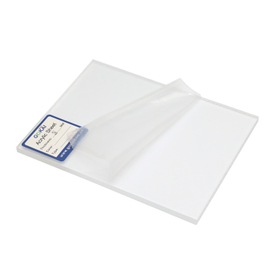
A protective film can make one side appear hazier, duller, or slightly different in color.
Before rejecting a delivery, check the packaging instructions and confirm whether either face has removable protection. Inspect a small sample area only when removal is permitted.
Avoid peeling protection from every sheet during incoming inspection. Premature removal can expose finished surfaces to scratches during storage and fabrication.
Not every difference is intentional.
Substrate production, surface preparation, adhesive application, and lamination conditions all influence the finished panel. An unexpected appearance may require investigation into the material or process.
Potential warning signs include bubbles, lifting edges, wrinkles, inconsistent texture, and localized discoloration.
A supplier's explanation should connect the observed difference to an agreed construction or an identifiable cause—not simply describe every mismatch as normal.
Use the purchase specification as the starting point.
| Observation | Possible explanation | Buyer’s next step |
|---|---|---|
| Wood-grain front and plain reverse | Intended single-sided decorative construction | Compare with the approved sample |
| Different colors but consistent bonding | Deliberately different face materials | Verify both material descriptions |
| Hazy appearance on one face | Protective film may remain attached | Follow removal instructions on a sample |
| Rougher reverse | Different preparation or substrate exposure | Confirm suitability for the intended process |
| Bubbles or peeling | Possible bonding or processing problem | Isolate affected sheets for investigation |
| Unexpected bowing | Construction, handling, or exposure may be unsuitable | Measure and review the complete panel system |
A deliberately different reverse can be acceptable. An undocumented substitution is a separate issue, even when the board initially looks usable.
A frequent purchasing mistake is treating "same color on both sides" as proof of equivalent construction.
Two white surfaces may use different materials, thicknesses, or coatings. Conversely, two differently colored faces may form an appropriately engineered panel.
Evaluate three separate questions:
1. Appearance: Do both sides meet the agreed visual requirements?
2. Construction: Are the specified materials and layers present?
3. Performance: Does the finished panel remain suitable for its application?
This distinction matters particularly for cabinet doors, movable partitions, and other components where both visibility and flatness affect customer acceptance.
Do not use visual similarity as a substitute for material identification or performance checks.
The following workflow is a practical procurement recommendation, not a universal laboratory standard.

Mark the intended decorative face and reverse on the sample or accompanying drawing.
Photograph both sides under the same lighting. Record the product code, batch identification, and whether protective film is present.
Examine a representative offcut.
Look for the foam core, visible overlays, and any obvious separation. A cross-section can help distinguish a laminated face from exposed PVC substrate.
Very thin films may require supplier documentation rather than visual inspection alone.
Use similar lighting, viewing distance, and orientation for every comparison.
Check color, gloss, embossing, scratches, and visible defects against an approved physical sample. Photographs are useful records, but they should not be the sole basis for accepting subtle color or texture differences.
Inspect representative sheets on a suitable reference surface.
Record thickness and any bowing using the agreed method. Set acceptance limits before ordering; do not invent tolerances after the shipment arrives.
Test cutting, routing, drilling, bonding, or printing on representative material before full production.
A decorative laminate that looks excellent may not accept the same ink or adhesive as bare PVC. Use recommendations for the exact exposed surface.
Retain a labeled sample with both faces identified.
Use it to review repeat orders, investigate complaints, and communicate clearly between purchasing, fabrication, and the supplier.
They can, but appearance alone does not establish the risk.
Panel behavior depends on the combination of substrate stiffness, overlay properties, adhesive, dimensions, support, and environmental exposure.
A large, freely moving door requires a different assessment from a small panel bonded to a rigid support.
Heat also deserves attention. Palram's guidance for its own foamed PVC sheets warns that excessive temperature or heating from one side can cause warping. Its published limits and processing advice are product-specific, not universal specifications for every laminated PVC board.
The practical lesson is to validate the complete assembly under intended service conditions. A moisture-resistant PVC core does not automatically make the overlay, adhesive, and finished installation suitable for every wet or heated environment.
Consider a bathroom cabinet door specified with a wood-grain exterior and a white interior.
Different finishes may be entirely appropriate because the two sides have different visual roles. Nevertheless, the door must remain usable when opened, cleaned, and exposed to the room's conditions.
Before approving production, the buyer should establish:
- Whether the white interior is bare PVC or a separate overlay.
- Whether both faces meet the required cleaning expectations.
- Whether the proposed construction is suitable for the door dimensions.
- How flatness will be measured and accepted.
- Whether edges and hardware details suit the assembly.
This is an illustrative purchasing scenario, not a reported Gokai project. It shows why "two different sides" is a specification question before it becomes a defect question.
For global OEM orders, describe both faces independently.
| Specification item | What to document |
|---|---|
| Board construction | Substrate type, nominal thickness, and agreed density |
| Side A | Overlay material, design code, color, texture, and gloss |
| Side B | Bare substrate, decorative overlay, or specified backing |
| Bonding | Compatible adhesive system and agreed verification |
| Dimensions | Sheet size and dimensional tolerances |
| Flatness | Measurement method and acceptance limit |
| Protection | Film placement, face labels, and packaging |
| Intended application | Visibility, support, fabrication, and exposure conditions |
Avoid ordering only "double-sided laminated board." Clarify whether that means identical decoration, different decorations, or a decorative face with a functional backing.
For Gokai inquiries, provide the finished application alongside the requested surface appearance. Gokai's published product information identifies OEM customization discussions covering dimensions, thickness, density, color, finish, and lamination.
Send Gokai your application, sheet dimensions, thickness, and separate requirements for Side A and Side B. Include photographs or physical samples of the desired finishes and explain whether both faces will remain visible.
Request confirmation of the proposed construction and approve a representative sample before bulk production. Clear face-by-face specifications make it easier to obtain the appearance, fabrication compatibility, and consistency your project requires.
Not necessarily. A decorative front and plain or functional reverse can be intentional. Investigate when the difference contradicts the approved specification, or when peeling, bubbles, or unacceptable deformation accompany it.
Yes, double-sided decorative constructions are commercially available. Confirm the overlay material, design, texture, and protection on both faces rather than relying on the phrase "same finish."
No. Double-sided construction alone does not guarantee flatness. Material compatibility, layer balance, adhesive selection, processing, storage, and service conditions still matter.
Possibly, but first identify the exposed material. Bare PVC, protective film, and a finished laminate require different assessments. Test the intended ink or adhesive on the actual production surface.
Not automatically. Sanding may be appropriate for some bonding systems but can damage others or change thickness. Follow the substrate and adhesive suppliers' instructions, then validate the process on a sample.
Use the face designated in the approved drawing or specification. Do not infer orientation from gloss alone. Clear Side A and Side B labels reduce mistakes during cutting and assembly.
The sources below support the material descriptions, manufacturing principles, and supplier capabilities discussed above. Inspection workflows and the cabinet-door scenario are editorial recommendations, not published test results.
1. [Gokai — PVC Laminated Foam Board]. Primary supplier description of PVC foam-core panels with overlays such as HPL and PVC film. [gokai.com]
2. [Gokai — PVC Foam Board]. Product applications and customization topics, including thickness, density, surface finish, and lamination. [gokai.com]
3. [Palram Industries — PALIGHT® PVC Foam Sheets]. Manufacturer guidance on foamed PVC fabrication, cleaning, lamination, and heat-related warping precautions. Recommendations apply to the identified products. [palram]
4. [Formica / Arpa — Technical Information, Part 1: Thin HPL]. Technical discussion of composite-panel stresses, balanced construction, surface preparation, and bonding. Not a PVC-core product approval. [www-upgrade.formica]
5. [Formica — HOMAPAL® Basic Metal Technical Brief]. Product-specific guidance illustrating protective peelcoat use and balanced assemblies for critical applications. [formica]
6. [Boardway — Laminated PVC Foam Boards for Interior Decorative Solutions]. Industry product examples covering overlay materials, decorative effects, and double-sided lamination. Commercial descriptions are not independent comparative testing. [boardwaybuilding]