Shanghai Gokai Industry Co,.Ltd.
Call Us: +86-18918606548
Call Us: +86-18918606548
- Product Name
- Product Keyword
- Product Model
- Product Summary
- Product Description
- Multi Field Search
Views: 257 Author: Gokai Publish Time: 2026-11-05 Origin: Site


Content Menu
● 1. Define What "Custom PVC Foam Core Boards" Means
>> Match the Board to Its Application
● 2. Create a Measurable PVC Foam Board Specification
● 3. Specify Thickness Tolerances and Flatness Correctly
● 4. Select Density Based on Performance, Not Price Alone
>> Distinguish Overall Density from Core Density
>> Use Sheet Weight as a Screening Check
● 5. Verify Mechanical Properties Under Relevant Conditions
>> Connect Laboratory Results to the Finished Part
● 6. Approve Surface Quality Through Real Fabrication Trials
>> For Printing and Lamination
● 7. Evaluate Environmental Exposure and Compliance Separately
>> Avoid Vague Fire-Safety Claims
● 8. Build a Sample-to-Production Approval System
>> Introduce a Change-Control Rule
● 9. Use a Risk-Based Pre-Shipment Inspection Plan
>> Classify Defects Before Inspection
● 10. Protect Approved Quality During Global Shipping
● 11. Illustrative Project: Preventing Display-Panel Assembly Failure
● 12. Turn Your Requirements into a Gokai OEM Brief
>> What information is needed for a custom PVC foam board quotation?
>> Does higher density always mean better PVC foam board quality?
>> How can buyers verify thickness consistency?
>> Can a sample guarantee that bulk production will match?
>> Are PVC foam core boards suitable for outdoor signs?
>> What is the difference between a technical data sheet and an acceptance specification?
Custom PVC foam core boards meet exact project specifications when buyers define measurable requirements, approve representative samples, and verify production against an agreed inspection plan. Thickness and color matter, but so do density, surface quality, fabrication performance, and packaging.
At Gokai, we supply PVC foam boards and other sheet materials to global customers, including OEM requirements. For buyers, positive feedback such as "good quality" is encouraging. However, repeatable quality requires something more precise: a written definition of what an acceptable board must do.
My recommendation is to make verification the foundation of every custom order. Start with the finished application, translate its requirements into measurable criteria, and confirm those criteria before mass production.
Product terminology can create problems before manufacturing begins.
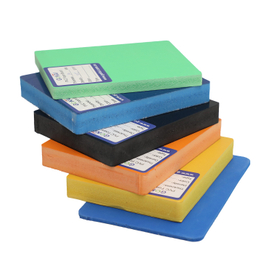
In this article, "PVC foam core board" means expanded rigid PVC sheet with a cellular structure. It does not mean paper-faced presentation board or automatically qualify as an engineered structural sandwich core.
Specify the exact construction you need. Free-foam, integral-skin, and co-extruded products can have different surface characteristics and fabrication behavior.
Describe how the finished component will be used:
- Printed retail graphics needing clean, consistent surfaces.
- Routed display panels requiring accurate dimensions.
- Cabinet components needing suitable fastening performance.
- Decorative panels requiring consistent appearance.
- Outdoor signs needing application-specific weathering assessment.
Avoid treating these uses as interchangeable. A board that prints well may not provide the fastening performance required by a cabinet assembly.
For load-bearing applications, obtain engineering approval rather than relying on a general-purpose sheet description.
A purchase order stating "white PVC board, 10 mm, good quality" leaves too much open to interpretation.
Create a controlled specification sheet covering the material, dimensions, performance, appearance, and delivery condition.
| Specification item | What to define | How to verify |
|---|---|---|
| Board construction | Expanded PVC type and surface structure | Technical documentation and approved sample |
| Dimensions | Length, width, thickness, and tolerances | Agreed measurement procedure |
| Density | Target range and overall/core basis | Suitable density test |
| Flatness | Maximum deviation under defined conditions | Agreed support and measurement setup |
| Surface appearance | Color, gloss, texture, allowable defects | Master sample and visual inspection |
| Fabrication | Printing, routing, bonding, or fastening requirements | Application trial |
| Packaging | Protection, quantity, labels, pallet requirements | Pre-shipment inspection |

Specify units consistently. Mixing millimeters, inches, and nominal trade sizes can introduce avoidable errors.
Also identify the document revision. Production should follow one approved drawing and specification, not conflicting instructions scattered across emails.
Nominal thickness is a product designation. A tolerance establishes the permitted variation.
For example, a nominal 10 mm sheet with an agreed tolerance of ±0.3 mm would allow measurements from 9.7 mm to 10.3 mm. This is an illustrative requirement, not a universal tolerance or a stated Gokai production capability.
Confirm achievable limits before ordering.
One measurement cannot establish thickness consistency.
Agree on a measurement map covering the center, intermediate positions, and locations near the edges. Define edge offsets, instrument type, contact pressure, and conditioning conditions.
These details matter because an inconsistent measurement procedure can make acceptable material appear defective—or hide variation that affects assembly.
A board can meet thickness requirements and still bow enough to interfere with printing or installation.
State:
- Whether the sheet rests freely or receives support.
- The surface used for inspection.
- The measurement span.
- The maximum allowable gap.
- Any conditioning period before inspection.
For precision-cut PVC foam boards, define squareness and finished-part tolerances as well as raw-sheet dimensions.
Density is useful, but it should not become a shortcut for assessing every aspect of quality.
A higher-density board does not automatically satisfy every application. Construction, thickness, formulation, and finished-part geometry also influence performance.
ASTM D1622 addresses apparent density of rigid cellular plastics and distinguishes overall density, including forming skins, from core density with those skins removed.
This distinction matters when comparing quotations. Two density figures may describe different measurement bases.
For custom PVC foam core boards, specify whether acceptance concerns overall density, core density, or both.
For a rectangular sheet:
Mass=Length×Width×Thickness×Density
Use compatible units. Weight checks can help identify unexpected variation, but they do not independently prove compliance.
A heavier sheet might be thicker rather than denser. Confirm dimensions and density before deciding why the weight changed.
General descriptions such as "strong" or "rigid" do not establish suitability.
For panels that must resist bending, flexural testing provides more useful information. ASTM D790 and ISO 178 are commonly used methods for evaluating plastic flexural properties.
Flexural strength concerns resistance to bending stress. Flexural modulus indicates stiffness. They are related but are not interchangeable.
Request the test method, specimen dimensions, conditioning, and test temperature alongside the reported result.
Intertek notes that thermoplastic properties can vary with temperature, making end-use conditions relevant to testing.
For furniture and display assemblies, supplement material tests with practical trials:
1. Assemble the actual joint.
2. Use the intended fastener and installation method.
3. Apply the agreed service load.
4. Check deformation, loosening, and damage.
Do not treat a successful short demonstration as proof of long-term performance. Define the duration and acceptance criteria appropriate to the application.
A smooth-looking sheet is only the starting point.
Custom PVC foam boards may need to accept ink, adhesive, film, paint, or routed detail. Test the combination that the customer will actually use.
Evaluate:
- Visible defects under agreed lighting.
- Color consistency against an approved reference.
- Ink adhesion after the required curing period.
- Compatibility with the selected adhesive.
- Bubbles, lifting, or distortion after lamination.
Use production equipment and consumables whenever possible. A sample printed with a different ink system may not resolve the buyer's actual risk.
Check edge finish, dimensional accuracy, small-feature integrity, and machining consistency.
Record the tooling and settings used during approval. Otherwise, later differences may arise from processing changes rather than the board itself.
Keep a signed master sample for appearance comparisons, while using written limits for measurable properties.

Indoor suitability does not automatically establish outdoor durability.
For exterior projects, describe sunlight exposure, expected temperature range, mounting arrangement, panel color, and service life expectations. Ask for evidence relevant to the proposed grade and application.
Do not transfer performance data from solid PVC sheet to expanded PVC foam board without justification.
Terms such as "fireproof" can create false expectations.
ASTM E84 measures comparative surface-burning behavior, including flame-spread and smoke-developed indices, under specified conditions. A flame-spread result alone does not classify a material as noncombustible.
Where fire performance matters, request a report matching the relevant product construction, thickness, and tested assembly. Confirm acceptance with the project's responsible professional or authority.
Similarly, requests concerning restricted substances should name the destination-market requirement and supporting documentation needed. Avoid relying on a broad "compliant" statement.
A carefully selected sample does not establish that every production shipment will match it.
Create a documented approval sequence:
1. Review the technical specification.
2. Evaluate representative material samples.
3. Conduct fabrication and assembly trials.
4. Approve a first article or pilot quantity.
5. Release mass production against the approved revision.
Require notification before changes to agreed material construction, formulation, surface finish, or other performance-critical characteristics.
Decide which changes require new samples or repeat testing.
This prevents a common purchasing problem: the product name stays the same while characteristics important to the buyer change.
Retain sample identifiers and approval records. Both parties should know which sample represents the accepted production target.
Inspection becomes more useful when it reflects the consequences of failure.
A small cosmetic mark on a hidden component differs from an undersized panel that cannot fit its frame.
Agree on practical categories:
- Critical: defects creating an unacceptable safety or regulatory issue.
- Major: defects preventing intended use, assembly, or customer acceptance.
- Minor: limited appearance deviations that do not prevent agreed use.
Define examples and acceptance rules for the actual project.
Inspect sheets from different packs and production positions rather than only the most accessible stack. Decide whether dimensions, appearance, and functional characteristics need different sampling approaches.
For failures, document identification, segregation, corrective action, and reinspection. Do not allow an undocumented concession to become the next shipment's assumed standard.
A conforming sheet can arrive unusable if packaging does not protect it.
For OEM PVC foam board orders, agree on surface protection, edge protection, stacking, pallet support, and shipment labels.
Protective film should also be evaluated for the intended storage and removal conditions. Do not assume every film is suitable for every surface or storage duration.
Include a packing list that connects each package to the order and relevant batch identification.
On arrival, inspect packaging condition before unpacking, photograph visible damage, and compare received quantities and material identification with the shipping documents.
This separates manufacturing issues from handling or transit damage and supports faster resolution.

Consider a retailer ordering routed PVC display panels for repeated store installations.
The first sample looks attractive, but the purchase order specifies only thickness, color, and overall size. Production panels later fit inconsistently into the mounting channels.
The better approach is to define the interface before ordering:
- Measure the channel's usable opening.
- Establish the acceptable finished-panel thickness range.
- Specify edge finishing and squareness.
- Test a complete assembly.
- Verify representative production pieces before shipment.
This is an illustrative scenario, not a reported Gokai customer case.
Its lesson is practical: acceptance should reflect how the board interacts with the finished system, not simply whether the sheet looks good.
Gokai supports global customers seeking customized PVC foam board supply. A complete inquiry makes technical discussions more productive and helps avoid mismatched expectations.
Send your intended application, drawings, sheet dimensions, density requirements, surface reference, fabrication process, quantity, destination, and required documentation.
Include the tolerances that matter most and explain why they matter.
Ask Gokai to review feasibility and propose representative samples before confirming the production order. Establish the inspection and packaging requirements at the same time—not after manufacturing is complete.
Provide board construction, thickness, density, dimensions, color, surface requirements, quantity, destination, packaging preferences, and any required testing. Include drawings and tolerances for precision applications.
No. Density must match the application. Confirm stiffness, fabrication behavior, surface performance, and assembly suitability rather than judging the board by density alone.
Use an agreed measurement map and suitable calibrated equipment. Check multiple positions across representative sheets, and define measurement conditions before inspection.
No. Samples establish an approval target. Production inspection, traceability, and change control help verify that the shipment follows that target.
Suitability depends on the grade, exposure, mounting design, and required service life. Request application-relevant evidence and assess a representative finished assembly.
A data sheet describes reported product characteristics. An acceptance specification defines the agreed limits, test methods, and decisions used to accept or reject the supplied material.
1- Gokai. "PVC Foam Board: The OEM Buyer's Guide to Materials, Applications, Quality Control, and Custom Manufacturing." Supplier guidance on quotation inputs and customization requirements. [gokai.com]
2- Gokai. "PVC Foam Board Manufacturer." Product overview and customization services; supplier information is not independent proof of application performance. [gokai.com]
3- ASTM International. "ASTM D1622-26: Standard Test Method for Apparent Density of Rigid Cellular Plastics." Basis for distinguishing apparent overall density from apparent core density. [store.astm]
4- Intertek. "Flexural Properties Testing." Explanation of ASTM D790, ISO 178, flexural strength, modulus, and temperature considerations. [intertek]
5- ASTM International. "ASTM E84-22: Standard Test Method for Surface Burning Characteristics of Building Materials." Scope, reported indices, and limitations of surface-burning assessment. [astm]