Shanghai Gokai Industry Co,.Ltd.
Call Us: +86-18918606548
Call Us: +86-18918606548
- Product Name
- Product Keyword
- Product Model
- Product Summary
- Product Description
- Multi Field Search
Views: 277 Author: Gokai Publish Time: 2026-10-28 Origin: Site


Content Menu
● What Are High-Performance Plastics?
>> Material Families Do Not Replace Grade Specifications
● Polycarbonate Sheet vs. PVC Foam Board
● When Polycarbonate Sheet Is the Better Choice
>> Protective Panels and Machine Guarding
>> Outdoor Polycarbonate Sheet Needs the Right Protection
>> Abrasion and Cleaning Require Separate Attention
● When PVC Foam Board Is the Better Choice
>> Density Should Match the Finished Product
>> Print Quality Begins Before Printing
>> Outdoor PVC Foam Board Requires Grade Verification
● Five Checks That Prevent Expensive Material Mistakes
>> 1. Separate Service Temperature from Laboratory Values
>> 2. Test Chemicals Under Real Conditions
>> 3. Allow for Thermal Movement
>> 4. Verify Fire Claims Precisely
>> 5. Evaluate Long-Term Behavior
● Three Application Scenarios That Clarify Selection
>> 1: A Frequently Cleaned Machine Window
>> 3: A Lightweight Cabinet Component
● How to Prepare an OEM Plastic Sheet Specification
>> 2: Specify Measurable Requirements
>> 3: Approve a Representative Sample
>> 4: Agree on Production and Inspection Controls
>> 5: Confirm Packing and Traceability
● Compare Total Project Cost, Not Just Sheet Price
● Work with Gokai on Your Next OEM Sheet Project
>> Is polycarbonate sheet a high-performance plastic?
>> Can PVC foam board be used outdoors?
>> Which is better for machine viewing panels?
>> Does higher-density PVC foam board always mean better quality?
>> Can these sheets be customized for OEM orders?
>> What should I send when requesting a quotation?
Choosing high-performance plastics starts with understanding what your application actually demands. For transparent protection, polycarbonate sheet may be the right candidate. For lightweight signage, display panels, or cabinetry, PVC foam board may offer a more practical solution. Neither should be selected simply because a supplier describes it as "high performance."
At Gokai, we supply polycarbonate sheet, PVC foam board, and OEM services for global customers. Our approach begins with a practical question: What must this sheet withstand throughout its working life?
This guide explains how to compare materials, identify specification gaps, and prepare an OEM inquiry that supports reliable purchasing decisions.

High-performance plastics are often associated with advanced polymers designed for demanding thermal, mechanical, or chemical environments. PEEK is a familiar example.
However, commercial discussions sometimes use the term more broadly to describe plastics that perform particularly well in a specific application.
That distinction matters. Polycarbonate is an engineering thermoplastic valued for transparency and impact resistance. PVC foam board is a lightweight cellular material widely used for printing and fabrication. Neither is automatically interchangeable with a high-temperature polymer.
A useful purchasing principle is to select the material that meets the actual service conditions—not the material with the most impressive description.
The polymer name is only the starting point.
Polycarbonate products can differ in UV protection, surface coatings, optical properties, and fire performance. PVC foam boards can differ in density, surface hardness, thickness consistency, and outdoor suitability.
Ask for documentation covering the exact grade, thickness, color, and construction being quoted. A generic brochure cannot establish that every version meets your requirements.
| Selection factor | Polycarbonate sheet | PVC foam board |
|---|---|---|
| Primary advantage | Transparency combined with impact resistance | Lightweight, opaque, workable panel |
| Typical applications | Viewing panels, protective glazing, equipment enclosures | Signs, displays, furniture components, decorative panels |
| Surface considerations | Scratching, haze, coating compatibility | Print quality, surface hardness, dent resistance |
| Outdoor requirement | Verify UV-protected grade and installation direction | Verify exterior-grade formulation |
| Fabrication priorities | Edge quality, hole geometry, thermal movement | Routing quality, fastening, print compatibility |
| Important limitation | Not universally scratch-resistant or chemically compatible | Not a substitute for transparent glazing or high-temperature engineering plastics |
This comparison narrows the shortlist. Final selection still depends on panel dimensions, loading, exposure, fabrication, and applicable requirements.
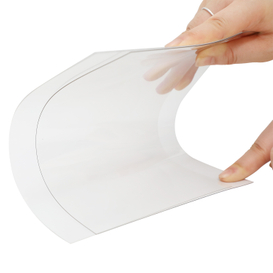
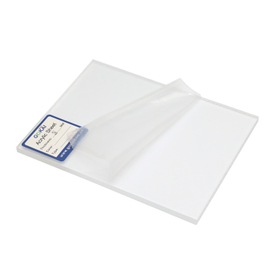
Polycarbonate is worth evaluating when visibility and impact resistance are central to the design.
Applications include machine viewing panels, equipment covers, protective partitions, and architectural glazing. Each application requires its own assessment; a material's general toughness does not establish that a finished assembly is safe.
A machine guard is a system, not just a plastic sheet.
Its performance depends on:
- The hazard and potential impact energy.
- Panel thickness and unsupported span.
- Frame design and fastening.
- Openings and access points.
- Exposure to heat, coolants, and cleaners.
For machinery used in the United States, guarding requirements address protection from hazards such as rotating parts, nip points, and flying chips. Choosing polycarbonate alone does not demonstrate compliance.
Have the responsible designer validate the complete guard rather than selecting thickness from appearance or habit.
Do not assume that every clear polycarbonate sheet has equivalent outdoor durability.
Commercial product ranges distinguish between general-purpose sheets, sheets with UV protection on one side, and sheets protected on both sides.
For exterior projects, confirm:
1. Whether the quoted grade has dedicated UV protection.
2. Which surface must face outward.
3. Whether fabrication affects the protected surface.
4. What exposure conditions any warranty covers.
Keep protective-film markings readable until installation orientation is confirmed.
Impact resistance is not the same as scratch resistance.
A panel can resist an impact yet develop visible surface damage through repeated wiping or abrasive contact. Abrasion-resistant grades may be appropriate for frequently cleaned viewing panels.
Also verify cleaning compatibility. Evaluate the actual detergent, disinfectant, coolant, adhesive, and sealant—not simply a broad claim of "chemical resistance."
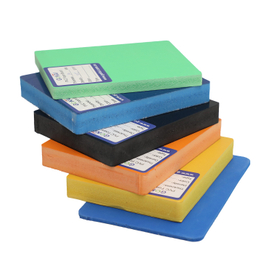
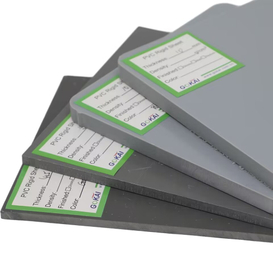
PVC foam board is useful when the project needs a lightweight, opaque panel that can be cut, routed, printed, or assembled.
Common applications include:
- Retail displays and exhibition graphics.
- Interior signage and decorative panels.
- Cabinet components and storage fixtures.
- Fabricated covers and non-load-bearing enclosures.
Its suitability depends on the formulation and construction. Moisture resistance alone does not establish suitability for structural, exterior, or marine safety-critical applications.
Density influences weight and can affect fabrication and mechanical behavior. However, density alone does not describe the entire board.
Surface hardness, cellular structure, thickness, and manufacturing consistency also matter.
For a printed display, a smooth, consistent surface may be the priority. For a cabinet component, edge strength and fastening performance deserve closer attention.
Compare samples using the actual cutting, fastening, and finishing methods planned for production.
For direct printing, inspect more than whiteness.
Useful checks include:
- Thickness variation across the sheet.
- Flatness before loading.
- Surface cleanliness and visible defects.
- Ink adhesion after curing.
- Edge quality after trimming.
- Appearance under the intended lighting.
Run a trial using the production ink, printer settings, and curing process. A sample that looks attractive on a desk may behave differently during fabrication.
Indoor printing board and exterior-grade PVC foam board should not be treated as equivalent.
Manufacturer product ranges include specially formulated outdoor versions. This distinction is important for signs exposed to sunlight and heat.
Specify exposure duration, mounting method, panel color, support spacing, and expected surface temperature. Avoid basing an exterior recommendation on water resistance alone.
The most useful material comparison connects published properties with the conditions of the finished product.
Melting temperature, heat-deflection temperature, and continuous-use guidance describe different behaviors.
For example, published data for one unreinforced PEEK grade lists a melting temperature of 343°C, but a heat-deflection temperature of 152°C under a specified 1.8 MPa load.
Neither number independently establishes an allowable working temperature.
Check temperature together with load, exposure duration, chemical contact, and dimensional tolerances.
Compatibility depends on concentration, temperature, contact duration, and mechanical stress.
Prepare a list of every substance the sheet may encounter, including cleaning products and installation materials. Request grade-specific guidance, then test representative samples where the application warrants it.
Do not substitute a brief room-temperature wipe test for prolonged exposure.
Plastic sheets expand and contract as temperatures change.
As an illustrative calculation, a 2,000 mm panel with a linear expansion coefficient of 0.065 mm/m°C changes length by approximately 5.2 mm over a 40°C temperature increase.
This is not a universal installation allowance. Joint design must consider the actual sheet grade, installation temperature, panel geometry, and mounting system.
Follow the selected product's installation guidance rather than rigidly clamping a large panel without movement provision.
A statement such as "flame-retardant" is incomplete without supporting details.
Request the test standard, classification, specimen thickness, and covered grade or color. Confirm whether the project requires a material test result or assessment of the finished assembly.
A classification for one thickness should not be assumed to cover every product variant.
A panel may look satisfactory immediately after installation yet deform or loosen during service.
For loaded components, examine sustained loading, support spacing, fastening, and temperature. Where failure could cause injury or significant damage, obtain application-specific engineering review.
These examples illustrate a decision process rather than documented customer projects.

The initial request is for a clear, impact-resistant panel.
The specification should also identify coolant exposure, cleaning frequency, viewing requirements, and possible projectiles. Abrasion-resistant polycarbonate may deserve evaluation, but frame design and hazard assessment remain essential.
The lesson: specify the complete operating environment, not transparency alone.
The buyer wants a lightweight panel with a clean printed surface.
An indoor printing grade may produce acceptable initial graphics without meeting long-term exterior needs. Evaluate an outdoor-grade board, printing compatibility, supports, and thermal movement together.
The lesson: successful printing does not establish outdoor durability.
The buyer wants a moisture-resistant alternative to a conventional panel.
PVC foam board may be worth testing, but the evaluation should include hinge attachment, screw retention, edge finishing, and sustained shelf loading.
The lesson: validate the assembled component, not just the sheet sample.
A detailed specification makes quotations easier to compare and reduces misunderstandings.

Describe the finished product, installation environment, expected service life, and consequences of failure.
Include drawings or photographs where useful.
Record:
- Material and required grade.
- Sheet dimensions and tolerances.
- Thickness and allowable variation.
- Color, finish, and appearance limits.
- UV or abrasion protection requirements.
- Required test reports and destination-market requirements.
For PVC foam board, include density where relevant. For transparent polycarbonate, identify optical and surface expectations.
Specify what sample approval covers: appearance, machining, printing, assembly, or functional performance.
Retain an approved reference sample and record the associated specification. A small sample may not reveal full-sheet flatness or behavior across a long unsupported span.
Discuss how thickness, dimensions, surface condition, labeling, and packaging will be checked.
Agree on acceptance criteria before production. Define how nonconforming material will be documented and addressed.
International shipments introduce handling and storage risks.
Confirm protective film, edge protection, pallet configuration, moisture protection, and identification. Ask how delivered material can be traced to the agreed order and specification.
The lowest sheet price may not produce the lowest finished-part cost.
Consider material yield, cutting waste, machining time, printing rejects, protective packaging, freight, and replacement risk.
A larger sheet may improve nesting but create handling difficulties. A lower-cost board may require extra finishing. An unnecessary premium grade can also waste budget.
Compare alternatives against the same drawing, acceptance criteria, and delivery basis.
Gokai supplies polycarbonate sheet and PVC foam board and offers OEM services for global customers.
Send your application details, drawings, dimensions, quantity, destination, and required documentation. Identify any critical requirements for UV exposure, printing, abrasion, temperature, or fire performance.
Request a quotation and representative samples against that specification. Confirm the available customization, tolerances, and verification documents before approving production.
Polycarbonate is an engineering thermoplastic valued for transparency and impact resistance. It can deliver strong application-specific performance, but it should not be treated as equivalent to high-temperature polymers such as PEEK.
Some grades are formulated for exterior use. Confirm the specific product's UV suitability, temperature limitations, thickness, installation requirements, and warranty conditions rather than assuming all PVC foam boards perform alike.
Polycarbonate is generally the more relevant candidate because PVC foam board is opaque. However, a safe viewing panel requires application-specific assessment of thickness, mounting, chemicals, temperature, and hazards.
No. Density is one selection factor. Surface quality, cellular consistency, thickness tolerance, fabrication behavior, and suitability for the intended component also matter.
Gokai offers OEM services. Discuss the required dimensions, appearance, protection, packaging, and documentation directly, then confirm which options are available for the selected product and order quantity.
Provide the application, material, dimensions, thickness, quantity, destination, and required performance. Add drawings, tolerances, processing details, and documentation requirements so the quotation reflects the intended finished product.
1. [Piedmont Plastics — Best High Performance Plastics]. Original article used as the topic baseline; its industry-led structure was replaced with application-based selection and purchasing guidance. [piedmontplastics]
2. [Palram — PALSUN Flat Solid Polycarbonate Sheet]. Supports distinctions between general-purpose, one-sided UV-protected, two-sided UV-protected, and abrasion-resistant product options. [palram]
3. [Palram — PALSUN Polycarbonate Technical Information]. Provides the illustrative linear thermal expansion coefficient of 0.065 mm/m°C. The article's expansion example is a calculation, not a Gokai product specification. [palram]
4. [Palram — PALIGHT PVC Foam Sheets]. Supports printing and fabrication applications, cabinet uses, processing considerations, and the distinction of dedicated outdoor grades. [palram]
5. [Victrex — VICTREX 450G Polymer Datasheet]. Supports the distinction between melting temperature and heat-deflection temperature, including the stated test load. [victrex]
6. [Occupational Safety and Health Administration — 29 CFR 1910.212: General Requirements for All Machines]. Supports discussion of machine hazards, guarding functions, attachment, and avoiding hazards created by the guard itself. [osha]
7. [Gokai — Official Product and OEM Overview]. Supports the company's sheet-product positioning and OEM offering. Specific project performance remains subject to confirmed product documentation. [gokai.com]