Shanghai Gokai Industry Co,.Ltd.
Call Us: +86-18918606548
Call Us: +86-18918606548
- Product Name
- Product Keyword
- Product Model
- Product Summary
- Product Description
- Multi Field Search
Views: 288 Author: Gokai Publish Time: 2026-10-31 Origin: Site


Content Menu
● Understanding the Product Before Comparing Suppliers
● Russia's Position in the PVC Sheet Supply Chain
>> Where Local Supply Advantages Are Concentrated
● How This Shortlist Was Built
>> 1. Confirmed Product Relevance
>> 3. Production and Development Evidence
>> 4. Quality-Control Transparency
>> 5. Delivery and OEM Suitability
● 1. Shanghai Gokai Industry Co., Ltd.: An Overseas OEM Option for Specification-Led Buyers
>> Company Background and Main Markets
>> Core Strengths and Purchasing Fit
>> OEM and ODM Scope to Confirm
● 2. UNITED EXTRUSION / UNEXT: Direct Russian Manufacturing with Published Capacity
>> Company Background and Main Markets
>> OEM and ODM Scope to Confirm
● 3. ZENON: A Regional Supply Channel for Signage and Printing Buyers
>> Company Background and Main Markets
>> OEM and ODM Scope to Confirm
● 4. ForDA: Mixed-Material Procurement for Fabrication Businesses
>> Company Background and Main Markets
>> OEM and ODM Scope to Confirm
● 5. Plastic-Souz: A Moscow-Based Source for Sheet Materials
>> Company Background and Main Markets
>> OEM and ODM Scope to Confirm
● Technical Buyer's Guide: How to Compare PVC Free Foam Board Properly
>> Specify Performance, Not Just "Premium Grade"
>> Treat CE, RoHS, and ISO as Different Questions
● Common Purchasing Problems and How to Reduce Them
>> Comparing Price per Sheet Without Matching Specifications
>> Accepting a Sample Without Establishing Its Origin
>> Confusing Distributor Service with Manufacturing Control
>> Relying on General Certificate Statements
● An Underused Procurement Safeguard: Control the Transition from Sample to Production
● Factory Verification, Sampling, and Logistics
>> Verify the Entity Before Evaluating the Offer
>> Use a Staged Sampling Process
>> Confirm Packaging in Writing
>> Check Trade Legality Before Booking Freight
● FAQ
>> 2. Can two free-foamed PVC sheets with the same thickness and density perform differently?
>> 3. Should every PVC Free Foam Board shipment include a CE certificate?
>> 4. How do I prevent a distributor from replacing the approved material with a cheaper alternative?
>> 5. Can an overseas buyer freely import Russian PVC foam sheets if the supplier agrees to ship?
Finding a reliable PVC Free Foam Board supplier requires more than comparing prices per sheet. Professional buyers need consistent material performance, traceable production, realistic delivery commitments, and documentation that matches the intended application.
For companies sourcing in Russia, the available options include domestic extrusion manufacturers, established sheet-material distributors, and overseas OEM factories. These businesses serve different purposes: a local distributor may support urgent replenishment, while a direct manufacturer may offer greater control over formulation, dimensions, and private-label production.
This guide evaluates five companies relevant to that sourcing decision, starting with Shanghai Gokai Industry Co., Ltd. as an overseas OEM alternative, followed by a Russian manufacturer and three Russian distribution businesses. Gokai is based in China, not Russia; its inclusion provides a comparison for buyers considering imported, customized supply alongside domestic purchasing.

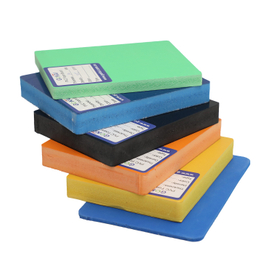
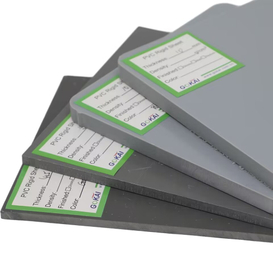
"PVC Free Foam Board" means PVC sheet produced through a free-foaming process. It does not mean a board that is free from PVC. Purchase orders should use the clearer wording "free-foamed PVC sheet" wherever possible.
It is also important not to confuse this material with paper-faced foam board. These are different product categories and should not be treated as interchangeable in specifications or quotations.
Equipment supplier KraussMaffei distinguishes compact, coextruded, and integral-foam PVC sheet processes. Similarly, Russian manufacturer UNITED EXTRUSION lists free-foam, compact, and coextruded sheets as separate product types. A supplier's ability to manufacture one does not automatically establish suitability for every other type.
Before requesting quotations, specify:
- Required sheet construction and intended application.
- Thickness, dimensions, and acceptable tolerances.
- Target density or an agreed density range.
- Surface finish, color, and protective-film requirements.
- Printing, routing, bonding, or assembly processes.
- Required product testing and destination-market documentation.
This prevents a common purchasing error: comparing sheets that share the same nominal thickness but have different constructions and performance expectations.
Russia has an established plastics-processing sector, although broad plastics statistics should not be presented as PVC foam board market figures.
IBISWorld's June 2025 analysis identified 21,886 businesses in Russia's plastic product manufacturing industry. Its coverage includes plastic plates, sheets, packaging products, tubes, profiles, and construction supplies—not free-foamed PVC sheets alone. The figure demonstrates the breadth of the processing sector, but it does not establish the number of PVC foam board manufacturers or their combined capacity.
A government-backed market overview from the Wisconsin Economic Development Corporation also identifies plastics production and processing as a substantial Russian chemical-industry subsector. Its production figures refer to earlier reporting periods and broad material categories, so they should not be interpreted as current PVC foam board demand.
The companies reviewed here illustrate a practical central-Russian sourcing corridor:
- UNITED EXTRUSION operates manufacturing facilities in Yasnogorsk, Tula Region.
- ZENON maintains an extensive Russian branch network.
- ForDA is headquartered in Saint Petersburg.
- Plastic-Souz serves the Moscow market.
These locations connect production and distribution with major commercial purchasing centers. However, the evidence supports a manufacturing-and-distribution network, not a claim that Russia has a formally defined PVC free-foam industrial cluster.
For buyers operating within Russia, local inventory may reduce replenishment complexity. For international buyers, Russian-origin supply requires an additional legal and logistical assessment before commercial negotiations progress.
This is an application-based shortlist, not a ranking by audited market share. It uses publicly available company information, product listings, and official compliance guidance.
Because Gokai is the commissioning supplier and appears first at the requested placement, its position should not be interpreted as an independently measured first-place ranking.
Companies must demonstrate a relevant PVC foam sheet offering or a documented position in the sheet-material supply chain.
A manufacturer, distributor, and sourcing intermediary provide different levels of production control. Their roles must remain visible throughout the evaluation.
Production lines, published sheet ranges, and technical product families provide useful evidence. General statements about innovation do not substitute for formulation records, development trials, or application testing.
Buyers should request incoming-material controls, in-process inspection procedures, finished-sheet acceptance criteria, and batch identification.
An attractive unit price is insufficient without a workable minimum order, production schedule, packaging specification, and clear responsibility for customization.
A certificate must match the legal entity, manufacturing location, product or management-system scope, and relevant validity period. A logo on a website is not enough. IAF CertSearch provides certificate-status and scope checks for accredited management-system certifications.
"Not publicly confirmed" means the reviewed source did not establish the information. It does not mean that the company lacks the capability or certificate.
| Company | Role and location | Established | Published capacity evidence | MOQ status | Certification evidence in reviewed sources | Main purchasing fit |
|---|---|---|---|---|---|---|
| Shanghai Gokai Industry Co., Ltd. | Manufacturer; Shanghai, China | 2009 | Company reports 10 production lines; PVC-only annual tonnage is not stated | Confirm by specification and OEM scope | Certificate numbers and scopes not shown on the reviewed About Us page | Overseas OEM sourcing and customized supply |
| UNITED EXTRUSION / UNEXT | Manufacturer; Tula Region, Russia | 2003 | Company reports 12,000 tonnes/year across three extrusion lines and multiple PVC sheet types | Confirm by grade, size, and production run | Company states certificates are available; individual validity requires verification | Direct Russian-manufactured PVC sheet sourcing |
| ZENON | Advertising-material supplier; Russia | 1992 | Extrusion capacity not established in reviewed sources | Confirm with the supplying branch | Request documentation for the exact brand and grade | Regional stock purchasing and sign-production materials |
| ForDA | Materials distributor; Saint Petersburg, Russia | 1993 | Manufacturing capacity not applicable to the reviewed distributor role | Confirm by stock item and delivery location | Request product-specific documentation | Mixed-material purchasing for fabrication businesses |
| Plastic-Souz | Sheet-material supplier; Moscow, Russia | 1997 | Extrusion capacity not established in reviewed sources | Confirm by sheet format and order | Request documentation for the exact supplied product | Moscow-area sheet-material sourcing |
Company history, capacity statements, and product positioning are drawn from the respective company sources. None of the reviewed sources establishes a universal MOQ or a complete, independently validated certification package for every listed supplier.
Shanghai Gokai Industry Co., Ltd. states that it was founded in 2009 and specializes in the research, development, and manufacture of PVC foam board and acrylic sheet. Its headquarters are in Shanghai, and its About Us page reports 10 production lines. That page does not separate annual PVC foam board output from other product capacity.
Gokai positions itself toward international buyers, and its website references participation in SGIA Expo, FESPA, and SGI Dubai. These references support an international commercial orientation, although the reviewed page does not provide an audited breakdown of sales by country.
Gokai is relevant to buyers comparing overseas factory sourcing with Russian stock purchasing. Its stated manufacturing and development focus makes it a candidate for specification discussions rather than simply selecting an existing distributor SKU.
For smaller brands and regional distributors, the useful commercial opportunity is to negotiate a manageable, clearly documented OEM program. That may involve a narrower initial product range, agreed packaging, repeatable specifications, and staged sampling rather than immediately committing to a broad catalog.
Its suitability as a cost-effective partner should be tested through landed-cost quotations and trial orders—not inferred from factory location alone.
The commissioning brief identifies OEM service as part of Gokai's offering. Buyers should request written confirmation of the available scope for:
- Custom dimensions and thicknesses.
- Agreed density, surface, and color specifications.
- Private-label protective film or packaging.
- Batch labels and inspection documentation.
- Mixed-specification orders.
- Application-led product development.
These are negotiation items, not verified standard inclusions.
Communication efficiency and flexibility are particularly important for smaller buyers. Evaluate them through an actual RFQ: does the supplier identify specification conflicts, explain production constraints, and return a complete quotation without repeated clarification?
Gokai's reviewed page also lists packaging options including corner protection, export wood pallets, and cartons. Buyers should turn those options into an agreed packing drawing and acceptance checklist.
UNITED EXTRUSION states that it was founded in 2003 and began operating KraussMaffei extrusion lines in 2005. Its production and warehouse facilities are located in Yasnogorsk, Tula Region. The company identifies Russia and the CIS in its manufacturing history and reports distribution through large Russian retail chains.
The company provides unusually concrete production information for this shortlist:
- Three extrusion lines.
- Reported total capacity of 12,000 tonnes per year.
- Free-foam PVC sheet thicknesses from 1–10 mm.
- Compact and coextruded PVC sheet production.
- Approximately 10,000 square meters of production and warehouse space.
The capacity figure covers multiple PVC sheet types. It should not be described as 12,000 tonnes of free-foamed board alone.
Its UNEXT range includes STRONG, FRESH, PRAGMATIC, COLOR, and PATRIOT product families. These offer buyers a starting point for comparing general-purpose, lightweight, colored, and budget-oriented materials.
UNITED EXTRUSION is the clearest candidate on this list for direct discussions with a Russian extrusion manufacturer. However, its reviewed public information does not establish private-label terms, custom-formulation MOQs, or an open-ended ODM service.
Ask whether the proposed order will use an existing UNEXT grade or a separately controlled formulation.
The company's English pages also show a minor dimensional inconsistency: one lists 1220 × 2400 mm, while another lists 1220 × 2440 mm. This illustrates why the signed order specification must control the transaction rather than a general website description.
ZENON's own company history states that it was established in March 1992 and moved toward outdoor-advertising production and material supply in 1995. Its branch directory demonstrates a broad Russian distribution presence.
Its relevant customer market is advertising production, including businesses purchasing materials for printing, display fabrication, and signmaking.
ZENON lists UNEXT-FRESH foamed PVC sheets and has published technical-commercial information about UNEXT-STRONG. This establishes a documented connection to Russian-produced foam PVC sheet supply.
For buyers, the principal value is distribution access and product selection—not verified control over the original extrusion process.
A regional supply channel may suit:
- Trial orders before a larger commitment.
- Replacement material for urgent projects.
- Purchases combining PVC sheet with other advertising materials.
- Buyers wanting to compare stocked grades.
Availability, branch inventory, and delivery timing still require confirmation.
The reviewed sources do not establish ZENON as the original manufacturer of the listed UNEXT products or verify a general private-label manufacturing program.
If customization is offered, ask whether it is:
1. Local cutting or order preparation.
2. A factory-coordinated special production run.
3. Private-label supply under a separate commercial agreement.
These services carry different lead times and responsibilities.
ForDA states that it has operated in Russia since 1993. Its company page gives a registration date of April 27, 1993, identifies its activity as wholesale and retail trade, and lists Saint Petersburg as its central-office location.
Its stated markets include advertising manufacturers, printing businesses, automotive workshops, construction companies, and design and architectural organizations.
ForDA's sheet-material category includes PVC sheet alongside acrylic, polystyrene, foam board, aluminum composite panels, PET-related sheets, and other fabrication materials.
That breadth makes it relevant for buyers whose main challenge is coordinating several materials for one project.
A display manufacturer, for example, may find that consolidated purchasing reduces administrative work even when the PVC sheet price is not the lowest quoted. The correct comparison is total procurement cost, including handling, delivery, and the consequences of receiving incompatible materials.
The reviewed sources support ForDA's distributor role, not ownership of PVC free-foam extrusion capacity.
Ask separately about cutting, nonstandard dimensions, factory-arranged orders, and repeat-order material continuity. Do not assume that broad catalog coverage means unrestricted formulation development.
Because supplier websites may retain older network descriptions, buyers should use ForDA's current contact directory to identify the actual selling entity and fulfillment location.
Plastic-Souz states that it was founded in 1997 and supplies materials for outdoor advertising and construction. Its company information identifies a Moscow presence.
The company lists Russian UNEXT foamed PVC and describes it as free-foamed sheet with a matte white surface and protective film. This is particularly relevant because it explicitly identifies the free-foamed product category.
Plastic-Souz is therefore a practical candidate for buyers seeking a Moscow-area source of established sheet brands.
The reviewed information does not establish an in-house extrusion plant, published annual capacity, or a general OEM/ODM manufacturing service.
Its appropriate evaluation path is distributor due diligence:
- Identify the original manufacturer.
- Confirm the exact grade and batch.
- Obtain product documentation.
- Verify stock condition and packaging.
- Establish whether repeat deliveries will use the same material.
Where cutting or special-order services are available, include dimensional acceptance criteria and responsibility for damaged edges in the purchase agreement.

Terms such as "premium," "high density," and "export quality" are insufficient acceptance criteria.
A more useful RFQ asks suppliers to state measurable values and test methods for the properties that matter to the application. UNITED EXTRUSION's separate sheet constructions and multiple product families demonstrate why a generic request for "PVC foam board" leaves too much room for substitution.
Use a specification matrix such as the following:
| Requirement | What the buyer should define | What to request from the supplier |
|---|---|---|
| Construction | Free-foamed PVC, not an unspecified alternative | Written grade and process identification |
| Dimensions | Length, width, thickness, tolerances | Inspection method and sampling plan |
| Density | Agreed range where relevant | Batch measurement records |
| Print application | Printer, ink, curing, cleaning process | Production-representative print samples |
| Fabrication | Routing, drilling, bonding, assembly | Trial pieces processed under actual conditions |
| Composition | Restricted-substance and recycled-content requirements | Declarations and relevant test evidence |
| Appearance | Color, finish, visible-defect limits | Retained approved sample |
| Packaging | Stack support, corner protection, labeling | Packing specification and loading photographs |
These are recommended purchasing controls, not a claim that every supplier already provides them.
A frequent procurement mistake is asking for "CE/RoHS/ISO certification" as though these were interchangeable product-quality approvals.
The European Commission states that not all products require CE marking and that manufacturers must not affix it to products outside the relevant legislation. CE marking is therefore not a universal quality badge for every PVC sheet.
For construction applications, identify the applicable regulatory route, intended use, and supporting performance documentation. The Construction Products Regulation provides a framework for communicating construction-product performance, but applicability must be assessed for the specific product and use.
For a RoHS-related customer requirement, ask the supplier to identify the exact substance restrictions, test methods, sample identity, and intended application addressed by its report. Do not accept an unexplained logo.
For ISO management-system claims, verify the certificate's status, site, and scope. A valid management-system certificate is useful evidence about organizational controls; it does not replace acceptance testing of the purchased sheet.
A low quotation may refer to a different grade, dimension, construction, or packaging arrangement.
Require every quotation to repeat the same specification table. Where a supplier proposes an alternative, insist that it be shown as a separate option rather than silently substituted.
A visually attractive sample does not by itself establish which factory, formulation, or production run it represents.
Ask for sample identification, production date, grade, and the manufacturing site. For repeat business, retain an approved reference sample and agreed inspection criteria.
ZENON, ForDA, and Plastic-Souz can be useful purchasing channels, but their reviewed sources do not establish the same extrusion-control position as UNITED EXTRUSION. The distinction matters when resolving formulation changes, production defects, or private-label requirements.
Make the complaint path explicit: who investigates a defect, who authorizes replacement, and who bears the resulting freight cost?
UNITED EXTRUSION states that its products have necessary certificates, but the reviewed About page does not provide enough detail to independently validate every document. Gokai's reviewed About page likewise does not establish specific certificate numbers or scopes. Buyers should request the actual documents rather than converting general website statements into verified compliance claims.
The most useful "inside" precaution is not a secret additive test. It is preventing an approved sample from becoming disconnected from the production material.
A recommended control sequence is:
1. Record the approved sample's grade, dimensions, appearance, and relevant test results.
2. Ask the supplier to identify the production specification that corresponds to it.
3. Require written notification before material, formulation, site, or construction changes.
4. Take inspection samples from more than one pallet or production position.
5. Repeat the buyer's critical printing or fabrication trial on shipment samples.
6. Retain labeled samples for future complaint investigation.
This recommendation is particularly relevant when purchasing across multiple product families or through a distributor carrying several brands. Public product ranges show that materially different PVC sheet options may be available within the same supply channel.
A second practical safeguard is to write down the approved protective film and surface-preparation procedure. ZENON's discussion of UNEXT-STRONG specifically connects surface characteristics with printing and protective-film adhesion, illustrating why the sheet surface deserves attention alongside the foam core.
Match the quotation, bank beneficiary, certificate holder, and manufacturing-site information.
For a distributor, identify both the selling company and original producer. For a manufacturer, request a live production walkthrough or an independent site assessment appropriate to the order's value.
A practical approval sequence is:
- Initial material sample.
- Full-sheet trial where necessary.
- Buyer-side printing or fabrication.
- Written approval against defined criteria.
- Pre-shipment inspection of production material.
- Retained shipment sample.
Do not approve only appearance if the commercial application depends on routing accuracy, ink adhesion, bonding, or assembly performance.
Gokai lists corner guards, export pallets, and cartons among its packaging options. These are useful starting points, but buyers should still specify pallet support, edge protection, labeling, handling restrictions, and any destination-specific wood-packaging requirements.

Russia-related transactions require current screening of the goods, origin, destination, counterparties, banks, carriers, and intended use.
The Council of the European Union describes restrictions affecting trade with Russia, including restrictions involving plastics and other goods. An unrestricted commercial quotation does not establish that a transaction is legally permissible. Obtain classification-specific advice before committing to Russian-origin imports or Russia-bound shipments.
Do not assume that routing goods through a third country removes restrictions or changes their origin.
These five companies represent different sourcing routes rather than interchangeable factories.
- Gokai provides an overseas manufacturing option for buyers investigating OEM customization.
- UNITED EXTRUSION offers the strongest published direct-manufacturing evidence among the Russian companies reviewed.
- ZENON provides a documented regional channel for advertising materials and UNEXT sheets.
- ForDA suits buyers coordinating several fabrication-material categories.
- Plastic-Souz offers a Moscow-based supply route for established sheet products.
For an OEM discussion with Shanghai Gokai Industry Co., Ltd., submit a specification-led RFQ covering application, sheet construction, dimensions, density requirements, order volume, destination, packaging, and required documentation.
Request a quotation, production-representative samples, and a written quality-control proposal together. That creates a more useful basis for comparison than a price list alone.
Search the legal company name or certificate number in IAF CertSearch. Review the status, standard, scope, locations, issuing certification body, and accreditation details. Then compare those details with the actual manufacturing site on the quotation.
If the record cannot be resolved, contact the issuing certification body directly before treating the claim as verified. A certificate for a trading office should not automatically be treated as covering an extrusion factory.
Thickness and density alone do not fully identify a commercial grade. Suppliers offer separate product families for different priorities, including lightweight construction, printing, color, and general-purpose use.
The safest purchasing approach is to combine dimensional requirements with application trials. Approve the actual material on the intended printer, router, adhesive system, or assembly process.
No. CE marking is required only where applicable legislation calls for it, and it must not be applied indiscriminately to other products. Determine the intended use and applicable legal framework before requesting specific documents.
For construction use, ask the supplier to explain the relevant performance-assessment route rather than simply supplying a generic certificate.
State the original manufacturer, brand, grade, dimensions, and acceptance criteria in the purchase order. Require written approval before substitution and retain a labeled reference sample.
This is especially important where a supply channel lists multiple foam PVC brands or grades. A broad catalog is commercially useful, but it makes precise order identification essential.
Not necessarily. Supplier willingness does not determine legality. The buyer must assess applicable import restrictions, sanctions, classification, origin, counterparties, banking, and transport arrangements.
EU guidance identifies substantial restrictions on Russian trade, including categories involving plastics. Obtain a transaction-specific compliance assessment before paying a deposit or booking freight.
1- Shanghai Gokai Industry Co., Ltd., company background, manufacturing focus, and packaging options. [gokai.com]
2- UNITED EXTRUSION, company history, manufacturing facilities, capacity, and product range. [en.unitedextrusion]
3- ZENON, company history, regional contacts, and UNEXT product information. [zenonline]
4- ForDA, company background and sheet-material categories. [forda]
5- Plastic-Souz, company history and free-foamed UNEXT sheet listing. [plastic-souz]
6- KraussMaffei, technical overview of PVC sheet extrusion processes. [plastrading]
7- IBISWorld, *Plastic Product Manufacturing in Russia*, June 2025. This is a broad industry report, not a dedicated PVC free-foam board market study. [ibisworld]
8- Wisconsin Economic Development Corporation, *Russia's Growing Plastics Market*, government-backed industry context. [wedc]
9- European Commission, CE marking guidance and construction-product framework. [single-market-economy.ec.europa]
10- IAF CertSearch, management-system certificate verification guidance. [iafcertsearch]
11- Council of the European Union, Russia-related sanctions and trade-restriction guidance. [consilium.europa]