Shanghai Gokai Industry Co,.Ltd.
Call Us: +86-18918606548
Call Us: +86-18918606548
- Product Name
- Product Keyword
- Product Model
- Product Summary
- Product Description
- Multi Field Search
Views: 289 Author: Gokai Publish Time: 2026-07-13 Origin: Site


Content Menu
● What Makes Multiwall Polycarbonate Hurricane Panels Different
● Understanding Polycarbonate Hollow Sheet Options for Hurricane Protection
● Preparing Openings for Multiwall Polycarbonate Hurricane Panels
>> Clean and Clear the Surrounding Area
● Essential Tools and Materials for Installation
● Step‑by‑Step: Cutting and Drilling Multiwall Polycarbonate Hurricane Panels
>> Laying Out and Drilling Fastener Holes
● Mounting Hardware and Direct‑Fastened Panel Installation
>> Locating Structural Support
● Long‑Term Care, Storage, and Inspection After Storms
● Expert Notes on Designing with Polycarbonate Hollow Sheets
● A Typical Residential Hurricane Panel Installation
● FAQs
Installing multiwall polycarbonate hurricane panels with hollow sheets is one of the most reliable ways to protect windows and doors while maintaining daylight and long-term durability. [acmeplastics]
Multiwall polycarbonate hurricane panels are engineered to combine impact strength, light transmission, and weather resistance in a single system. Unlike plywood, they are lighter, reusable, and transparent, so you can board up well before a storm without living in the dark. When produced as polycarbonate hollow sheets (also known as multiwall panels), the internal rib structure provides stiffness, energy absorption, and thermal insulation with far less weight than solid glazing materials. [duralightplastics]
High-quality hurricane-grade panels have been tested to withstand large missile impacts and extreme wind pressures typical of severe coastal storms. For example, 16 mm multiwall hurricane panels have passed tests simulating a 9 lb 2" x 4" impact and pressure loads equivalent to winds around 170 mph when properly installed over glass openings. [duralightplastics]
From an installer's perspective, multiwall polycarbonate is easy to fabricate on site using common woodworking tools, and can be direct-mounted to typical residential substrates such as wood framing, brick, or concrete block. This combination of performance and practicality explains why multiwall polycarbonate hollow sheets are increasingly specified for residential hurricane protection, canopies, skylights, and other architectural glazing applications. [polycarbonlatepanel]

When selecting panels for hurricane shutters or storm protection, it helps to distinguish the main sheet types and their strengths. [acmeplastics]
- Twinwall polycarbonate: Two outer skins with hollow channels between them, commonly used where clarity and insulation are important, such as skylights or greenhouse roofs. [xhplasticsheet]
- Multiwall hurricane panels: Multiple layers and chambers designed specifically to resist flying debris and pressure cycling in severe storm events. [polycarbonlatepanel]
- Clear monolithic polycarbonate: Solid transparent sheets used for safety shields and machine guards where high clarity and impact resistance are critical. [duralightplastics]
- Thicker specialty grades: Bullet‑resistant or enhanced impact formulations used in banking and security applications where projectile threats exceed typical storm conditions. [duralightplastics]
For direct-mount hurricane applications, installers should prioritize multiwall or heavier-gauge hollow sheets that carry appropriate test reports and approvals for residential wind-borne debris zones. In practice, this means confirming thickness, fastening details, and allowable spans against manufacturer technical guides before cutting panels to size. [acmeplastics]
Correct panel sizing and substrate preparation determine how well the system performs when a storm hits. [duralightplastics]
For typical windows without sills, measure the clear opening and add approximately 8 inches to both height and width. This yields about 4 inches of panel overhang on each side, creating space for anchors while fully covering the glass. Where a defined window sill is present, add roughly 4 inches to the height so the sill-mounted bracket can support the bottom edge without excessive projection. [youtube]
A simple way to visualize this is to sketch the opening and mark the 4-inch perimeter. This "safety border" becomes the fastening zone, ensuring anchors engage solid framing while keeping fastener lines out of the immediate glass area. [youtube]
Before any drilling or bracket installation, clean the wall surface around each opening with mild soap and water to remove dust and grime. A clean substrate helps sealants bond properly and reduces the chance of water tracking behind the panel during wind-driven rain. At the same time, remove or secure loose items such as planters, toys, or hose reels that could become projectiles in high winds. [duralightplastics]
One of the advantages of multiwall polycarbonate hurricane panels is that they can be installed with standard tools most homeowners already own. [acmeplastics]
Typical tools include: [acmeplastics]
- Drill with suitable bits and a step bit for clean polycarbonate holes.
- Measuring tape, level, and marker for layout and alignment.
- Circular or table saw fitted with a fine‑toothed blade.
- Stud finder to locate structural members behind siding.
- Ladder, safety glasses, work gloves, and dust mask for safe working conditions.
Hardware and accessories usually comprise: [polycarbonlatepanel]
- Anchor screws selected for wood, brick, or block substrates.
- Neoprene‑bonded washers and wing nuts or similar mechanical fasteners.
- Sill brackets where windows have projecting sills.
- Weather‑resistant sealant compatible with polycarbonate.
- For hollow sheets in permanent glazing: H‑channel connectors, U‑profiles, and vent or aluminum tapes to seal and protect open ribs. [xhplasticsheet]
For long-term performance, it is important to match fastener type and length to the substrate and sheet thickness so that anchors penetrate at least 1 inch into solid structure and washers spread loads evenly without dimpling the sheet. [polycarbonlatepanel]
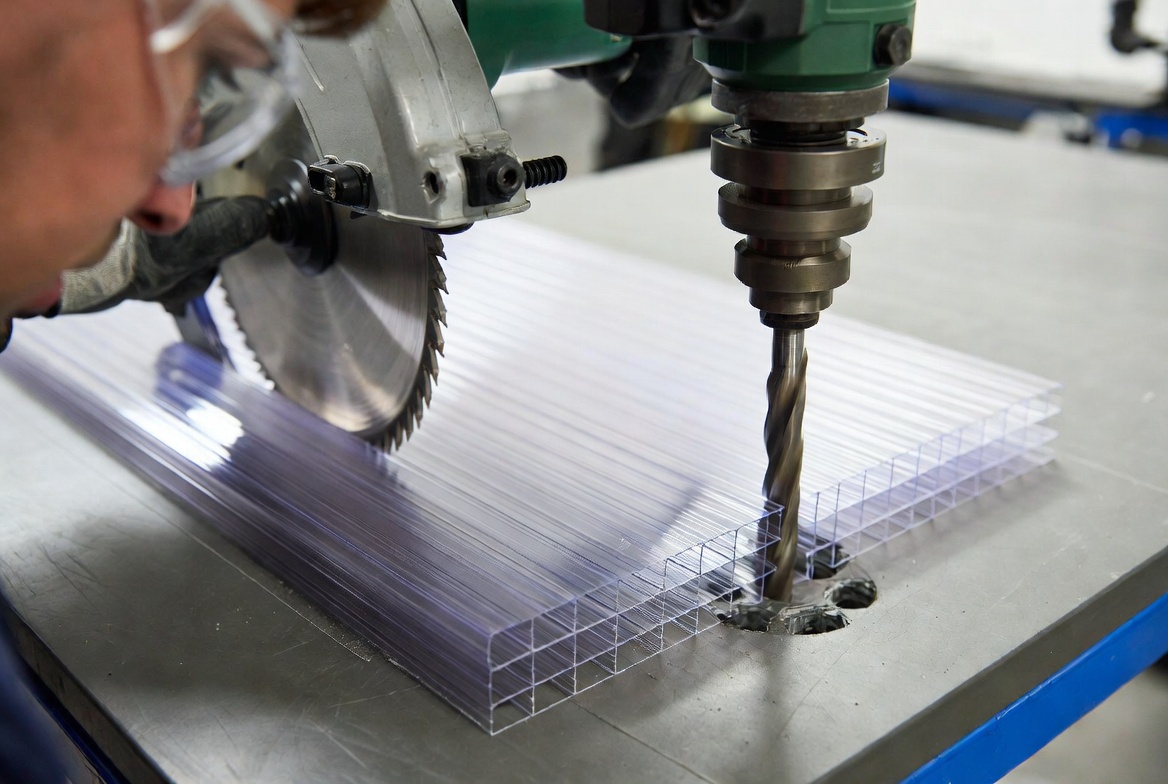
Although multiwall polycarbonate is virtually unbreakable under impact, it still requires precise cutting and drilling to avoid stress points and ensure predictable performance. [acmeplastics]
Cut panels using a circular or table saw equipped with a fine‑tooth blade, and secure the sheet to sawhorses or a workbench to minimize vibration. A plywood‑style blade with at least 10 teeth per inch generally produces a smooth edge while avoiding excessive heat buildup. For shorter cuts on thinner gauges (up to around 10 mm), a utility knife guided by a straight edge can be used, but multiple passes may be required. [acmeplastics]
Allow space for thermal expansion when finalizing dimensions, maintaining a small clearance where panels interface with frames or profiles so they can move without buckling. After cutting, remove dust from both faces and blow debris out of hollow channels using compressed air or a vacuum. [xhplasticsheet]
Mark hole positions approximately 6 inches in from each corner and at least 1 inch from sheet edges, then space additional holes no more than about 12 inches apart along the perimeter. This pattern distributes loads evenly and reduces the risk of local stress concentrations. [youtube]
Pre‑drill through the sheet using a sharp bit or step bit, and oversize each hole by about 1/16 inch relative to the screw diameter to allow for thermal movement over seasonal temperature swings. Avoid drilling within the immediate edge zone of hollow sheets and keep holes clear of sharp corners to prevent crack initiation. [xhplasticsheet]
Throughout cutting and drilling operations, maintain the protective film over most of the sheet surface, peeling back only a narrow strip along edges where tape, profiles, or fasteners will be applied. This protects against installation‑related scratching and preserves the clarity of the UV‑exposed face. [acmeplastics]
Once panels have been cut and drilled, the next phase is establishing secure fixing points in the building envelope. [youtube]
Use a stud finder on the exterior, or measure stud positions from inside where siding materials obscure framing, to ensure anchor locations align with solid structure. For stucco or masonry surfaces, mark hole positions, then drill with appropriate masonry bits so anchors seat firmly in block or brick rather than only in finish layers. [youtube]
Brackets at window sills provide a positive bearing for the bottom edge of panels on openings with pronounced sills, bridging between sill and lower fastener points. These elements should be installed according to manufacturer instructions before panels are positioned. [youtube]
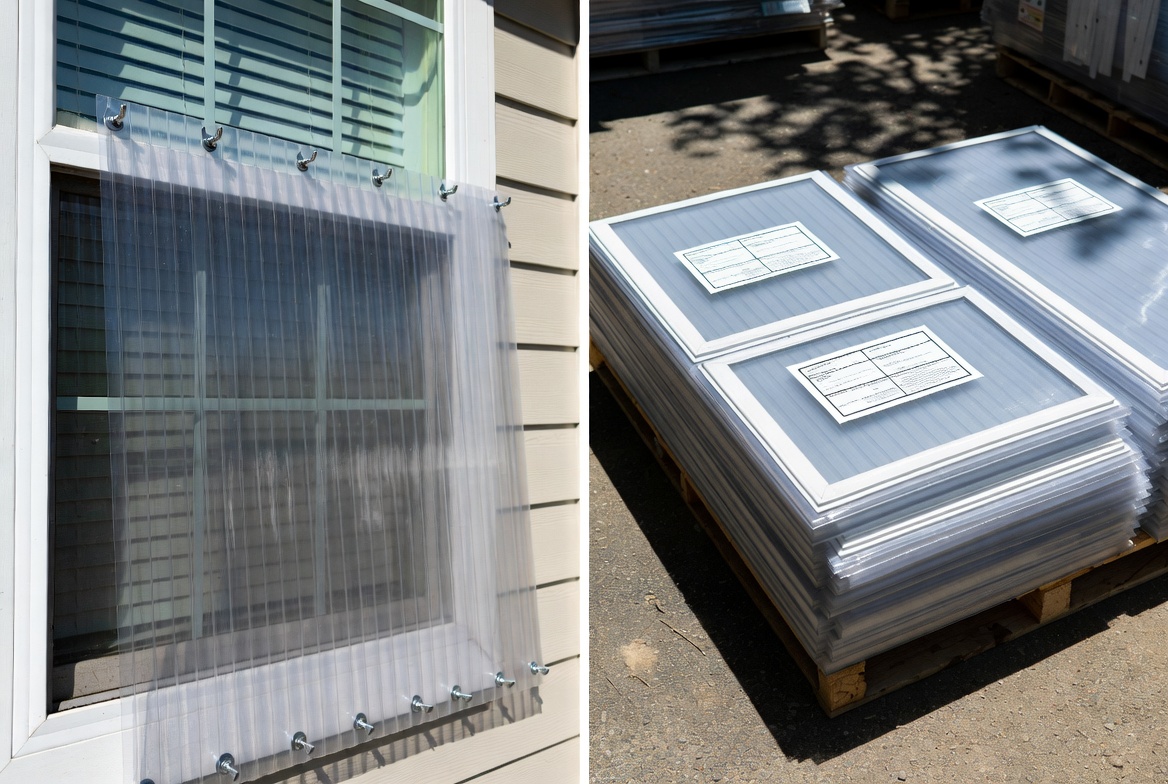
With anchors in place, center the panel over the opening with the UV‑protected face oriented outward toward the sun, and confirm alignment using a level. Slide the pre‑drilled holes over anchor posts, install neoprene‑bonded washers, and secure with wing nuts or comparable hardware, tightening only until washers sit flush and compression is uniform. [polycarbonlatepanel]
Over‑tightening can create dimples or stress cracks in polycarbonate, especially at elevated temperatures, so it is better to apply firm but controlled torque. After the panel seats flat and fasteners are checked, peel off the remaining protective film and label the panel with its location (for example, "Living room – left window") using a permanent marker. [xhplasticsheet]
To complete the installation, apply a suitable weather‑resistant sealant in any small gaps between the panel edge and mounting surface, focusing on joints where water intrusion is most likely during driving rain. Only use sealants verified as safe for polycarbonate to avoid chemical attack or discoloration over time. [duralightplastics]
The value of polycarbonate hollow sheets lies not only in their performance during a single storm but also in their ability to be removed, stored, and reused over multiple seasons. [duralightplastics]
After a storm, remove wing nuts and washers, lift panels off anchors, and visually inspect each sheet for cracks, deep scratches, or edge damage. Clean panels with mild detergent and lukewarm water using a soft cloth or sponge, then rinse thoroughly to prevent spotting. Avoid abrasive pads, aggressive solvents, or razor blades, all of which can scratch or chemically damage the glazing surface. [acmeplastics]
For storage, stack panels flat in a cool, dry, shaded location using a pallet or raised support that matches the length of the longest sheet. Shorter panels should be stacked on top of longer ones, and storage should provide ventilation to reduce heat build‑up and condensation. On the building, cover exposed anchors with paintable caps to protect them from corrosion and improve aesthetics. [duralightplastics]
Regular inspection of the building substrate, fasteners, and sealant joints before each storm season ensures that the system remains ready for rapid deployment when severe weather is forecast. [acmeplastics]
From an industry practitioner's perspective, polycarbonate hollow sheets behave like structural glazing components and benefit from basic engineering checks before installation. [polycarbonlatepanel]
- Support spacing and sheet thickness should be aligned so deflection under combined wind and impact loads stays within recommended limits, often on the order of about 1 inch maximum for typical spans. [acmeplastics]
- Hollow sheets should be installed with ribs running vertically in sloped or vertical applications for drainage and structural efficiency. [xhplasticsheet]
- All edges must accommodate both thermal expansion and contraction; rules of thumb for multiwall polycarbonate often specify a few millimeters of clearance per meter of sheet length to avoid buckling or frame distortion. [xhplasticsheet]
- UV‑protected faces must always be oriented outward to prevent premature aging, yellowing, or loss of toughness. [xhplasticsheet]
When hollow sheets are used for permanent glazing systems—such as canopies, skylights, or greenhouses—additional detailing is required: sealing open ribs with vent and aluminum tapes, using U‑profiles at panel ends with weep holes for condensate, and connecting panels side by side via H‑channels that allow free expansion without trapping water. These principles inform residential hurricane panel design as well, even though direct fastening to the exterior wall is typically used instead of complete framing systems. [polycarbonlatepanel]
Consider a one‑story coastal home with a mix of standard windows and a sliding glass door. The homeowner chooses multiwall polycarbonate hurricane panels cut from hollow sheet stock to match each opening.
1. Each window opening is measured, and panel sizes are calculated by adding 8 inches of height and width, with a reduced 4‑inch height addition where sills require sill brackets. [youtube]
2. Panels are cut from stock sheets using a fine‑tooth circular saw, then drilled with perimeter holes following the spacing guidelines above. [duralightplastics]
3. External studs are located, anchors are set, and sill brackets installed for lower edges where needed. [youtube]
4. Panels are mounted, washers and wing nuts installed, and gaps sealed where the wall surface is irregular. [duralightplastics]
5. After the storm, panels are removed, cleaned, inspected, and stored flat on a pallet in the garage for the next season. [acmeplastics]
By following these practices, the homeowner gains a repeatable, low‑maintenance system that balances safety, daylight, and long-term cost effectiveness compared with disposable wood or single‑use protection methods. [duralightplastics]
How do multiwall polycarbonate hurricane panels compare to plywood?
Multiwall polycarbonate panels are lighter, reusable, and allow natural light to pass through, while plywood is opaque, heavier, and more cumbersome to store and reuse. [youtube]
Can polycarbonate hollow sheets be cut and drilled with standard tools?
Yes, most multiwall polycarbonate sheets can be cut with circular or table saws and drilled with common bits, provided sharp fine‑tooth blades and proper clearance for thermal movement are used. [acmeplastics]
Do I need a full frame system to install hurricane panels?
Many residential installations use direct fasteners into wood, brick, or block substrates rather than complete framing, but permanent glazing systems often rely on structured rafters, purlins, and profiles. [duralightplastics]
How should panels be stored between storm seasons?
Panels should be cleaned, stacked flat on a raised support, and kept in a cool, dry, shaded environment with good ventilation to prevent heat and moisture damage. [acmeplastics]
Why is UV orientation so important for polycarbonate hollow sheets?
The UV‑protected face resists sunlight‑induced degradation; installing sheets with this side outward prevents early yellowing, cracking, and loss of mechanical strength. [xhplasticsheet]
1. Acme Plastics. *How to Install Multiwall Polycarbonate Hurricane Panels*. [https://www.acmeplastics.com/content/how-to-install-multiwall-polycarbonate-hurricane-panels/]
2. AmeriLux International. *Multiwall Polycarbonate Technical & Install Guide*. [https://ameriluxinternational.com/wp-content/uploads/2021/pdf-downloads/install-guides/amerilux-multiwall-install-guide.pdf]
3. Duralight Plastics. *Hurricane Storm Panel Installation Guide*. [https://www.duralightplastics.com/wp-content/uploads/2022/hurrigal-images/duralight-hurricane-storm-panel-install-guide.pdf]
4. XH Plastic Sheet. *Hollow Polycarbonate Sheet Installation Method*. [https://www.xhplasticsheet.com/news/hollow-polycarbonate-sheet-installation-method/]
5. Polycarbonate Panel. *Polycarbonate Hollow Sheets: A Comprehensive Guide*. [https://www.polycarbonlatepanel.com/news/industry-news/polycarbonate-hollow-sheets-a-comprehensive-guide.html]