Shanghai Gokai Industry Co,.Ltd.
Call Us: +86-18918606548
Call Us: +86-18918606548
- Product Name
- Product Keyword
- Product Model
- Product Summary
- Product Description
- Multi Field Search
Views: 266 Author: Gokai Publish Time: 2026-08-22 Origin: Site


Content Menu
● What Makes a Plastic "Marine Grade"?
● PVC Foam Board for Marine Applications
>> Key Benefits of Marine PVC Foam Board
>> Where PVC Foam Board Works Best
>> PVC Foam Board Limitations to Specify Early
● ABS Sheet for Marine Applications
>> Why Marine-Grade ABS Sheet Is Valuable
>> Best Applications for ABS Sheet
● PVC Foam Board vs. ABS Sheet: Which Should You Choose?
● Expert Checklist for OEM Marine Plastic Sourcing
● Marine Safety and Compliance Considerations
● Why Work With an OEM PVC and ABS Sheet Manufacturer?
● Request a Marine Plastic Sample or OEM Quote
● FAQ
>> 1. Is PVC foam board waterproof for marine use?
>> 2. Can ABS sheet be used outdoors on boats?
>> 3. Is PVC foam board stronger than marine plywood?
>> 4. What is the best plastic for a boat console?
>> 5. Can PVC foam board replace wood in boat cabinetry?
>> 6. How do I choose between PVC foam board and ABS sheet?
Selecting the best marine-grade plastic is not simply about choosing a waterproof board. In real marine environments, materials must withstand moisture, salt spray, UV exposure, vibration, cleaning chemicals, and repeated impact—while remaining practical to cut, machine, bond, and install. For boatbuilders, refit yards, marine-equipment brands, and OEM buyers, PVC foam board and ABS sheet are two highly effective choices when specified for the correct application.
As a manufacturer of PVC foam board and ABS sheet for global OEM projects, we help buyers match sheet properties to the actual operating environment. The key is to select a qualified, application-specific grade—not to assume every PVC or ABS sheet is suitable for direct, long-term outdoor marine exposure.

"Marine grade" should describe performance requirements, not just a product label. A marine plastic should be assessed by its ability to resist the specific risks present on or around a vessel.
The core risks include:
- Saltwater and humidity exposure
- Direct UV radiation and heat cycling
- Vibration from engines, waves, and transport
- Mechanical impact and abrasion
- Oils, fuels, detergents, and marine cleaning agents
- Dimensional movement caused by changing temperatures
- Fire, electrical, or regulatory requirements in certain vessel zones
Marine-grade PVC foam board is commonly used where low weight, moisture resistance, a smooth finish, and easy fabrication matter most. Marine-grade ABS sheet is often selected when higher impact strength, rigidity, and durable thermoformed shapes are required.
A material can resist water but still be wrong for an exterior component. For example, standard ABS may lose appearance or mechanical performance under continuous sunlight unless it includes an appropriate UV-stabilized formulation or protective cap layer. Likewise, standard PVC foam board may be suitable for interior cabinetry but require enhanced UV protection for permanently exposed deck-side use.
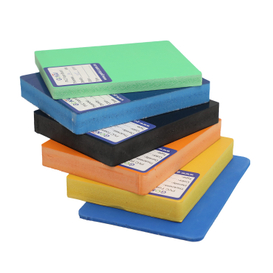
PVC foam board is a lightweight, rigid cellular sheet made from polyvinyl chloride. It is widely used in boat interiors and moisture-prone marine components because it does not rot, rust, delaminate like plywood, or absorb water through its flat faces in the way wood-based panels can.
For marine buyers, the strongest commercial case is not that PVC foam board replaces every structural material. It is that it can replace many non-load-critical wood panels while simplifying maintenance, fabrication, and long-term moisture management.

- Water and humidity resistance: Closed-cell PVC foam structures are designed to resist moisture-related swelling, rot, and delamination.
- Low weight: Lower mass can make handling, cutting, installation, and retrofit work more efficient.
- Corrosion resistance: PVC does not rust or corrode like unprotected ferrous metals.
- Easy fabrication: The board can generally be cut, drilled, routed, printed, painted, bonded, or mechanically fastened using appropriate processes.
- Smooth, cleanable surface: This suits interior wall liners, cabinetry, partitions, and decorative panels.
- Chemical resistance: PVC can perform well around many common marine contaminants, although chemical compatibility should be confirmed for the specific exposure.
- UV-capable formulations: UV-stabilized grades can provide better exterior durability than standard interior grades.
Industry suppliers commonly position marine-grade PVC foam for boat interiors, dashboard panels, cabinetry, bulkheads, hatch covers, wall liners, and other high-humidity applications because of its weatherability and dimensional stability.
PVC foam board is particularly suitable for:
- Boat cabin wall panels and ceiling liners
- Cabinet doors, drawer fronts, and furniture components
- Bulkhead cladding and lightweight partitions
- Upholstery backing boards
- Hatch covers and access panels
- Decorative signage and identification panels
- RV, pontoon, dock, and coastal equipment interiors
- Non-structural marine enclosures
A practical example: a boatbuilder replacing marine plywood cabinet panels with white PVC foam board can reduce concerns about edge swelling and surface delamination in a humid cabin. However, the builder should still use proper fasteners, support spacing, and edge finishing because foam board is not a universal replacement for heavily loaded structural plywood.
The most common purchasing error is specifying only "PVC foam board" without identifying density, thickness, surface finish, UV requirement, and load condition.
Before sourcing, confirm:
1. Whether the part is interior, shaded exterior, or continuously sun-exposed.
2. Whether the panel carries load, receives point impact, or only provides enclosure and decoration.
3. Whether the component needs screws, hinges, inserts, adhesive bonding, or thermoforming.
4. Whether the material will contact fuel, oils, solvent cleaners, or aggressive chemicals.
5. Whether a flame-performance or vessel-specific compliance requirement applies.
For critical outdoor applications, buyers should request UV-stabilized material and verify the grade through the supplier's technical data sheet rather than relying on color or appearance alone. UV performance varies by formulation and pigment package.
ABS—acrylonitrile butadiene styrene—is a rigid thermoplastic valued for its balance of toughness, impact resistance, dimensional stability, and processing versatility. In marine equipment, ABS sheet is often a better choice than PVC foam board when the part must tolerate knocks, vibration, repeated handling, or thermoforming into a shaped component.
ABS is especially useful for OEM manufacturers producing repeatable components such as console panels, instrument housings, protective covers, trim panels, storage units, and equipment enclosures.

| Performance factor | Why it matters in marine use |
|---|---|
| Impact resistance | Helps components resist knocks from gear, hatches, tools, and daily use |
| Rigidity | Supports clean, stable panels and fabricated housings |
| Thermoformability | Enables molded covers, consoles, trays, and shaped enclosures |
| Dimensional stability | Helps parts retain their intended form under changing conditions |
| Moisture resistance | Supports use in wet and humid applications |
| Surface quality | Can provide a polished, textured, embossed, or color-matched OEM finish |
| UV-stabilized options | Improves performance for sun-exposed components when properly specified |
Marine-grade ABS is commonly recommended for boatbuilding, marine interiors, outdoor applications, consoles, housings, and covers because it combines impact resistance with moisture resistance and UV-capable formulations.
Use ABS sheet when the component needs a stronger, more impact-resistant skin or a shaped finish:
- Helm consoles and dashboard panels
- Instrument and electronic enclosures
- Storage-box lids and compartment covers
- Interior trim and protective wall panels
- Seating shells and molded furniture elements
- Protective machine covers
- Vent covers, trays, and access doors
- Equipment housings for docks, marinas, or marine vehicles
For a custom helm console, an OEM can thermoform a UV-stabilized ABS sheet into a one-piece shell, then add cutouts for navigation electronics, switches, gauges, and charging ports. This can reduce assembly complexity compared with building an equivalent enclosure from multiple wood or metal pieces.
The best choice depends on the job the part must perform—not on which material has the longest list of general advantages.

| Selection factor | PVC Foam Board | ABS Sheet |
|---|---|---|
| Main advantage | Lightweight, moisture-resistant, easy-to-fabricate panels | Tough, rigid, impact-resistant fabricated or formed parts |
| Typical marine use | Cabinetry, liners, partitions, backing boards, decorative panels | Consoles, housings, covers, trim, molded parts |
| Weight | Usually lower | Usually higher than foam board |
| Impact resistance | Suitable for many panel applications, but lower than ABS | Generally stronger for repeated impact and handling |
| Thermoforming | Limited compared with ABS | Excellent option for shaped OEM components |
| Surface finish | Smooth, printable, paintable | Smooth, textured, embossed, or custom-finished options |
| Outdoor UV use | Use UV-enhanced grades for exposed locations | Specify UV-stabilized or capped grades for exposed locations |
| Structural use | Best for non-load-critical applications unless engineered otherwise | Suitable for rigid fabricated parts, but not a substitute for all structural composites |
Choose PVC foam board when you need a lightweight, water-resistant panel for interiors, cabinetry, partitions, backing, or decorative construction.
Choose ABS sheet when you need a tougher panel, a thermoformed part, a protective enclosure, or a component expected to experience vibration and impact.
A professional sourcing process begins with the part, not the material name. Sending a supplier a vague inquiry such as "Need marine PVC board" often produces inconsistent quotations and unsuitable material recommendations.
Use this specification checklist instead:
1. Define the application: State whether the sheet will be used for a cabinet, bulkhead, console, enclosure, cover, interior panel, or exterior-facing component.
2. Identify the exposure: Clarify salt spray, direct sunlight, immersion, humidity, fuel contact, temperature range, and impact risk.
3. Specify dimensions: Include thickness, width, length, density where relevant, tolerance, and required flatness.
4. Select appearance requirements: Identify color, gloss level, texture, protective film, printability, or surface lamination.
5. Confirm fabrication needs: State whether the sheet will be CNC-routed, drilled, bonded, welded, thermoformed, bent, or fastened.
6. Request technical evidence: Ask for a technical data sheet, material samples, test method references, and batch consistency information.
7. Plan qualification testing: Test prototype parts under realistic installation conditions before approving volume production.
This process is especially important for OEM projects because a sheet that performs well in a sample may fail in production if density, UV additives, color pigments, surface treatment, or thickness tolerance changes without control.
Material durability is only one part of marine design. A plastic's inherent flame behavior does not automatically mean the completed boat component complies with a specific vessel, market, electrical, or fire-safety requirement.
For projects involving fuel systems, engine compartments, electrical equipment, passenger vessels, or regulated commercial applications, verify the relevant rules with qualified engineers and the applicable authority. U.S. Coast Guard guidance addresses construction and equipment requirements for recreational boats, while electrical installations may require materials and equipment that meet applicable marine standards.
Do not position PVC foam board or ABS sheet as a certified safety solution unless the exact material, thickness, test standard, and intended end-use have been verified.
For global marine-product brands, distributors, and fabricators, a capable supplier should offer more than standard sheets. The value lies in consistent specifications, responsive technical communication, and customization that supports production efficiency.
Our OEM service can support requirements such as:
- Custom thickness, size, density, and color
- UV-stabilized PVC foam board and ABS sheet options
- Smooth, matte, textured, embossed, or protective-film surfaces
- Cut-to-size sheets for reduced customer waste
- OEM packaging, labeling, and export-ready loading plans
- Sample development and pre-production approval support
- Application-based recommendations for marine, outdoor, and wet-area components
The right marine plastic is the one that meets your actual exposure, fabrication, and performance requirements at a cost that works over the product's service life.
If you are developing boat interiors, marine equipment housings, dock accessories, yacht cabinetry, or outdoor marine components, send us your drawing, target application, thickness requirement, and annual volume estimate.
We can help you evaluate whether PVC foam board or ABS sheet is the more suitable solution—and develop an OEM specification that supports stable quality from sample approval through container-scale production.
PVC foam board is highly resistant to moisture and does not rot, rust, or delaminate like plywood. However, suitability depends on the grade, installation method, UV exposure, load conditions, and whether the board is intended for interior or fully exposed outdoor use.
Yes, but buyers should specify UV-stabilized ABS sheet or another suitable weather-resistant construction for direct outdoor exposure. Standard ABS may not provide the same long-term UV performance as a formulated outdoor-grade product.
Not in every situation. PVC foam board offers major moisture and weight advantages, but marine plywood may be more suitable for certain load-bearing or screw-holding applications. The correct choice depends on panel thickness, support spacing, fastener design, and structural load.
UV-stabilized ABS sheet is often an excellent choice for boat consoles because it combines rigidity, impact resistance, surface quality, and thermoformability. For a flat, lightweight internal panel, PVC foam board may also be appropriate.
In many interior cabinet and panel applications, yes. It can reduce risks related to moisture swelling, rot, and delamination. The design should still account for hinges, screws, edge finishing, support points, and expected loads.
Choose PVC foam board for lightweight, moisture-resistant panels and interior fabrication. Choose ABS sheet for impact-resistant, rigid, shaped, or thermoformed components. Request technical data and test samples when the application is exposed, safety-sensitive, or high-volume.
1. Piedmont Plastics. "[How Strong Is Marine-Grade Plastic?]" Accessed August 2026.
2. Piedmont Plastics. "[Marine Grade PVC Foam Sheet]" Accessed August 2026.
3. U.S. Coast Guard Boating Safety. "[Boatbuilder's Handbook]" Accessed August 2026.
4. Blue Sea Systems. "[United States Coast Guard Requirements for Recreational Boats]" Accessed August 2026.
5. Acme Plastics. "[A Guide to Choosing the Right Marine Plastic for Your Project]" October 2024.
6. Alfa Chemistry. "[Outdoor Applications of ABS Plastic Sheets]" April 2024.
7. Jinbao PVC. "[PVC Foam Board in Marine and Coastal Applications: Performance Limitations and Best Practices]" May 2026.