Shanghai Gokai Industry Co,.Ltd.
Call Us: +86-18918606548
Call Us: +86-18918606548
- Product Name
- Product Keyword
- Product Model
- Product Summary
- Product Description
- Multi Field Search
Views: 279 Author: Gokai Publish Time: 2026-08-15 Origin: Site


Content Menu
● What Is the Best Clear Plastic Sheet?
● The Clear Choice for Visual Quality
>> Why OEM buyers choose acrylic sheet
>> Typical acrylic sheet applications
>> When acrylic is not the best option
>> Why polycarbonate solid sheet performs in demanding environments
>> Important polycarbonate limitations
● Practical Material Comparison
● A Better OEM Material-Selection Process
>> 1. Define the performance risk
>> 2. Specify the finished part—not only the raw sheet
>> 3. Request testable documentation
>> 4. Approve a physical sample before mass production
>> 5. Design for thermal movement
● Thickness Is an Engineering Decision
● Why Work With Gokai for Clear Plastic Sheet OEM Supply?
>> 1. Is acrylic sheet clearer than polycarbonate solid sheet?
>> 2. Which is stronger: acrylic or polycarbonate?
>> 3. Can polycarbonate sheet be used outdoors?
>> 4. Does acrylic sheet turn yellow in sunlight?
>> 5. Which clear plastic sheet is easier to cut and polish?
>> 6. Should I choose standard or hard-coated polycarbonate?
Choosing the best clear plastic sheet is not simply a matter of selecting the most transparent material. For OEM buyers, fabricators, contractors, sign manufacturers, and product designers, the right choice depends on the balance between optical clarity, impact strength, outdoor durability, fabrication method, safety requirements, and total project cost.
At Gokai, we supply Acrylic Sheet (PMMA) and Polycarbonate Solid Sheet (PC) for global OEM projects. From our material-selection experience, acrylic is usually the stronger choice when visual clarity, surface appearance, weatherability, and economical fabrication lead the specification. Polycarbonate solid sheet is the better answer when impact resistance, heat performance, and safety are the non-negotiable priorities.

For most transparent-sheet applications, acrylic and polycarbonate are the two leading alternatives to glass. Both are lightweight thermoplastics with excellent transparency, but they solve different engineering and commercial problems.
Acrylic sheet is widely selected for retail displays, illuminated signs, protective glazing, photo frames, furniture panels, and decorative partitions because it provides a bright, glass-like appearance. Polycarbonate solid sheet is preferred for machine guards, security glazing, safety shields, protective covers, transportation components, and demanding industrial environments because it is exceptionally resistant to impact.
The "best" material therefore depends on the application—not on a single headline specification.
| Selection priority | Recommended material | Why it matters |
|---|---|---|
| Maximum optical clarity and glossy finish | Acrylic sheet | Acrylic can achieve approximately 92% light transmission and offers a premium glass-like appearance. |
| High-impact safety protection | Polycarbonate solid sheet | PC has far greater impact resistance than acrylic and is used when breakage risk is a central concern. |
| Outdoor signs and display glazing | Acrylic sheet | PMMA has strong inherent weatherability and UV stability. |
| Machine guards and safety barriers | Polycarbonate solid sheet | Its toughness helps reduce cracking or shattering from accidental impact. |
| Heat-intensive applications | Polycarbonate solid sheet | PC generally maintains performance at higher service temperatures than acrylic. |
| Cost-sensitive decorative projects | Acrylic sheet | Acrylic often provides an efficient balance of appearance, performance, and fabrication cost. |
Published comparisons report light transmission of roughly 92% for acrylic and 86–88% for polycarbonate, while PC has substantially higher impact performance. Exact values vary by grade, thickness, color, coating, and test method, so buyers should always review the product-specific technical data sheet before approval.
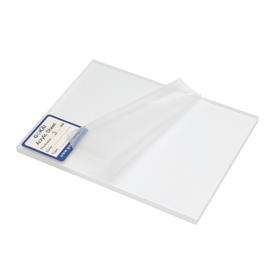
Acrylic sheet, also known as PMMA or plexiglass, is an optically clear plastic valued for its brightness, rigidity, surface gloss, and fabrication flexibility. It can be supplied in clear, frosted, colored, mirrored, textured, fluorescent, and light-diffusing options, making it particularly useful for projects where the material itself is part of the visual experience.
Optical clarity: Clear acrylic provides a clean, high-transparency appearance that works especially well in display, lighting, and signage applications.
Weather resistance: Acrylic is a practical option for many outdoor uses because it generally resists UV-related yellowing better than unprotected polycarbonate.
Surface quality: Compared with standard PC, acrylic usually offers better scratch resistance and a glossier finish. It can also be polished after cutting to create attractive edges.
Fabrication versatility: Acrylic can be CNC machined, laser cut, drilled, routed, thermoformed, printed, bonded, and polished. This allows OEM customers to turn a sheet material into branded, finished components efficiently.
Lightweight replacement for glass: Acrylic is approximately half the weight of glass, helping reduce transport, handling, and installation burdens.
- Retail displays, POP fixtures, cosmetic stands, and museum cases
- Channel letters, illuminated sign faces, LED diffusers, and architectural signage
- Picture frames, protective covers, furniture inserts, and interior partitions
- Aquarium panels, decorative glazing, and exhibition structures
- Machine covers where optical clarity matters but extreme impact exposure is not expected
Acrylic is not the default choice for every transparent application. It is more rigid than polycarbonate and can crack under severe impact or during poor drilling and installation practices. Projects involving repeated impact, vandalism risk, extreme cold, high heat, or safety-critical protection should be assessed for polycarbonate solid sheet instead.
Polycarbonate solid sheet is a transparent engineering thermoplastic known for exceptional toughness. It is often selected when standard acrylic or glass could crack, shatter, or create a safety risk.
The key advantage is not merely that PC is "strong." It is that the material can absorb much more impact energy before failure. Industry comparisons commonly describe polycarbonate as roughly 200–250 times more impact resistant than glass, while acrylic is still meaningfully more impact resistant than glass. These ratios are useful directional guidance, not a substitute for application-specific testing.
Impact resistance: PC is appropriate for protective shields, machine guards, protective windows, and other applications exposed to accidental strikes or repeated handling.
Heat resistance: Polycarbonate typically has a higher service-temperature capability than acrylic. This matters near equipment, lighting assemblies, industrial processes, or heat-generating electronics.
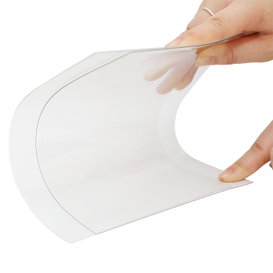
Cold-forming capability: Unlike acrylic, many PC sheet grades can be cold bent to a controlled radius, expanding design possibilities for curved guards, covers, and enclosures.
Drilling tolerance: Polycarbonate is generally less likely to crack during drilling than acrylic, provided the correct tooling, clearance, and installation practices are used.
Safety-oriented applications: Clear PC is commonly considered for applications in which a broken transparent panel could endanger operators, customers, or equipment.
Standard polycarbonate can scratch more easily than acrylic. For projects requiring long-term surface durability, specify a hard-coated polycarbonate sheet rather than assuming a standard grade will perform like glass or acrylic.
Outdoor use requires an equally careful discussion. Unprotected PC may yellow or lose clarity under prolonged UV exposure. For exterior glazing, skylight covers, outdoor protective barriers, or agricultural structures, specify a UV-protected or co-extruded UV-layer polycarbonate grade and confirm which side faces outward during installation.
The table below helps procurement teams move beyond vague claims such as "clear," "durable," or "high quality."

| Property | Acrylic Sheet (PMMA) | Polycarbonate Solid Sheet (PC) | Selection implication |
|---|---|---|---|
| Optical clarity | Excellent | Very good to excellent | Choose acrylic when display-grade appearance is the priority. |
| Light transmission | Around 92% for typical clear grades | Around 86–88% for typical clear grades | Confirm the required value at the specified thickness. |
| Impact resistance | Good | Excellent | Choose PC for high-risk impact or safety applications. |
| Scratch resistance | Better in standard form | Lower in standard form | Specify hard coating for scratch-sensitive PC applications. |
| UV/weathering | Excellent inherent resistance | Requires UV-protected grade for extended outdoor use | Do not treat all PC sheets as outdoor-ready. |
| Heat resistance | Moderate | Higher | PC suits hotter service conditions. |
| Rigidity | Higher | More flexible | Acrylic suits flat, rigid visual structures; PC supports controlled curvature. |
| Machining and polishing | Excellent | Good | Acrylic is often favored for polished, premium visual components. |
| Relative cost | Often lower | Often higher | Compare delivered performance, not unit price alone. |
For transparent plastics, clarity is not measured only by "how much light gets through." Haze also matters. Haze describes scattered light that can make a sheet look cloudy, reduce visibility, or create glare. ASTM D1003 is a recognized method for measuring luminous transmittance and haze in transparent plastics. Ask suppliers to clarify the test standard, thickness, and specimen condition behind any optical claim.
The most expensive mistake is selecting a sheet solely from a catalogue image or a unit-price comparison. A more reliable process is to define the end-use environment before requesting a quotation.
Start with the conditions that could cause a field failure:
- Is the panel exposed to impact, abrasion, UV radiation, chemicals, heat, moisture, or vibration?
- Is failure mainly cosmetic, operational, or safety-related?
- Does the application require regulatory testing, flame performance, food-contact documentation, or a specific local building code?
- Will the sheet be installed outdoors, near a heat source, or in contact with cleaners and solvents?
This step often reveals that a visually similar sheet is not technically equivalent.
A professional OEM request should include sheet thickness, dimensions, color, surface finish, protective film, UV requirement, tolerance, cutting method, printing requirement, packaging, and expected order volume.
For example, "clear acrylic sheet, 3 mm" is incomplete. A more useful specification is: "3 mm cast clear acrylic sheet, 92% minimum light transmission target, both sides masked, CNC-cut with polished visible edges, export pallet packaging, and private-label protective film."
Do not rely only on phrases such as "100% virgin material" or "premium quality." Request a current technical data sheet and confirm whether stated values apply to the precise grade being quoted.
For impact-sensitive applications, ask for data based on a defined method such as ASTM D256, which evaluates the impact resistance of plastic specimens using a pendulum test. Results from this test should be compared only when the test conditions and sample details are relevant to the project.
A sample is essential when appearance, fit, fabrication, or installation performance is important. Review it under the actual lighting and usage conditions—not only in a warehouse.
Check:
- Transparency, haze, color consistency, and protective-film quality
- Thickness and dimensional tolerance
- Cutting quality, edge finish, and hole placement
- Resistance to the intended cleaning method
- Packaging performance during freight handling
- Fit with frames, fasteners, adhesives, or metal hardware
Both acrylic and polycarbonate expand and contract with temperature changes. A sheet that fits tightly during fabrication may warp, bow, crack, or buckle after installation if the design does not allow adequate clearance.
Use appropriate oversized mounting holes, compatible gaskets, correct fastener torque, and sufficient expansion space. This is particularly important for long sheets, dark colors, outdoor installations, and regions with large temperature swings. Your final installation design should be validated by the project engineer or qualified installer.

A common weakness in generic "best clear plastic" guides is treating thickness as a universal recommendation. There is no single best thickness for acrylic or polycarbonate sheet.
Thickness should be determined by panel size, support spacing, wind load, impact exposure, deflection limits, temperature, fabrication method, and applicable code requirements. A thin acrylic display cover and a large polycarbonate machine guard may both be transparent sheets, but they are fundamentally different engineering applications.
Instead of asking, "What thickness should I buy?" ask these questions:
1. What are the unsupported dimensions of the panel?
2. Will the sheet receive impact, wind, or equipment loads?
3. How much deflection is acceptable visually and functionally?
4. Is the sheet framed on two sides, four sides, or mechanically fastened?
5. Does the application need a certified design or local code review?
This approach improves safety, reduces material waste, and prevents a low-cost sheet from becoming a costly replacement project.
Gokai focuses on acrylic sheet and polycarbonate solid sheet solutions for international OEM customers. We understand that global buyers do not only need material; they need repeatable quality, specification control, export-ready packaging, and responsive communication throughout the sourcing process.
Our OEM support can be tailored around your project requirements, including custom dimensions, thicknesses, colors, surface finishes, protective films, processing requirements, and branding-related packaging needs. For applications where clarity, strength, or outdoor durability is critical, we recommend confirming the final grade and performance requirements through samples and technical documentation before placing a production order.
Need help choosing between acrylic sheet and polycarbonate solid sheet? Send Gokai your drawings, dimensions, operating environment, quantity, and required performance criteria. Our team can help you identify the material solution that fits your application, not just the lowest initial price.

Generally, yes. Typical clear acrylic can provide about 92% light transmission, while clear polycarbonate is often reported around 86–88%. Both can look highly transparent, but acrylic is often preferred for premium display and signage applications.
Polycarbonate is much more impact resistant. Acrylic is rigid and strong for many general applications, but PC is more suitable when safety, shock resistance, or vandalism resistance is a major requirement.
Yes, but choose a UV-protected polycarbonate grade designed for outdoor exposure. Confirm the UV-protected side, installation orientation, weathering test information, and warranty conditions with the supplier.
Acrylic is widely valued for its weather resistance and generally performs well under sunlight exposure. However, real-life durability still depends on the grade, installation, environment, cleaning chemicals, and project design.
Acrylic is typically easier to machine and polish into clean, high-gloss visible edges. Polycarbonate can also be cut and machined, but it is usually selected for toughness rather than decorative edge quality.
Choose hard-coated polycarbonate when the surface will receive frequent cleaning, touching, abrasion, or visual scrutiny. Standard PC is highly impact resistant but is more prone to scratching than acrylic.
1. Piedmont Plastics. "[Clear Plastic Sheets: Technical & Buying Information]." Accessed August 2026.
2. Curbell Plastics. "[Acrylic vs. Polycarbonate: Transparent Plastic Material Comparison]." Accessed August 2026.
3. Protolabs. "[Acrylic vs. Polycarbonate: Comparing the Transparent Plastics]." November 2023.
4. ASTM International. "[ASTM D1003: Haze and Luminous Transmittance of Transparent Plastics]." Accessed August 2026.
5. ASTM International. "[ASTM D256: Izod Pendulum Impact Resistance of Plastics]." Accessed August 2026.
6. Intertek. "[Haze and Luminous Transmittance Testing, ASTM D1003]." Accessed August 2026.
7. Intertek. "[Notched Izod Impact Testing, ASTM D256 / ISO 180]." Accessed August 2026.