Shanghai Gokai Industry Co,.Ltd.
Call Us: +86-18918606548
Call Us: +86-18918606548
- Product Name
- Product Keyword
- Product Model
- Product Summary
- Product Description
- Multi Field Search
Views: 259 Author: Gokai Publish Time: 2026-10-19 Origin: Site


Content Menu
● Why Choose Polycarbonate Sheets for Greenhouse Roofing?
● Solid Polycarbonate vs. Polycarbonate Sun Sheet
>> Twinwall and Multiwall Polycarbonate Sun Sheet
● How Much Light Do Greenhouse Polycarbonate Panels Transmit?
>> Visible Light Is Not the Complete Crop-Growing Picture
● Compare U-Values Instead of Broad Savings Claims
>> What Those Numbers Mean in Practice
● Choosing Polycarbonate Greenhouse Roofing Thickness
>> Start With Climate and Structural Loads
>> Balance Insulation Against Available Light
● UV Protection, Impact Resistance, and Service Life
>> Confirm the UV-Protected Surface
● Condensation Control: A Detail That Deserves More Attention
>> Anti-Drip Treatment Does Not Remove Humidity
● Installation Checklist for Polycarbonate Greenhouse Roof Panels
>> 1. Orient the Channels for Drainage
>> 2. Allow for Thermal Expansion
>> 3. Use the Specified Accessories
● An OEM Purchasing Checklist for Greenhouse Projects
● Choose a Roofing System, Not Just a Sheet
>> Is polycarbonate a good roofing material for a greenhouse?
>> Is twinwall polycarbonate better than solid polycarbonate?
>> What thickness should greenhouse roof panels be?
>> Can plants grow under UV-protected polycarbonate?
>> Does polycarbonate prevent greenhouse overheating?
>> How should polycarbonate greenhouse roofing be cleaned?
>> Can Gokai provide OEM greenhouse panels?
Polycarbonate greenhouse roofing offers a practical balance of light transmission, insulation, impact resistance, and manageable weight. However, choosing the right polycarbonate sheet requires more than comparing thickness and price. Panel structure, UV protection, installation details, and local weather conditions all influence how well your greenhouse performs.
At Gokai, we supply Polycarbonate Sheet and Polycarbonate Sun Sheet products with OEM services for global customers. Our approach to selection starts with a simple question: what does your greenhouse need to protect, and under which conditions?
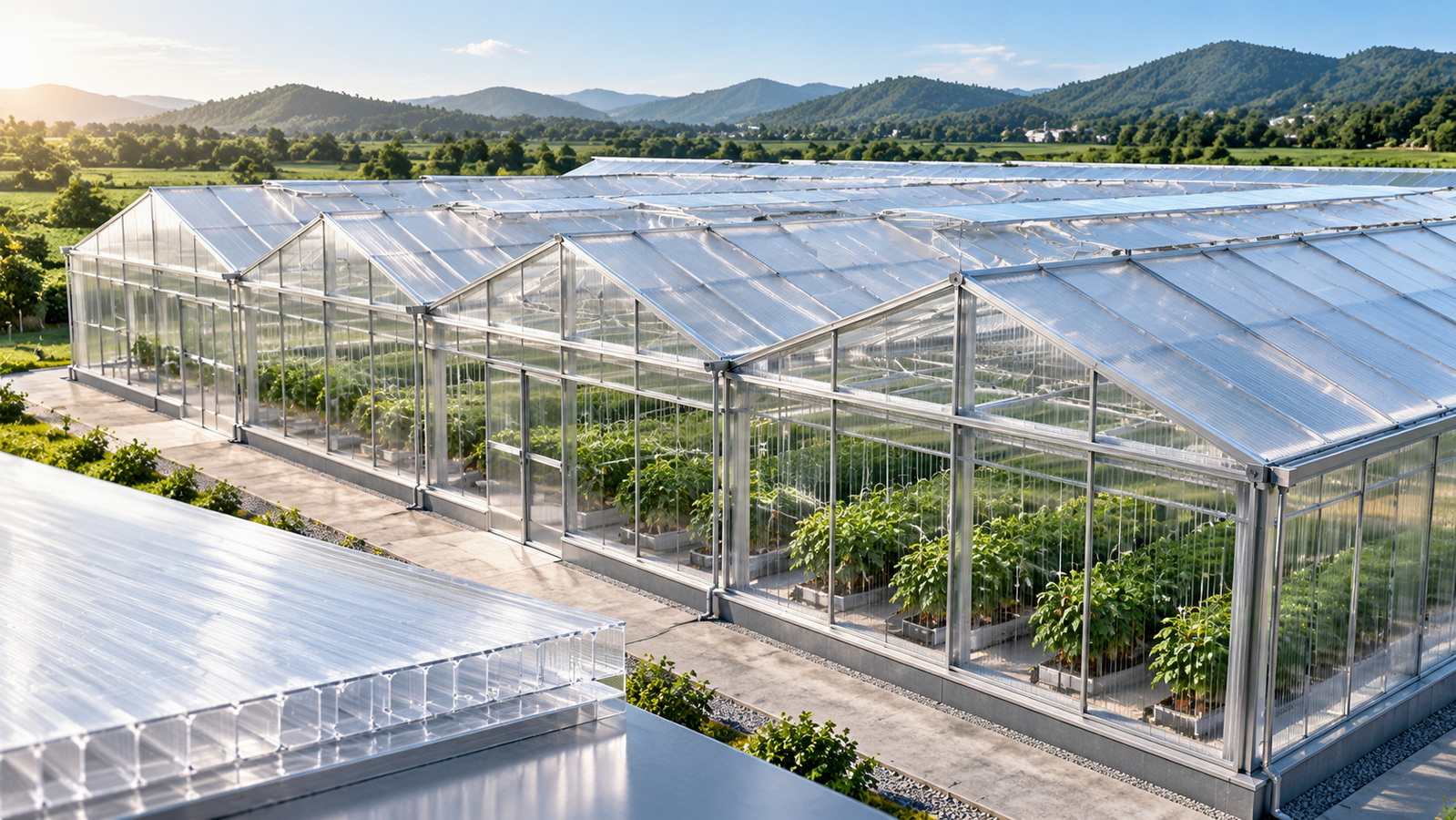
A greenhouse roof must admit useful sunlight while limiting unwanted heat loss and protecting crops from weather. Polycarbonate can address these competing requirements, particularly when hollow or multiwall sheets suit the project.
Its main advantages include:
- Lower weight than comparable glass glazing.
- Good impact resistance.
- Insulating air chambers in twinwall and multiwall panels.
- Options for different light transmission levels.
- Fabrication possibilities for varied greenhouse designs.
These benefits are not identical across all products. A solid sheet behaves differently from a multiwall panel, and a clear panel does not perform like a tinted one.
The best choice is therefore a documented roofing specification—not simply a material name.
Understanding panel construction is the first step toward selecting appropriate greenhouse glazing.
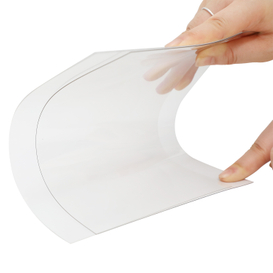
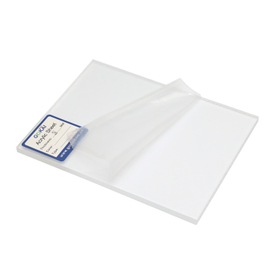
Solid polycarbonate has a continuous cross-section without internal air chambers. It suits applications where visibility, impact performance, and a smooth appearance are priorities.
However, a single solid sheet does not provide the insulating benefit of a hollow, air-filled structure. For heated greenhouses, compare its thermal performance carefully before choosing it primarily for clarity.
Polycarbonate Sun Sheet generally refers to hollow panels with internal ribs separating two or more walls.
Those chambers reduce weight and slow heat transfer. This makes twinwall and multiwall polycarbonate sheets useful for greenhouse roofs where insulation matters.
Additional walls can improve insulation, but may also reduce light transmission. Thickness alone does not tell the whole story: wall configuration, sheet weight, color, and coatings also matter.

| Roofing option | Main advantage | Main limitation | Selection priority |
|---|---|---|---|
| Solid polycarbonate | Visibility and impact resistance | Limited insulation as a single layer | Optical and structural requirements |
| Twinwall polycarbonate | Balance of light, weight, and insulation | Performance varies by construction | Verified light transmission and U-value |
| Multiwall polycarbonate | Greater insulation potential | Possible reduction in transmitted light | Crop requirements and heating demand |
| Single glass | High clarity | Weight and breakage considerations | Frame capacity and glazing system |
| Polyethylene film | Lower initial covering cost | Requires a different replacement strategy | Budget and operating model |
Avoid assuming that every polycarbonate greenhouse panel transmits 90% of incoming light.
Published examples for clear twinwall products show light transmission around 79–82%, depending on thickness and construction. Certain solid products can transmit more, while tinted, diffusing, and more complex multiwall products may transmit less.
These are product-specific examples, not guaranteed values for every supplier.
Visible light transmission describes light in terms relevant to human vision. For crop production, photosynthetically active radiation, or PAR, provides a more relevant spectral reference.
When evaluating greenhouse roofing panels, request:
- Visible light transmission.
- PAR transmission, where available.
- Diffusion characteristics.
- Measurements for the exact thickness and color.
- Information about how coatings affect transmission.
Diffused light can distribute illumination more evenly, but diffusion and total transmission are different properties. A panel can scatter light without transmitting more of it.
For winter production, evaluate the complete greenhouse. Frames, roof geometry, dirt, and condensation also influence the light reaching plants.
A U-value measures heat transfer through a building component. Lower values indicate less heat transfer under the stated conditions.
Published manufacturer examples illustrate how panel construction changes performance:
| Example construction | Thickness | Published U-value |
|---|---|---|
| Twinwall polycarbonate | 6 mm | 3.5 W/m²·K |
| Twinwall polycarbonate | 8 mm | 3.3 W/m²·K |
| Twinwall polycarbonate | 10 mm | 2.9 W/m²·K |
These figures describe specific reference products. They should not be presented as Gokai product specifications without supporting documentation.
For an illustrative 100 m² roof with a 20°C indoor–outdoor temperature difference, estimated conductive heat flow is:
Heat flow = U-value × roof area × temperature difference.
Using the values above:
- A U-value of 3.5 gives approximately 7,000 watts.
- A U-value of 2.9 gives approximately 5,800 watts.
That represents about 17% less conductive heat transfer through the modeled roof.
It does not establish a 17% reduction in total heating bills. Actual consumption also depends on air leakage, walls, ventilation, weather, heating controls, and operating hours.
This distinction makes thermal comparisons more useful—and prevents unrealistic expectations.
There is no universally correct thickness for greenhouse roofing.
A panel that suits a sheltered seasonal structure may not suit a heated commercial greenhouse exposed to snow or strong winds.
Before comparing thicknesses, establish:
1. Project location and applicable building requirements.
2. Design wind and snow loads.
3. Roof slope and support spacing.
4. Panel dimensions and fixing method.
5. Indoor temperature targets and growing season.
Then evaluate the proposed panel against its load tables and installation requirements.
Do not assume that a thicker sheet can automatically span farther. Rib geometry, sheet weight, edge engagement, and support conditions influence capacity.
In a heated greenhouse operating through cold weather, lower heat transfer may justify a more insulating panel.
In a mild climate, light transmission and ventilation may deserve greater emphasis.
For light-sensitive winter crops, assess whether any reduction in daylight creates a need for supplementary lighting. The right specification balances crop requirements with both heating and lighting costs.
Polycarbonate resists impact well, but "unbreakable" is not a useful purchasing specification.
Performance depends on panel construction, temperature, aging, support spacing, and the impact involved. Hail resistance should be supported by relevant testing or clearly defined warranty terms.
Outdoor roofing sheets need suitable weathering protection. Some products have protection on one side; others use different arrangements.
Before installation, verify:
- Which surface must face outward.
- How that surface is identified.
- Whether protection applies to one or both sides.
- What weathering documentation is available.
- What the warranty covers and excludes.
A warranty period is not the same as guaranteed unchanged appearance or performance. Read any conditions concerning yellowing, light transmission, breakage, installation, and maintenance.
Greenhouses contain moisture from plants, irrigation, and humid air. When the inside roof surface cools sufficiently, condensation can form.
Droplets may reduce transmitted light and drip onto crops or equipment.
Anti-condensation surfaces encourage moisture to spread rather than form discrete droplets. They can help manage dripping, but they do not replace ventilation or humidity control.
Ask whether the proposed treatment is intended for greenhouse use, which side faces inward, and what maintenance it requires.
Internal channel moisture is a separate issue. Multiwall roofing needs the specified tapes, profiles, and drainage arrangements to limit contamination while allowing the system to function as designed.
Even a well-specified panel can perform poorly when installation restricts movement or traps moisture.

For sloped multiwall roofing, channels normally follow the slope so moisture can move toward the lower edge. Follow the particular system's instructions.
Polycarbonate expands and contracts with temperature.
A published coefficient of 0.065 mm per meter per degree Celsius illustrates the scale: a 3-meter sheet experiencing a 40°C change can change length by approximately 7.8 mm.
This calculation is not a fixing-gap instruction. Required clearances depend on the complete glazing system and installation conditions.
Confirm compatibility of:
- Joining and edge profiles.
- Gaskets and washers.
- Fasteners and sealants.
- Upper and lower channel-end treatments.
Do not apply a generic sealing method to every system. Use the manufacturer's details for the selected product.
Fixings must secure the roof without unnecessarily restricting movement or damaging the sheet. Follow prescribed hole sizes, fixing positions, and tightening guidance.
Check orientation, edge engagement, drainage, accessory compatibility, and protective-film removal. Record the installation with photographs and retain the product documentation.
For distributors and greenhouse manufacturers, repeatability matters as much as the first sample.
A quotation becomes more meaningful when each supplier receives the same specification.
| Specification item | What to confirm |
|---|---|
| Construction | Solid, twinwall, or specified multiwall geometry |
| Dimensions | Thickness, width, length, and tolerances |
| Sheet weight | Agreed mass per square meter |
| Optical properties | Transmission, color, and diffusion |
| Weathering protection | UV-protected side and supporting documentation |
| Thermal performance | U-value for the proposed construction |
| Structural suitability | Relevant load tables and support conditions |
| Accessories | Profiles, tapes, gaskets, and fixings |
| OEM requirements | Branding, labels, packing, and dimensional customization |
| Quality control | Sample approval and shipment inspection criteria |
Gokai supports OEM sourcing for global customers. For customized requirements, confirm technical feasibility, production tolerances, packaging, and commercial terms before placing an order.
A practical procurement sequence is to approve the specification, evaluate a sample, and agree on inspection criteria before production begins.
The strongest greenhouse roofing decision connects material selection with crop needs, structural design, installation, and maintenance.
A lower sheet price can lose its advantage if the panel needs closer supports, transmits insufficient light, or arrives without suitable accessories.
For your next project, send Gokai your greenhouse location, drawings, panel dimensions, growing requirements, and OEM expectations. Request a specification-based quotation with supporting product data so you can compare suitable options on equal terms.
Yes. It can combine useful light transmission, impact resistance, and manageable weight. Hollow panels also offer insulation. Suitability depends on the exact product and greenhouse design.
Twinwall panels generally offer an insulation advantage because of their air chambers. Solid sheets may suit projects prioritizing visibility. Neither is automatically better for every greenhouse.
Choose thickness together with panel construction, support spacing, local loads, and thermal requirements. Do not select roofing thickness from climate descriptions alone.
Yes. UV protection does not mean all plant-useful light is blocked. Check PAR transmission and consider whether your crops have particular spectral requirements.
No. Even an insulating greenhouse covering can admit substantial solar energy. Ventilation, shading, and suitable environmental controls remain important.
Follow the product's cleaning instructions. Use approved, nonabrasive methods and verify cleaner compatibility. Avoid assuming that a cleaner suitable for glass is also suitable for polycarbonate.
Gokai offers OEM services for global customers. Confirm the requested dimensions, construction, branding, packing, documentation, and acceptance criteria during quotation.
1. Acme Plastics. "Why Polycarbonate Is the Right Roofing Material for a Greenhouse." Original article used for topic analysis and restructuring; broad performance claims were replaced with qualified, product-specific discussion. [acmeplastics]
2. Palram Industries. "SUNLITE® Twinwall & Multiwall Polycarbonate Sheet." Reference for construction types, example U-values, and product-dependent performance. [palram]
3. Palram Industries. "SUNLITE® PLUS." Reference for light transmission, anti-condensation features, UV protection, and thermal expansion properties. [palram]
4. Palram Industries. "SUNLITE® Plus" technical leaflet. Supporting reference for thickness-specific optical and thermal examples and the thermal expansion coefficient. [palram]
5. University of Alaska Fairbanks Cooperative Extension Service. "Controlling the Greenhouse Environment." Reference for greenhouse heat-loss calculations, glazing comparisons, and the relationship between covering materials and environmental control. [uaf]
6. University of Wisconsin–Extension. "Glazings, Structures and Other Factors Affecting Light Transmission in Greenhouses." Reference for light availability, condensation, and crop-related considerations. [fyi.extension.wisc]
7. University of Massachusetts Amherst Extension. "Selecting and Building a Commercial Greenhouse." Reference for glazing choices and the insulation–initial-cost trade-off. [umass]
8. Shanghai Gokai Industry Co., Ltd. "Polycarbonate Sheet." Reference for Gokai's solid and hollow sheet categories, greenhouse applications, and dimensional customization. [gokai.com]