Shanghai Gokai Industry Co,.Ltd.
Call Us: +86-18918606548
- Product Name
- Product Keyword
- Product Model
- Product Summary
- Product Description
- Multi Field Search
Views: 246 Author: Gokai Publish Time: 2026-11-24 Origin: Site


Content Menu
● What Is the Difference Between KT Board and PVC Foam Board?
● KT Board vs PVC Foam Board: Comparison Table
● Which Board Is Better for Your Application?
>> Temporary Indoor Signs and Exhibition Graphics
>> Damp Locations and Outdoor Signage
● Printing, Cutting, and Assembly: Check the Complete System
>> Match the Surface to the Printing Process
>> Check Adhesives and Paints Before Production
>> Design Fixings Around the Board
● Three Purchasing Mistakes That Increase Project Risk
>> Comparing Thickness Without Comparing Density
>> Treating "Flame-Retardant" as "Fireproof"
>> Assuming Either Material Is Automatically Sustainable
● Compare Total Cost, Not Just Sheet Price
● A Five-Step Sample Approval Process
>> 1. Define the Service Conditions
>> 2. Request Representative Samples
>> 3. Reproduce Your Production Process
>> 4. Test the Finished Assembly
>> 5. Approve a Reference Sample
● What to Include in an OEM PVC Foam Board Inquiry
● Discuss Your Board Requirements with Gokai
>> Is KT board the same as PVC foam board?
>> Is PVC foam board waterproof?
>> Can KT board be used outdoors?
>> Which board is better for printing?
>> What thickness should I choose for a sign?
>> Can PVC foam board replace structural plywood?
Choosing between KT board vs PVC foam board starts with one practical question: what must the finished panel survive? A lightweight exhibition graphic, a reusable retail display, and an outdoor sign face different conditions. Choosing by price or thickness alone can leave you with a board that looks right initially but fails during installation or use.
At Gokai, our approach is to start with the application rather than recommend PVC for every project. KT board can be an economical choice for temporary indoor graphics. PVC foam board deserves closer consideration when moisture resistance, fabrication options, or repeated handling matter.
This guide explains the differences and provides a practical framework for comparing samples, specifications, and OEM quotations.

The fundamental difference is construction.
KT board generally uses a polystyrene foam core combined with laminated surface layers. PVC foam board is a cellular polyvinyl chloride sheet. That distinction affects printing, edge finishing, moisture resistance, and fabrication.
However, neither name describes every available grade. Always confirm the actual construction before comparing quotations.
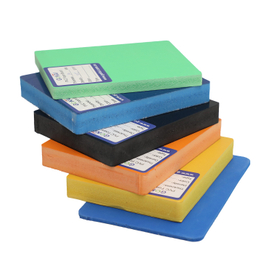
KT board is a commercial term commonly used for lightweight display panels with a polystyrene foam core. Depending on the supplier, the facers may be paper-based, plastic-based, or another laminated construction.
Common applications include:
- Temporary promotional displays.
- Exhibition graphics.
- Presentation boards.
- Mounted photographs.
- Indoor directional signs.
Do not assume every product described as "foam board" is identical. A paper-faced panel and a plastic-faced panel can behave differently around moisture, adhesives, and surface damage.
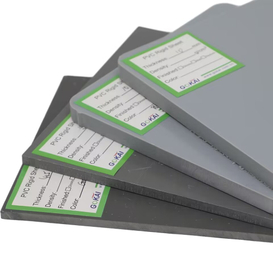
PVC foam board, also called expanded PVC sheet, combines a cellular structure with a surface suitable for selected printing and fabrication processes.
Available constructions include free-foam, Celuka, and multilayer products. Their surface hardness, core structure, and machining behavior can differ.
For buyers, the important question is not simply "Is this PVC?" It is "Does this particular grade meet the requirements of my finished product?"
The following comparison describes typical purchasing considerations, not guaranteed specifications for every supplier's products.
| Selection factor | KT board | PVC foam board |
|---|---|---|
| Main construction | Polystyrene foam core with laminated facers | Cellular PVC, with construction varying by grade |
| Typical application | Temporary indoor displays | Signs, reusable displays, and fabricated panels |
| Handling weight | Often very lightweight | Commonly heavier at comparable dimensions |
| Moisture exposure | Strongly influenced by facer and edge construction | Generally better suited to moisture exposure |
| Cutting | Often convenient for knife cutting | Suitable grades support sawing and routing |
| Repeated handling | Exposed edges may need protection | Often a stronger candidate for reusable work |
| Outdoor suitability | Do not assume suitability | Requires an appropriate grade and installation |
| Purchase decision | Evaluate temporary-use economics | Evaluate finished-service requirements |
A supplier's technical data sheet should take priority over broad category descriptions.
For a short indoor campaign, KT board is often a sensible starting point. Low handling weight and convenient cutting can simplify installation, especially when panels are replaced after the event.
Consider how the board will be supported. A panel mounted against a wall faces different demands from a large freestanding display.
Before ordering, confirm the intended printing method and whether exposed edges will remain visible.
PVC foam board is worth evaluating when graphics or display components will be transported, stored, and installed repeatedly.
The advantage is not simply a more durable surface. Fabricators may also need routed shapes, drilled holes, finished edges, or more substantial mounting arrangements.
Nevertheless, PVC is not damage-proof. Protective packaging and sensible handling remain important.

For locations exposed to splashes or damp cleaning, PVC foam board is generally the more appropriate candidate.
Outdoor use requires additional checks:
- Is the exact grade recommended for exterior exposure?
- What temperature range does the manufacturer specify?
- How will the panel accommodate thermal movement?
- What support and fixing arrangement is required?
- Are the ink, adhesive, and protective finish suitable?
Moisture resistance does not automatically establish long-term outdoor performance. Sunlight, heat, panel dimensions, and installation can all affect results.
Both board categories can be used for graphic applications, but print compatibility depends on the surface and production method.
Before committing to a batch, print a sample using the intended equipment and consumables. Check:
- Fine text and image sharpness.
- Solid-color consistency.
- Ink adhesion after curing.
- Surface marks under display lighting.
- Any distortion following production.
A successful test on one branded sheet does not prove that every similar-looking sheet will perform identically.
Adhesive and paint compatibility deserves particular attention with polystyrene-core boards. Some solvent-containing products can attack exposed foam.
For either material, obtain compatibility guidance and test the actual assembly. Include cut edges, not just the intact face.
Surface appearance alone cannot confirm bond strength or long-term compatibility.
Where a PVC panel needs mechanical fixing, specify the support arrangement and follow the selected product's fabrication guidance.
Do not assume that a lightweight cellular sheet can carry substantial loads because it accepts a screw.
For large panels, installation must also account for temperature-related movement. Tight restraint without appropriate allowance can compromise flatness or damage the assembly.
Two PVC foam sheets of equal thickness can have different densities and mechanical properties.
Ask for thickness tolerance, density information, and relevant performance data. A lower price may reflect a different specification rather than a more competitive offer.
Thickness alone also cannot establish the required support spacing.
A fire classification applies to the tested product under stated conditions. It is not a universal property of everything sold under the same material name.
Request documentation identifying the product, thickness, classification, and applicable standard.
For regulated projects, confirm acceptance with the relevant project authority. Never substitute a general marketing statement for the required evidence.
A lightweight board may reduce transport weight, while a reusable board may avoid repeated replacement. Neither observation proves that one option always has a lower environmental impact.
Consider the complete use pattern, production waste, and available collection routes.
Ask local recyclers whether they accept the specific finished material, including its facers, inks, films, and adhesive layers.
The lowest sheet price does not necessarily produce the lowest project cost.
A useful comparison includes:
- Material and printing.
- Cutting and finishing.
- Packaging and freight.
- Installation and removal.
- Damage and replacement.
- Storage between uses.
Consider this illustrative scenario, not a market quotation: a temporary display costs $12 per installation and is replaced four times. Its material-and-print total is $48. A reusable alternative costing $30 initially could be less expensive if it survives all four installations.
However, heavier shipping, storage, or changed graphics could reverse that result.
The lesson is to compare cost per use, not assume that a particular material always wins. Ask whether the entire display will be replaced or only its graphics.
A structured trial makes supplier comparisons more useful than collecting small swatches without a test plan.

Record the location, intended lifespan, panel dimensions, mounting method, cleaning routine, and expected handling.
For exterior work, include likely sun exposure and temperature conditions.
Ask for the proposed construction, thickness, density range, finish, and protective film.
Confirm that the sample represents the intended production specification rather than a different demonstration grade.
Use the intended printing, cutting, drilling, and bonding methods.
A board that performs well as an unprinted sample may respond differently after fabrication.
Check edge quality, flatness, print adhesion, mounting security, and packaging protection.
For repeated-use displays, rehearse unpacking, installation, removal, and repacking. Record observations against agreed acceptance criteria.
Keep an approved sample alongside the written specification.
Use both when reviewing production deliveries. An agreed reference reduces misunderstandings about appearance and workmanship.
These checks support purchasing decisions; they do not replace required laboratory testing or engineering approval.
Gokai supplies PVC foam board and other board materials to global customers, with OEM service available. A detailed inquiry helps establish the right starting specification.
Include:
1. Application and destination market.
2. Sheet dimensions and thickness.
3. Required tolerances.
4. Preferred construction and density, if known.
5. Color and surface finish.
6. Printing and fabrication methods.
7. Indoor or outdoor conditions.
8. Required test documentation.
9. Packaging and labeling requirements.
10. Quantity and delivery expectations.
If density or construction is undecided, describe the performance you need instead. For example, explain whether the panel will be routed into letters, mounted flat, or repeatedly transported.
Ask the supplier to confirm feasibility, sample availability, minimum order quantity, and lead time in writing.
Choose KT board when lightweight, temporary indoor presentation is the priority. Evaluate PVC foam board when your project requires moisture resistance, fabrication flexibility, or repeated use.
Send Gokai your dimensions, application, printing method, expected exposure, and OEM requirements. Request a proposed specification and representative samples so you can validate the material before approving production.
No. KT board generally uses a polystyrene foam core with laminated facers. PVC foam board is a cellular PVC product. Always confirm the specification because commercial naming varies.
PVC foam board generally offers strong moisture resistance, but "waterproof" should not be treated as approval for every wet application. Joints, adhesives, fixings, and prolonged exposure conditions require separate consideration.
Do not assume that standard KT board is suitable outdoors. Check the exact product's intended applications and exposure limitations. Short-term protected use is different from prolonged exposure to rain and sunlight.
Neither is universally better. The answer depends on the surface, ink system, equipment, and required finish. Test the actual board using the intended production process.
There is no universally correct thickness. Panel size, support spacing, orientation, handling, and exposure all matter. For large or exposed installations, obtain product-specific guidance and appropriate design advice.
Not automatically. A display or fabrication-grade sheet should not be treated as a structural panel without documented suitability. Shelving, load-bearing assemblies, and overhead installations require application-specific verification.
1- [Aibo — "KT Board VS PVC Foam Board: Which One to Choose"]. Original article used as the starting point for restructuring and comparison topics. Its broad performance statements are not treated as universal guarantees. [aibofoamboard]
2- [3A Composites USA — FOME-COR® Product Information]. Supports the description of paper-faced polystyrene foam board, short-term interior applications, printing and cutting options, and solvent-related precautions. FOME-COR is an industry example, not a specification for all KT boards. [3acompositesusa]
3- [3A Composites USA — GP APEX™ Product Information]. Supports the distinction between paper-faced and plastic-faced polystyrene foam constructions. [3acompositesusa]
4- [Palram — PALIGHT® Foamed PVC Product Information]. Supports the discussion of free-foam and Celuka technologies, product-specific temperature limits, and conditional fire classifications. Published values are not Gokai product specifications. [palram]
5- [Palram Americas — Frequently Asked Questions]. Supports the discussion of PVC thermal expansion, product-specific installation guidance, and factors affecting outdoor performance. [palram]
6- [3A Composites USA — Display & Graphics Sustainability]. Provides context on material construction, production-scrap recovery, and why environmental claims need product-specific qualification. [3acompositesusa]