Shanghai Gokai Industry Co,.Ltd.
Call Us: +86-18918606548
Call Us: +86-18918606548
- Product Name
- Product Keyword
- Product Model
- Product Summary
- Product Description
- Multi Field Search
Views: 260 Author: Gokai Publish Time: 2026-09-26 Origin: Site


Content Menu
● Why Choose PP Corrugated Sheet?
>> Key Advantages of PP Hollow Sheet
● PP Hollow Sheet vs. Cardboard vs. Solid Plastic Board
● Best Uses for PP Hollow Sheet
>> Reusable Packaging and Returnable Transit Systems
>> Printed Signs, Displays, and Advertising Boards
>> Construction Protection and Temporary Site Applications
>> Agriculture and Produce Packaging
>> Industrial Partitions and Product Protection
● How to Choose the Right PP Hollow Sheet Specification
● OEM PP Hollow Sheet: What Global Buyers Should Prepare
● Important Limitations and Practical Considerations
● Why Work With Gokai for PP Hollow Sheet Projects?
>> 1. What is PP hollow sheet made of?
>> 2. Is PP hollow sheet the same as corrugated plastic board?
>> 3. Can PP corrugated sheet be used outdoors?
>> 4. Can PP hollow sheet be printed?
>> 5. Is PP hollow sheet waterproof?
>> 6. Is PP hollow sheet recyclable?
>> 7. What thickness of PP hollow sheet should I choose?
>> 8. Can Gokai provide OEM PP hollow sheet?
PP hollow sheet is a lightweight, durable, and highly adaptable plastic board used in reusable packaging, advertising signs, industrial protection, agriculture, construction, and custom OEM products. Also known as PP corrugated sheet, polypropylene hollow sheet, corrugated plastic board, Corflute, or Correx, this material combines a rigid outer surface with hollow internal flutes.
For buyers who need a material that is easier to handle than solid plastic board and more moisture-resistant than paperboard, PP hollow sheet can be a practical solution. Its internal channel structure reduces weight while preserving useful rigidity, impact resistance, and fabrication flexibility.
At Gokai, we work with global distributors, packaging converters, printing businesses, advertising companies, and industrial buyers that require standard or custom PP hollow sheet specifications. The right sheet is not simply a question of thickness. It depends on the product's end use, expected handling cycle, printing method, load requirement, exposure environment, and conversion process.

PP hollow sheet is an extruded board made primarily from polypropylene. Unlike a solid PP sheet, it has internal parallel flutes or channels. This hollow structure creates a balance between low weight and practical strength.
The sheet is commonly supplied in flat panels and can be converted into boxes, dividers, signs, floor-protection sheets, agricultural packaging, display panels, and temporary partitions.
Depending on regional terminology and industry practice, buyers may search for the same product using several names:
- PP hollow sheet
- PP corrugated sheet
- Corrugated plastic board
- Polypropylene hollow board
- PP fluted sheet
- Corflute sheet
- Correx board
- Twin-wall polypropylene sheet
Although the names vary, the procurement questions remain similar: How stiff does the sheet need to be? Will it be printed? Will it be reused? Will it face moisture, chemicals, outdoor conditions, or repeated handling?
The value of PP corrugated sheet comes from the relationship between the polypropylene resin and its fluted structure. The material uses less mass than a comparably sized solid board, while the channels provide structural support in one direction.
For many commercial applications, this makes PP hollow sheet easier to transport, cut, fold, print, wash, and assemble.
- Lightweight: The hollow-core structure reduces material weight, helping improve handling and transportation efficiency.
- Moisture resistant: PP does not readily absorb water, unlike many paper-based boards that can soften or deform in humid conditions.
- Reusable and washable: Suitable for selected returnable packaging, industrial partitions, and protection-board applications.
- Impact resistant: The fluted structure can help protect products during handling, storage, and transport.
- Chemical resistant: Polypropylene generally performs well against many common chemicals, oils, and cleaning agents, although suitability must be checked for the exact substance and exposure conditions.
- Easy to fabricate: PP hollow sheet can be cut, die-cut, folded, welded, printed, and assembled into customized products.
- Printable surface: With appropriate surface preparation, such as Corona treatment, it can support compatible printing processes.
- Recyclable material: PP is generally identified as plastic resin code 5. Actual recycling depends on local collection, sorting, and processing infrastructure.
Gokai supplies PP hollow sheet in standard and custom formats for B2B projects. Available options include different thicknesses, densities, sizes, colors, surface treatments, cutting requirements, and OEM configurations.
Choosing between corrugated plastic, cardboard, and solid plastic board requires more than comparing initial sheet price. Buyers should consider the product's expected lifespan, environment, handling frequency, printing requirements, and disposal pathway.
| Material | Key Strength | Main Limitation | Typical Best Use |
|---|---|---|---|
| PP hollow sheet | Lightweight, moisture resistant, reusable, customizable | Needs correct grade and surface treatment for specific printing or outdoor applications | Returnable packaging, signs, partitions, protection boards |
| Corrugated cardboard | Low initial cost and easy recycling where systems exist | Can lose strength after moisture exposure | Single-use dry packaging and retail cartons |
| Solid PP sheet | Stronger and more rigid for some demanding uses | Heavier and usually uses more material | Machine parts, rigid industrial panels, chemical-service components |
| Foam board | Light and easy for indoor graphics | Can dent or degrade more easily in tough environments | Indoor displays and short-term presentations |
A PP hollow sheet is often a strong candidate when the product must survive repeated handling, high humidity, cleaning, or exposure to dirt during logistics. It is not automatically the best choice for every project. For example, high-load structural components may require a thicker solid sheet, a reinforced design, or an entirely different engineering material.
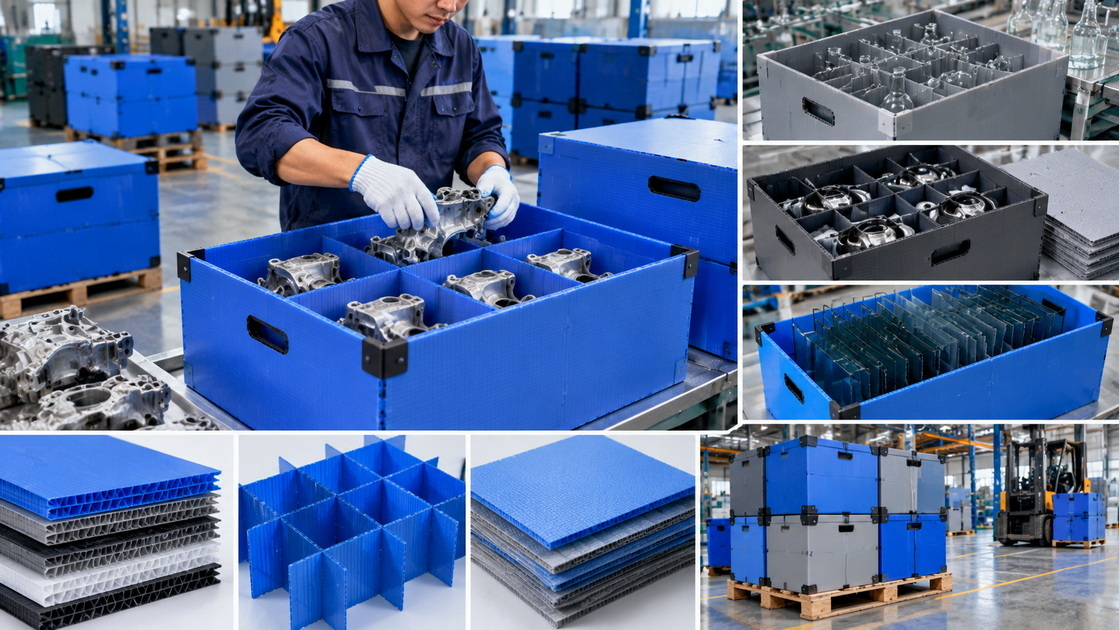
One of the most common uses for PP hollow sheet is reusable packaging. Manufacturers and logistics operators can convert the sheet into foldable boxes, internal dividers, layer pads, bottle separators, tote inserts, and protective sleeves.
Unlike untreated paperboard, PP hollow sheet can be wiped down or washed after use. This makes it useful in controlled industrial environments where packaging cycles repeat and where moisture exposure is possible.
Common packaging applications include:
- Automotive-part separators
- Bottle and glass dividers
- Fruit and vegetable boxes
- Turnover boxes
- Mailers and protective sleeves
- Appliance-component protection
- Hardware and tool packaging
- Reusable warehouse partitions
- Layer pads for stacked goods
Expert procurement insight: A reusable packaging project should be designed around the real handling cycle. Consider the number of anticipated trips, stacking height, product weight, cleaning method, warehouse temperature, folding pattern, and return-logistics route before finalizing the sheet grade.
PP hollow sheet is widely used for temporary and medium-term signage because it is lightweight, economical, and easy to cut into custom shapes. Its smooth faces can support graphic applications when the material and printing process are properly matched.
Typical uses include:
- Real estate signs
- Election and campaign signs
- Event signage
- Retail promotions
- Directional signs
- Lawn signs
- Exhibition displays
- Point-of-purchase panels
- Indoor promotional boards
- Short-term outdoor advertising
For print buyers, Corona treatment matters. Polypropylene has a relatively low surface energy, so untreated surfaces may not provide the desired ink adhesion. Corona treatment can improve surface compatibility for appropriate inks and printing processes. Gokai offers Corona-treated PP hollow sheet within applicable width ranges for customers with specific printing requirements.
Before full production, request a print test using the final ink, curing method, artwork coverage, and storage conditions. This is especially important for high-coverage graphics, outdoor signs, or projects that may experience heat, moisture, abrasion, or long storage periods.

Construction crews need protection materials that are easy to move, simple to cut, resistant to moisture, and cost-effective for large temporary areas. PP hollow sheet can be used as a lightweight protection layer for selected construction and renovation applications.
Examples include:
- Temporary floor protection
- Window protection
- Wall protection
- Surface covers during renovation
- Temporary partitions
- Dust and debris barriers
- Interior protection during installation work
- Lightweight panels for exhibition build-outs
The correct thickness depends on the exposure risk. A thin panel may work for a temporary graphic or light wall covering, while floor protection or repeated impact exposure usually requires a thicker, higher-density specification.
Important: PP hollow sheet should not be assumed to be a permanent load-bearing building material. For fire performance, structural performance, weather resistance, and code compliance, confirm the local project requirements and test data before specifying the product.
Agricultural supply chains often expose packaging to moisture, dirt, frequent handling, and temperature variation. PP hollow sheet can be converted into produce boxes, plant trays, protective dividers, and reusable containers for fruits, vegetables, flowers, and other agricultural products.
Its moisture resistance can offer an advantage over paper-based packaging in humid conditions. The material can also be cleaned between cycles when a reuse system is appropriate.
Potential agricultural uses include:
- Fruit and vegetable packaging
- Reusable harvest boxes
- Plant and flower separators
- Greenhouse and nursery protection panels
- Temporary crop or equipment covers
- Agricultural product dividers
For food-contact uses, do not rely on a general product description alone. Buyers should request documentation relevant to the intended market, resin grade, colorants, additives, migration requirements, and final product design. A material that is appropriate for one food-related application may not automatically meet the regulatory or hygiene requirements of another.
Industrial products often need separation during warehousing and transport. Metal, glass, coated parts, and finished components can be damaged by vibration, direct contact, abrasion, or shifting loads.
PP hollow sheet can be converted into custom partitions, die-cut inserts, corner protectors, sleeves, and tray components. Its low weight helps minimize added packaging mass, while its fluted construction provides useful cushioning and separation.
This application is especially relevant for:
- Automotive components
- Glass products
- Electronic parts
- Metal hardware
- Painted or coated components
- Household appliances
- Medical-device packaging components
- Export packaging systems
For a high-value component, create a small test batch before approving a large order. Test actual packing, vibration, stacking, unloading, and reuse cycles. This approach gives buyers more meaningful information than relying only on a nominal thickness value.
The best PP hollow sheet is not necessarily the thickest one. Over-specifying can increase cost and freight weight. Under-specifying can result in warping, crushing, poor print results, or premature failure.
Use the following specification checklist when requesting a quotation.
| Selection Factor | Questions to Ask |
|---|---|
| Application | Is the sheet for packaging, signage, protection, agriculture, or fabrication? |
| Thickness | How much rigidity, impact resistance, or panel stability is required? |
| Density | Does the application require a lighter sheet or greater stiffness? |
| Sheet size | What dimensions reduce waste during cutting, printing, or die-cutting? |
| Color | Does the project require white, black, transparent, clear, or brand-matched color? |
| Surface treatment | Is Corona treatment needed for printing or coating adhesion? |
| Fabrication | Does the project require cutting, creasing, welding, punching, or die-cutting? |
| Environment | Will the product face UV exposure, humidity, chemicals, heat, or repeated cleaning? |
| Reuse cycle | Is the product single-use, multi-use, or part of a returnable packaging loop? |
| Compliance | Are food contact, print, chemical, flame, or market-specific requirements relevant? |
Gokai's PP hollow sheet range includes approximately 2–10 mm thickness options, standard 1220 × 2440 mm sheets, customizable widths and lengths, multiple color options, and OEM support. The company indicates that customized dimensions and processing can be arranged according to project needs.
OEM sourcing works best when the buyer provides clear conversion and end-use information from the beginning. A vague request such as "we need corrugated plastic sheets" can lead to unnecessary sampling rounds, inconsistent results, and delayed production.

When contacting a PP hollow sheet manufacturer, prepare the following information:
1. End-use description: Explain whether the material will become packaging, signs, dividers, floor protection, displays, or another finished product.
2. Required dimensions: State final sheet width, length, thickness, and acceptable tolerances.
3. Density or stiffness expectation: Explain whether low weight or higher rigidity is the priority.
4. Color requirement: Provide a color reference, especially for brand-sensitive projects.
5. Printing requirement: Identify the printing method, ink system, coverage level, and whether Corona treatment is needed.
6. Fabrication requirement: Clarify cutting, scoring, die-cutting, folding, welding, punching, or assembly needs.
7. Usage environment: Mention indoor/outdoor use, moisture, chemical exposure, temperature range, and expected reuse cycles.
8. Order quantity and shipping destination: These details affect sheet optimization, packaging, loading plans, and lead-time planning.
9. Quality-control criteria: Define what will be inspected, such as thickness, weight, dimensions, color, flatness, flute direction, surface quality, and print adhesion.
A capable OEM project should move through sample confirmation, technical specification approval, pre-production verification, quality inspection, and packaging confirmation. This process protects both the buyer and the supplier by turning general expectations into measurable requirements.
PP hollow sheet is versatile, but it should be selected responsibly.
- Outdoor durability varies. Standard PP can degrade under prolonged UV exposure. For long-term outdoor use, discuss UV-stabilized material and test the required service conditions.
- Chemical resistance is not universal. Polypropylene often resists many acids, bases, and oils, but some oxidizers, solvents, temperature conditions, and concentrations may be unsuitable. Material compatibility should be verified for the real chemical and exposure period.
- Food-contact suitability must be documented. A general statement that a material is "food safe" is not enough for all markets or applications.
- Recycling is location-dependent. PP can be recycled, but actual recovery depends on local collection systems, contamination level, product design, and downstream recycling capability.
- Print quality requires testing. Surface treatment, ink selection, curing, storage, and abrasion conditions all affect final print performance.
- Flute direction affects strength. The direction of the internal channels should be considered when designing signs, boxes, partitions, and load-bearing folds.
Gokai supplies PP hollow sheets for international B2B customers across packaging, advertising, printing, construction, agriculture, and industrial markets. The company supports standard and customized specifications, including different sizes, thicknesses, densities, colors, printing-oriented surface treatments, cutting, fabrication, and OEM requirements.
For buyers, the goal is not simply to purchase a sheet. It is to receive a PP corrugated sheet that performs reliably within the intended application, processing method, logistics conditions, and target cost structure.
Need a custom PP hollow sheet solution? Send Gokai your application, required dimensions, thickness, color, density, printing process, fabrication needs, expected order quantity, and destination market. Our team can help you evaluate a suitable corrugated plastic board specification for packaging, signs, protection, or OEM conversion projects.
PP hollow sheet is primarily made of polypropylene, a thermoplastic polymer. It is extruded into a board with flat outer surfaces and hollow internal flutes. This construction helps create a lightweight material with useful rigidity and impact resistance.
Yes. PP hollow sheet is commonly called PP corrugated sheet, corrugated plastic board, polypropylene fluted sheet, Corflute, or Correx. Terms vary by country and industry, but they generally describe a fluted polypropylene board.
It can be used outdoors for temporary or selected medium-term applications, such as signs and protection panels. However, long-term outdoor durability depends on UV exposure, climate, sheet formulation, thickness, color, and whether UV stabilization is included. Confirm the required service life with the supplier before ordering.
Yes, PP hollow sheet can be printed with appropriate printing systems. Because polypropylene has a relatively low surface energy, Corona treatment or another suitable preparation may be needed to improve ink adhesion. Always conduct a production-representative print test before placing a large order.
PP hollow sheet is moisture resistant and does not readily absorb water like paperboard. This makes it suitable for many humid, washable, or wet-handling environments. However, "waterproof" performance in a finished box or fabricated product also depends on seams, folds, openings, assembly design, and exposure conditions.
Polypropylene is recyclable where suitable recycling systems exist. However, actual recyclability depends on local collection and processing infrastructure, as well as whether the final product contains inks, adhesives, mixed materials, or contamination that may affect sorting and recycling.
The right thickness depends on your application. Lightweight signs may need a thinner sheet, while reusable packaging, industrial dividers, construction protection, or larger panels may require greater thickness and density. Provide the supplier with product weight, panel size, handling conditions, and expected reuse cycles for a more accurate recommendation.
Yes. Gokai supports OEM requirements including custom dimensions, thicknesses, densities, colors, surface treatment, cutting, fabrication, and bulk-order configurations for international B2B customers.
1. [Piedmont Plastics, "Advantages of Polypropylene: A Versatile and Resilient Thermoplastic"] — Reference article reviewed for general polypropylene properties and broad application categories. [piedmontplastics]
2. [Gokai, "PP Hollow Sheet"] — Source for Gokai product positioning, PP hollow sheet construction, applications, customization options, standard thickness range, sheet sizing, Corona-treatment availability, OEM capability, MOQ, and stated lead-time information. [gokai.com]
3. [Gokai, "PP Hollow Sheets"] — Source for product-use examples, stated specification ranges, application categories, and product features. [gokai.com]
4. [ChemicalResistance.org, "PP (Polypropylene) Resistance Chart"] — Reference for general polypropylene chemical-resistance context and the need to evaluate chemical compatibility by substance and conditions. [chemicalresistance]
5. [Pro-Measures, "Polypropylene Chemical Resistance Guide"] — Reference for the importance of testing PP against specific chemicals, concentrations, temperatures, and exposure conditions. [pro-measures]
6. [Efficido, "PP Corrugated Sheet Material Data Sheet"] — Reference for indicative, grade-dependent PP corrugated-sheet material-property ranges and the need to confirm project-specific performance with actual technical documentation. [efficido]