Shanghai Gokai Industry Co,.Ltd.
Call Us: +86-18918606548
Call Us: +86-18918606548
- Product Name
- Product Keyword
- Product Model
- Product Summary
- Product Description
- Multi Field Search
Views: 257 Author: Gokai Publish Time: 2026-09-22 Origin: Site


Content Menu
● Polycarbonate Solid Sheet vs. Polycarbonate Hollow Sheet
>> When to Choose Polycarbonate Solid Sheet
>> When to Choose Polycarbonate Hollow Sheet
● Key Benefits of Polycarbonate Sheet
>> Exceptional Impact Resistance
>> Easy Fabrication and OEM Customization
● Important Limitations Buyers Should Know
>> Scratch Resistance Is Lower Than Glass
>> UV Protection Is Not Optional Outdoors
>> Thermal Expansion Must Be Designed In
>> Not Every Polycarbonate Sheet Has the Same Fire Rating
● How to Select the Right Polycarbonate Sheet
>> 1: Define the Installation Environment
>> 2: Decide Whether You Need Solid or Hollow Structure
>> 3: Select Thickness Based on Performance, Not Guesswork
>> 4: Verify Coatings, Standards, and Documentation
>> 5: Plan Installation Before Ordering
● Why Many Polycarbonate Projects Fail Early
● Gokai OEM Polycarbonate Sheet Solutions
● Request a Polycarbonate Sheet Quote
>> 1. Is polycarbonate stronger than acrylic?
>> 2. Can polycarbonate sheet be used outdoors?
>> 3. What is the difference between solid and hollow polycarbonate sheet?
>> 4. Can polycarbonate sheet be cut and drilled?
>> 5. Does polycarbonate sheet expand in heat?
>> 6. Is polycarbonate sheet fireproof?
>> 7. How do you clean polycarbonate sheet?
Polycarbonate sheet is a high-performance thermoplastic glazing material valued for its exceptional impact resistance, light weight, transparency, and fabrication flexibility. For projects that need safer, lighter alternatives to glass—from machine guards and security glazing to skylights, canopies, greenhouses, and partitions—polycarbonate solid sheet and polycarbonate hollow sheet offer different but highly practical performance advantages.
At Gokai, we work with global OEM buyers, distributors, contractors, and project-based customers who need more than a generic plastic panel. The real purchasing decision involves selecting the right sheet structure, thickness, UV protection, color, coating, fire-performance documentation, dimensions, packaging, and processing approach for the final application. This guide explains how to make that decision with greater confidence.

Polycarbonate, commonly abbreviated as PC, is an engineering thermoplastic known for combining transparency with very high impact resistance. Clear grades can provide approximately 88–90% light transmission, while the material weighs roughly half as much as glass at comparable panel dimensions.
Unlike conventional glass, polycarbonate does not usually shatter into dangerous sharp fragments under impact. Unlike many standard plastics, it also maintains useful dimensional stability and heat performance for demanding industrial and architectural applications.
Polycarbonate resin can be classified under ASTM D3935, a standard covering unfilled and reinforced polycarbonate and polycarbonate copolymer materials used in processes such as extrusion, injection molding, and blow molding.
For sheet buyers, however, resin classification is only the starting point. The final performance of a polycarbonate panel depends on several factors:
- Sheet structure: solid, twin-wall, multiwall, corrugated, embossed, or specialty construction
- Thickness: thinner sheet improves flexibility; thicker sheet generally improves stiffness and impact capacity
- UV protection: essential for most outdoor-facing installations
- Surface treatment: hard coating or abrasion-resistant coating for scratch-sensitive applications
- Color and light transmission: clear, opal, bronze, blue, green, white, or customized colors
- Fire-performance requirements: rating, thickness, color, and test scope must match the actual supplied grade
- Installation design: especially clearance for thermal expansion and contraction
A supplier should therefore not simply answer, "Can we provide polycarbonate sheet?" A better technical discussion begins with: Where will the sheet be used, what must it withstand, and what documentation does the project require?
The most important specification decision is often whether a project needs polycarbonate solid sheet or polycarbonate hollow sheet, also called multiwall polycarbonate sheet.
| Feature | Polycarbonate Solid Sheet | Polycarbonate Hollow Sheet |
|---|---|---|
| Internal structure | Dense, continuous panel | Internal channels, ribs, or multiwall cells |
| Typical visual effect | High clarity, glass-like appearance | Transparent, translucent, or diffused daylighting |
| Impact resistance | Very high | High, depending on wall structure and thickness |
| Thermal insulation | Moderate | Better due to internal air chambers |
| Weight | Heavier than hollow sheet | Lighter at comparable overall thickness |
| Sound performance | Can provide useful sound control | Often useful for lightweight roof and wall systems |
| Best applications | Machine guards, security glazing, shields, windows, partitions | Greenhouses, skylights, canopies, roofing, wall cladding |
| Processing options | Cutting, drilling, thermoforming, bending, CNC fabrication | Cutting and installation with edge sealing and rib orientation control |
Polycarbonate solid sheet is the stronger choice when the priority is impact resistance, visibility, security, forming capability, or a more glass-like appearance.
Common applications include:
- Machine safety guards and equipment enclosures
- Protective barriers and transparent partitions
- Security glazing and anti-vandalism screens
- Bus shelters and public-space protection panels
- Face shields and industrial protective components
- Retail displays and signage
- Sound barriers
- Interior glazing and protective doors
- Thermoformed covers, housings, and fabricated components
Solid polycarbonate is particularly useful when designers need a clear barrier that can tolerate accidental impact. However, buyers should not assume all clear PC sheet is automatically suitable for exterior use. Outdoor projects normally need UV-stabilized grades or a UV-protective co-extruded surface layer.
Without suitable UV protection, polycarbonate can yellow, become brittle, and lose long-term visual quality under direct sunlight. A glazing guide from Laird Plastics notes that unprotected polycarbonate may yellow and become brittle within 2–5 years of direct sun exposure, while quality UV-coated material may retain clarity and impact performance for 10–15 years in temperate conditions. Actual service life will still depend on climate, installation, cleaning practice, sheet grade, and exposure intensity.
Polycarbonate hollow sheet is usually the more efficient option for daylighting roofs, greenhouse glazing, covered walkways, canopies, and lightweight architectural systems.
Its internal wall-and-channel structure creates air spaces that help improve thermal insulation compared with a single solid panel. That makes multiwall PC sheet especially valuable when a project needs a balance of daylight admission, lower weight, weather resistance, and energy-conscious enclosure design.
Typical applications include:
- Commercial and residential greenhouses
- Agricultural facilities
- Skylights and roof lights
- Patio covers and pergolas
- Walkway canopies
- Stadium and transit-station roofing
- Carports
- Swimming-pool enclosures
- Industrial daylighting roofs
- Interior partitions with diffused light
For roofing and greenhouse projects, multiwall sheet can reduce direct glare compared with clear solid sheet while maintaining bright, useful daylight. Opal, embossed, tinted, and diffused options can further help manage privacy, light scattering, and solar comfort.
图2
The most widely recognized advantage of polycarbonate is its toughness. It is frequently selected where standard glass could break or where acrylic may not provide enough impact resistance.
A published materials guide reports that clear PC grades can offer approximately 88% optical transmission while delivering impact resistance described as up to 250 times greater than glass. Exact performance varies by thickness, grade, test method, panel design, and test conditions, so buyers should always request a product-specific technical data sheet rather than rely on generic comparison claims.
For safety-critical applications, the correct question is not simply, "Is polycarbonate unbreakable?" No material is literally unbreakable in every real-world condition. The correct question is:
Clear solid polycarbonate can transmit close to 88–90% of visible light, depending on thickness and grade. This makes it suitable for transparent machine guards, skylights, windows, protective screens, and display applications.
Hollow polycarbonate sheets usually transmit less light than solid clear sheet because their internal structure scatters or diffuses light. However, that diffusion can be an advantage in greenhouses, canopies, and daylighting roofs because it reduces glare and spreads light more evenly.
Polycarbonate sheet is significantly lighter than glass. This reduces handling effort during installation, lowers dead load in many roof and canopy designs, and can simplify transportation and fabrication.
For OEM buyers, lower sheet weight can also support:
- More efficient international freight loading
- Easier site handling
- Lower structural support requirements in some applications
- Safer installation workflow
- More flexible design options for large-format panels
Polycarbonate performs well across a broad temperature range compared with many commodity plastics. Laird Plastics lists a glass transition temperature of approximately 147°C and a heat-deflection range of about 128–140°C, depending on grade and test conditions.
However, heat resistance should not be confused with unlimited high-temperature suitability. Continuous service temperatures, load-bearing behavior, chemical exposure, and fire requirements should be checked against the specific product data sheet.
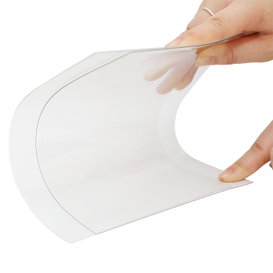
Polycarbonate sheet can be cut, drilled, routed, CNC-machined, cold bent within recommended limits, thermoformed, and fabricated into custom components.
For global OEM programs, Gokai can support specifications such as:
- Custom thickness and sheet dimensions
- Clear, opal, bronze, blue, green, white, and customized colors
- UV-protected sheet options
- Embossed or textured finishes
- Solid, twin-wall, multiwall, and specialty structures
- Custom protective film and logo printing
- Retail-ready or export-grade packaging
- Private-label or OEM identification requirements
- Project-based cutting and fabrication discussions
The final feasibility depends on the requested volume, panel design, production requirements, packaging specifications, and applicable regional standards.

A credible polycarbonate guide should explain not only where the material performs well, but also where it needs extra attention.
Standard polycarbonate surfaces are generally more prone to scratching than glass and often less scratch-resistant than acrylic. For applications exposed to frequent cleaning, abrasion, repeated contact, or public use, consider an abrasion-resistant or hard-coated polycarbonate sheet.
Potential applications for coated PC include:
- Security windows
- Protective viewing panels
- Transportation glazing
- Retail barriers
- High-contact machine windows
- Public facilities
Use only cleaning products approved for the selected sheet grade. Abrasive powders, rough brushes, strong solvents, and incompatible cleaners can damage the surface or cause stress cracking.
For outdoor glazing, ask the supplier whether UV protection is:
- Co-extruded on one side
- Co-extruded on both sides
- Applied as a coating
- Included in the resin formulation
- Covered by a product warranty under stated conditions
For multiwall PC sheets, the UV-protected surface must face outward during installation. SABIC's LEXAN THERMOCLEAR installation guidance specifically notes that the UV-protected surface should face outward and that sheet ribs should run vertically in relevant glazing configurations.
Polycarbonate expands and contracts more than glass, steel, and many common building materials. This is one of the most frequent causes of avoidable installation problems, including panel bowing, stress around fasteners, optical distortion, cracking, and leakage.
A common fabrication guideline is to allow about 1/16 inch of movement per foot of panel length and width, although the correct allowance must be calculated for the actual sheet size, temperature range, frame system, color, and installation design.
For multiwall polycarbonate, one manufacturer's installation guidance gives a general allowance of approximately 3 mm per linear meter at a 50°C temperature difference.
Avoid broad claims such as "polycarbonate is fireproof." Polycarbonate can offer favorable flame behavior compared with some other plastics, but its fire classification depends on the precise formulation, sheet thickness, color, coating, test method, and certification scope.
For example, a flame-retardant polycarbonate sheet may achieve UL 94 V-2 at 0.060 inch and UL 94 V-0 at 0.236 inch or above in one published product data sheet. This does not mean every polycarbonate sheet has the same rating.
For construction, transportation, electrical, or public-project applications, request:
1. The required local test standard.
2. The required classification.
3. The exact supplied thickness and color.
4. A current test report matching that product configuration.
5. Written confirmation linking the tested grade to the quoted material.
Choosing the right product begins with application requirements—not with the lowest price per square meter.
Start with the service conditions:
- Indoor or outdoor?
- Direct sunlight or shaded location?
- High wind, snow, hail, or impact exposure?
- Hot, cold, humid, coastal, or chemical environment?
- Frequent cleaning or human contact?
- Temporary structure or long-term installation?
Outdoor installations generally require UV-protected sheet. Coastal, industrial, and chemical environments may require additional review of sealant compatibility, fastener materials, coatings, and cleaning practices.
Choose solid polycarbonate sheet when you need high impact resistance, transparency, visual clarity, security, and fabrication flexibility.
Choose hollow polycarbonate sheet when you need lightweight daylighting, better thermal insulation, a roof or canopy system, and lower structural weight.
Thickness should reflect:
- Panel span
- Support spacing
- Wind and snow loading
- Required impact resistance
- Sheet structure
- Building code requirements
- Expected thermal movement
- Visual and insulation requirements
A thicker sheet is not automatically the correct answer. For example, a properly supported multiwall panel may perform better for a roof than a thick solid panel if insulation and low weight are priorities. Conversely, a multiwall sheet is usually not a replacement for a solid security window.
Before approving a supplier, request documentation relevant to your market and end use:
- Technical data sheet
- UV-protection specification
- Light-transmission data
- Fire-performance reports, if required
- Impact-test information
- Thickness tolerance
- Warranty terms, if applicable
- Quality-control procedures
- Product samples
- Packaging details
- Batch traceability options for larger projects
A technically good sheet can still fail in the field if it is installed incorrectly. Confirm:
- Sheet orientation
- UV-facing side
- Thermal expansion clearance
- Edge engagement
- Fastener-hole diameter
- Gasket and sealing system
- Compatible sealants
- Drainage and condensation control
- Multiwall sheet end-tape requirements
- Rib direction for roof drainage
In our experience supporting B2B sheet buyers, early failure is often not caused by the polycarbonate resin itself. It is usually caused by a mismatch between material selection and installation design.
Common preventable mistakes include:
- Using non-UV sheet outdoors
- Installing the UV side inward
- Cutting multiwall sheets without sealing the open channels
- Running hollow-sheet ribs horizontally where vertical drainage is required
- Tightening screws directly against the sheet without movement allowance
- Using undersized fastener holes
- Applying incompatible sealants or solvents
- Ignoring thermal movement in long panels
- Choosing a thickness based only on price
- Assuming a fire rating applies to every thickness and color
For example, if a 6-meter polycarbonate roof panel is fixed rigidly in a metal frame with no allowance for temperature movement, it may expand on a hot day and develop stress at the fasteners. Over time, this can lead to distortion, cracking, leakage, or premature visual defects. The solution is not necessarily a thicker panel; it is an installation system designed to let the panel move safely.


Gokai supplies polycarbonate solid sheet and polycarbonate hollow sheet for customers seeking reliable materials and flexible OEM support for international markets.
Whether you are sourcing sheet for a distributor program, greenhouse system, roofing project, machine-guard manufacturer, signage business, or customized industrial application, an effective OEM discussion should include more than price and size. It should cover technical performance, packaging, quality consistency, application environment, and market-specific documentation.
When sending an inquiry, include the following information whenever possible:
- Solid sheet or hollow/multiwall sheet
- Required thickness
- Required width and length
- Color or transparency requirement
- UV-protection requirement
- Surface finish or hard-coating requirement
- Application and installation location
- Estimated quantity and purchasing frequency
- Packaging and branding requirements
- Destination market
- Required certifications or test reports
- Target delivery timeline
The more complete the project information, the more accurately a supplier can recommend the appropriate polycarbonate sheet structure and OEM solution.
Need a dependable supplier for polycarbonate solid sheets, polycarbonate hollow sheets, or custom OEM polycarbonate panels?
Contact Gokai with your drawing, sheet dimensions, required thickness, application details, target market, and estimated order volume. Our team can help you compare solid versus hollow sheet options, identify suitable UV and surface-treatment requirements, and prepare a solution aligned with your project or distribution program.
Request samples, technical data, OEM packaging options, and a quotation for your next polycarbonate sheet project.
Polycarbonate is generally much more impact-resistant than acrylic. Acrylic often offers better inherent scratch resistance and can provide excellent clarity, while polycarbonate is usually preferred where safety, impact resistance, and shatter resistance matter most. The best option depends on the application.
Yes, but outdoor installations should normally use a UV-stabilized or UV-coated polycarbonate grade. Standard unprotected sheet can yellow and lose performance during long-term sun exposure. Confirm whether UV protection is on one side or both sides and ensure the protected side faces outward during installation.
Solid polycarbonate sheet is dense and glass-like, making it suitable for safety glazing, machine guards, partitions, and security applications. Hollow polycarbonate sheet has internal channels that reduce weight and improve insulation, making it suitable for roofing, skylights, greenhouses, and canopies.
Yes. Polycarbonate can generally be cut, drilled, routed, and machined using suitable tools and correct processing parameters. Use sharp tools, control heat buildup, remove swarf, and provide oversized holes where thermal movement is required. Always follow the supplier's fabrication guidance for the selected grade.
Yes. Polycarbonate has a relatively high coefficient of thermal expansion compared with glass and metal. Installation systems should allow the sheet to move as temperatures change. Published guidance commonly recommends planned clearance and oversized holes rather than rigidly locking the sheet into place.
No. Polycarbonate should not be described as universally fireproof. Its flame behavior and fire classification depend on the specific grade, thickness, color, coating, and test standard. If your project requires UL 94, EN 13501, ASTM E84, or another standard, request a test report covering the exact quoted material configuration.
Use lukewarm water, mild soap, and a soft cloth or sponge. Rinse loose dust first to reduce scratching. Avoid abrasive pads, strong solvents, aggressive alkaline cleaners, and unapproved chemicals. Check the cleaning guidance for the specific polycarbonate grade, especially if it has a hard coating or UV-protective surface.
1. Laird Plastics. "[What is Polycarbonate?]" Accessed September 19, 2026. Used for baseline material characteristics, including density, light transmission, heat-performance ranges, relative weight versus glass, and general fabrication guidance. [lairdplastics]
2. Laird Plastics. "[Plastics for Architectural Glazing]" Published June 18, 2026. Used for outdoor UV-degradation context and architectural glazing installation considerations. [lairdplastics]
3. SABIC. "[LEXAN™ THERMOCLEAR™ Multiwall Polycarbonate Sheet Technical Manual]" Used for multiwall PC installation considerations, including thermal expansion, minimum edge engagement, rib direction, and UV-side orientation. [sabic]
4. Plaskolite. "[TUFFAK® Polycarbonate Sheet Fabrication Guide]" Used for thermal-expansion and glazing-system guidance. [plaskolite]
5. ASTM International / Plaskolite. "[ASTM D3935: Polycarbonate Classification Overview]" Used for polycarbonate-resin classification context. [plaskolite]
6. Plaskolite. "[TUFFAK OP-V Polycarbonate Sheet Product Data Sheet]" Used to illustrate why UL 94 ratings are grade- and thickness-specific. [plaskolite]
7. Ready Plastics. "[Polycarbonate Properties: Impact, Optical and Thermal Data]" Published May 8, 2026. Used for indicative performance comparisons and thermal-expansion context; values must be verified against the product-specific data sheet before specification. [readyplastics]
8. Palram. "[Thermal Expansion and Polycarbonate Roofing Sheets]" Published July 23, 2023. Used for practical guidance on oversized holes, compatible gaskets, and avoiding overtightened fasteners. [palram]