Shanghai Gokai Industry Co,.Ltd.
Call Us: +86-18918606548
Call Us: +86-18918606548
- Product Name
- Product Keyword
- Product Model
- Product Summary
- Product Description
- Multi Field Search
Views: 222 Author: Gokai Publish Time: 2026-05-23 Origin: Site


As a manufacturer and global OEM supplier of acrylic mirror sheet, I've seen firsthand how projects succeed—or fail—based on the choice between acrylic and glass mirrors. This guide combines industry experience with up‑to‑date product data to help you choose the right material for your next installation, whether you are an architect, fabricator, brand owner, or importer. [attractandengage.co]
Acrylic mirror sheet is a cast or extruded PMMA (polymethyl methacrylate) sheet with a highly reflective metal coating on one side, designed to mimic the appearance of glass mirror while offering better impact resistance and lower weight. The reflective layer is typically applied through vacuum metallizing, then protected on the back with a durable coating or film to reduce scratching and damage during processing. [attractandengage.co]
Because it is a plastic mirror, acrylic can be cut, drilled, routed, laser‑cut, bent, and thermoformed without shattering, which opens applications that are not realistic for traditional glass. For OEMs and fabricators, this processability translates directly into lower scrap rates, shorter production cycles, and more flexible product design. [attractandengage.co]
The table below summarizes the most important technical and commercial differences between acrylic mirror sheet and traditional glass mirror. [attractandengage.co]
| Aspect | Acrylic mirror sheet | Glass mirror |
|---|---|---|
| Material | Cast/extruded PMMA with metalized back attractandengage.co | Soda‑lime glass with silver/aluminum backing attractandengage.co |
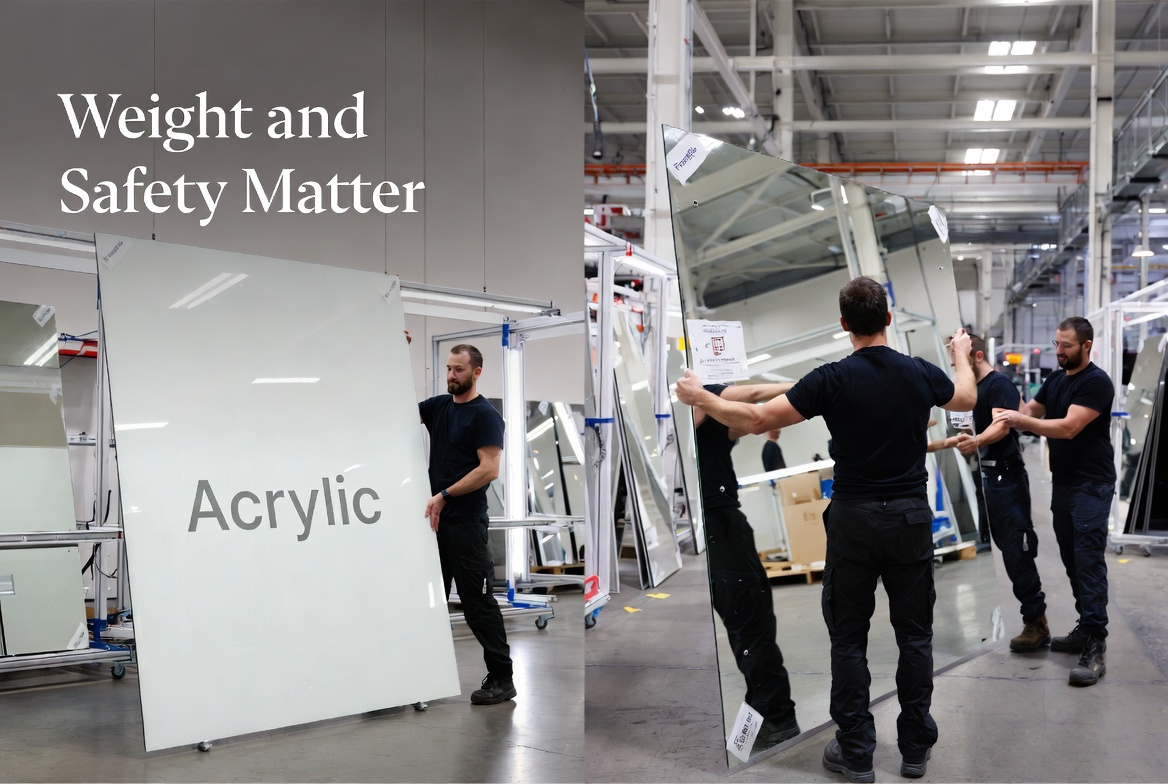
| Weight | Less than half the weight of glass attractandengage.co | Heavy, especially in large sizes attractandengage.co |
| Impact resistance | Up to ~17–20× more impact resistant than glass attractandengage.co | Brittle, shatters into sharp fragments attractandengage.co |
| Shatter behavior | Shatter‑resistant, safer in public areas attractandengage.co | Can break into dangerous shards and fine particles attractandengage.co |
| Rigidity | More flexible, can bend or warp if not installed correctly attractandengage.co | Very rigid, stays flat when properly supported attractandengage.co |
| Optical clarity | Excellent clarity; may show minor distortion in very large or curved panels attractandengage.co | Excellent clarity and highly accurate reflection attractandengage.co |
| Workability | Easily cut, drilled, CNC‑routed, and thermoformed attractandengage.co | Difficult to drill and cut; limited forming options attractandengage.co |
| Outdoor use | Good when specifically treated and properly backed; needs attention to moisture on back side attractandengage.co | Good general weather resistance; surface can be fragile to impact attractandengage.co |
| Cost | Generally lower material + handling cost for large, safety‑critical installations attractandengage.co | Higher handling and installation cost due to weight and breakage risk attractandengage.co |
| Typical uses | Gyms, studios, signage, POP displays, retail fixtures, marine, RV, decorative panels attractandengage.co | Decorative interior mirrors, small framed mirrors, architectural features attractandengage.co |
From an OEM perspective, acrylic mirror is usually the better choice where safety, weight, and processing flexibility matter more than absolute optical perfection. Glass remains the premium option where a perfectly flat, rigid decorative mirror is the top priority and impact risk is low. [attractandengage.co]
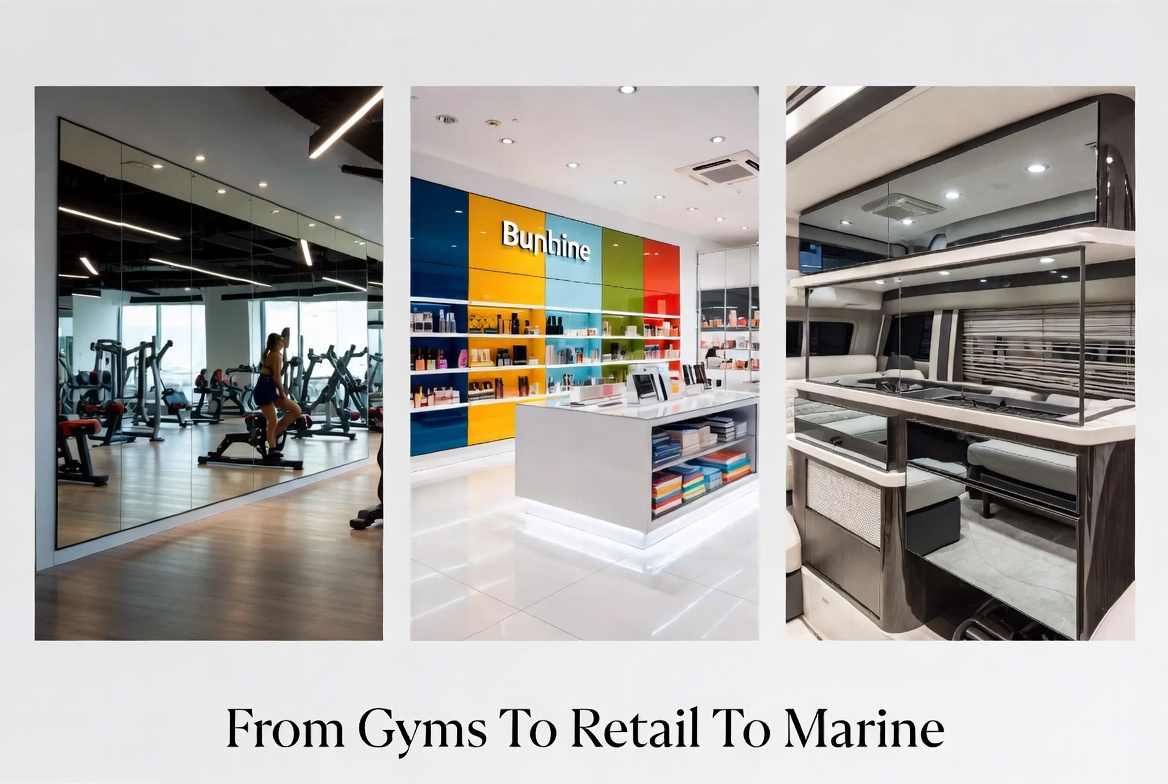
In gyms, dance studios, martial arts schools, shopping malls, and educational facilities, the mirror surface is exposed to continuous movement and occasional impact. Acrylic mirror sheets are significantly more impact resistant than glass and are effectively shatterproof under normal use, which dramatically reduces the risk of injury. [attractandengage.co]
Glass mirrors can break into sharp shards and tiny particles that are difficult to clean and dangerous in public spaces, especially where children or athletes are present. For this reason, many facility owners now specify acrylic mirror panels instead of glass for walls, columns, and large mirrored surfaces. [attractandengage.co]
Because acrylic mirror sheet weighs less than half of glass for the same thickness, installers can handle larger panels with fewer people, less equipment, and lower risk of damage during transport. This is especially important for OEM clients shipping pre‑assembled mirror panels or DIY kits to international markets, where freight cost and breakage can kill project margins. [attractandengage.co]
On large surface applications such as full‑wall mirrors, mirrored ceilings, or long corridors, the weight difference also reduces load on the supporting structure and fixings. [attractandengage.co]
Acrylic's thermoplastic nature allows you to create curved mirrors, 3D lettering, illuminated logos, and complex shapes that are very difficult or impossible to achieve economically with glass. Gokai's acrylic mirror panels can be laser‑cut and CNC‑routed to tight tolerances, making them ideal for brand signage, wayfinding systems, decorative wall features, and backlit retail fixtures.
For example, many retail brands now use colored acrylic mirror sheet for 3D logos, cosmetic display units, and illuminated shelving where both reflection and color are part of the brand experience. [margacipta]
Acrylic mirror sheet is used across a wide range of industries, from commercial interiors to marine and automotive projects. Below are some of the most common and high‑value applications we see among OEM customers. [attractandengage.co]
- Gym and studio wall mirrors
- Decorative wall panels and ceiling features
- Hotel bars and restaurant partitions
- Retail store signage and POP/retail/store fixtures [attractandengage.co]
- Convention booths and exhibition stands [attractandengage.co]
In these environments, the combination of shatter resistance, ease of installation, and design flexibility makes acrylic mirror a practical alternative to glass. [attractandengage.co]
- 3D channel letters and logos in mirror gold or silver
- Cosmetic and jewelry display fixtures
- Illuminated booth walls and suspended sculptures
- Wayfinding and directional signage in malls and airports [attractandengage.co]
Because acrylic mirror can be supplied in multiple colors—silver, gold, rose gold, bronze, black, red, blue, purple, and more—you can match or emphasize brand identities more easily than with standard glass mirror.
Acrylic mirror's low weight and impact resistance make it a natural fit for boats, recreational vehicles, and specialty vehicles, where weight reduction and safety are critical. Panels are commonly used in cabins, bathrooms, wardrobe doors, and decorative trims where glass would be too heavy or risky. [attractandengage.co]
Acrylic mirrors also appear in medical and dental instruments, scientific instruments, telescopes, and optical equipment that require lightweight, durable reflective components. In these applications, machinability and chemical resistance are as important as optical performance. [attractandengage.co]
From an engineering standpoint, acrylic mirror sheet offers a balance of mechanical, thermal, optical, and electrical properties that support demanding OEM applications. Below is a snapshot based on Gokai's standard mirrored acrylic specifications.
- Density: Approximately 1.19–1.20 g/cm³
- Light transmission of clear acrylic base: up to about 93% before metallizing
- Rockwell hardness: around M‑100, providing a hard, scratch‑resistant surface when properly handled
- Forming temperature: roughly 150–180°C for thermoforming and bending
- Vicat softening point: about 120°C
- Deflection temperature under load: around 95°C
- Good electrical insulation and low water absorption (around 0.3% in standard tests)
For design engineers and buyers, these data points help in assessing suitability for heat‑forming, bonding, and outdoor exposure, as well as for integrating acrylic mirror into electronic or lighting assemblies. A full technical data sheet should be downloadable from your product page for specifiers and quality teams.
Despite the many advantages of acrylic mirror, traditional glass mirrors retain a clear edge for certain decorative and architectural uses. [attractandengage.co]
- Flatness and rigidity: Glass mirrors remain perfectly straight and flat when properly supported, which is critical for high‑precision decorative mirrors and large, frameless interior installations. [attractandengage.co]
- Moisture resistance on the back side: While acrylic mirror sheets can be weather‑resistant when properly treated and backed, the back surface can absorb moisture in damp conditions and may warp if not installed correctly, whereas glass generally resists moisture and keeps a stable reflection. [attractandengage.co]
- Premium decorative framing: For pre‑made framed mirrors used purely for decoration—such as luxury bathroom mirrors, ornate wall mirrors, or antique replicas—glass mirrors often offer a more "traditional" feel that interior designers prefer. [attractandengage.co]
In practice, many projects use a hybrid approach: glass mirrors for premium decorative focal points, and acrylic mirrors for high‑traffic or high‑risk areas where safety and weight are more important than absolute optical perfection. [attractandengage.co]
Drawing on both manufacturer data and field feedback, here are practical best practices to get the best performance from acrylic mirror sheets. [attractandengage.co]
- For small decorative pieces, 1–2 mm thickness is often sufficient.
- For wall cladding in gyms or studios, 3–5 mm provides better rigidity and reduced distortion. [attractandengage.co]
- For curved or formed shapes, thinner sheets are easier to thermoform but require careful design to maintain optical quality.
Gokai provides extruded mirror acrylic in standard thickness ranges from 0.8–6 mm and can advise on suitable thickness by application.
Acrylic expands and contracts more with temperature than glass, so you should:
1. Allow for thermal expansion in frame and mounting designs.
2. Use flat, rigid backing boards (such as MDF, aluminum composite, or plywood) to minimize visual distortion on large panels. [attractandengage.co]
3. Avoid point loads or hard clamps that can "pinch" the sheet and cause localized warping. [attractandengage.co]
Correct backing and expansion allowance are the single biggest factors in achieving a flat‑looking installation with acrylic mirror. [attractandengage.co]
Solvent‑based adhesives can attack acrylic and damage the reflective coating. Use neutral, mirror‑safe adhesives or double‑sided foam tapes recommended for plastics, and apply them evenly to avoid stress points. [attractandengage.co]
For OEM parts with pre‑applied adhesive, Gokai can supply acrylic mirror sheet with a pressure‑sensitive adhesive backing to simplify assembly and field installation.
- Keep protective film on the mirror surface during cutting, drilling, and transport.
- Use fine‑tooth blades, sharp bits, or laser cutting to get clean edges without chipping. [attractandengage.co]
- Clean surfaces with mild soap solution and a soft, non‑abrasive cloth; avoid strong solvents and harsh scouring pads that could scratch or cloud the surface. [attractandengage.co]

As a dedicated acrylic sheet supplier, Gokai offers more than just standard "off‑the‑shelf" sheets—we support your full product lifecycle from design to mass production.
- Broad product range: Silver, gold (light, standard, dark), rose gold, bronze, black, red, blue, purple, and custom colors for branding projects.
- Flexible formats: Standard sheet sizes like 1220 × 1830 mm and 1220 × 2440 mm, plus custom cut‑to‑size options for OEM clients.
- Production capabilities: Extruded mirrored acrylic with high optical quality and thickness uniformity, suitable for CNC machining, laser cutting, and forming.
- Certifications and quality: ISO and SGS certifications help global buyers meet documentation requirements for sourcing and compliance.
- OEM/ODM support: Private labeling, custom packaging, and project‑specific specifications for manufacturers, importers, and international distributors.
To make a practical decision, start with these questions: [attractandengage.co]
1. Is safety a critical factor?
- If yes (public spaces, children, sports facilities, transportation), acrylic mirror is usually the safer choice. [attractandengage.co]
2. How large are the mirror surfaces?
- For very large surfaces, acrylic's low weight and shatter resistance provide clear handling and installation advantages. [attractandengage.co]
3. Do you require complex shapes or 3D forms?
- Acrylic is much easier to cut into intricate shapes and to thermoform for signage, displays, and decorative pieces. [attractandengage.co]
4. Is absolute flatness and optical precision the top priority?
- For premium decorative mirrors and high‑end interior accents, glass may still be preferred. [attractandengage.co]
5. What is your total cost of ownership?
- Consider not just material price, but transportation, breakage, installation labor, and safety liability. Acrylic often wins when all costs are counted, especially for global OEM shipments. [attractandengage.co]
If you are planning a new gym, retail rollout, marine interior, or branded display program and want to reduce risk while staying on budget, acrylic mirror sheet is a proven alternative to traditional glass. As a specialized acrylic sheet OEM supplier, Gokai can help you select the right grade, thickness, and color—and then support you with cut‑to‑size service, private label packaging, and consistent global supply. [attractandengage.co]
Contact our team today to discuss your drawings, sample needs, and annual volume, and we will help you turn your mirror concept into a reliable, scalable product line.
1. Does acrylic mirror sheet distort more than glass?
Acrylic mirrors can show slight distortion on very large or poorly supported panels because the material is more flexible than glass, but proper thickness selection, backing, and installation can minimize this effect for most applications. [attractandengage.co]
2. Can acrylic mirror be used outdoors?
Yes, acrylic mirror can be used outdoors when produced with weather‑resistant grades and installed correctly, but the back side should be protected from long‑term moisture contact to prevent warping or clouding. [attractandengage.co]
3. How do I clean acrylic mirror without scratching it?
Use a mild soap solution or plastic‑safe cleaner with a soft microfiber cloth, gently wiping the surface and avoiding abrasive pads or strong solvents that can scratch or damage the coating. [attractandengage.co]
4. Is acrylic mirror more expensive than glass?
Per square meter, material costs are often comparable, but acrylic's lower weight, easier handling, and reduced breakage typically result in lower total installed cost, especially for large installations or international shipping. [attractandengage.co]
5. Can I order custom colors and sizes from Gokai?
Gokai offers a wide range of standard colors and thicknesses and can provide custom colors, sizes, and even adhesive‑backed variants for OEM customers, subject to minimum order quantities.
1. Piedmont Plastics – "Shatterproof And Stylish: The Advantages Of Acrylic Mirror" (Acrylic vs. glass mirror properties and applications). [page:1]
2. Shanghai Gokai Industry Co., Ltd. – "Acrylic Mirror Sheet" product page and technical data. [page:0]
3. Sana Commerce – "The complete guide to SEO for manufacturers" (SEO and content strategy insights for industrial suppliers). [](https://www.sana-commerce.com/blog/seo-for-manufacturers/)
4. Workshop Digital – "An SEO Guide to E‑E‑A‑T" (guidance on demonstrating experience, expertise, authoritativeness, and trust). [](https://www.workshopdigital.com/blog/googles-e-e-a-t-and-seo-guidelines/)
5. iO – "Google E‑E‑A‑T: creating content that puts people first" (best practices for author transparency and source citation). [](https://www.iodigital.com/en/insights/blogs/google-e-e-a-t-creating-content-that-puts-people-first)