Shanghai Gokai Industry Co,.Ltd.
Call Us: +86-18918606548
Call Us: +86-18918606548
- Product Name
- Product Keyword
- Product Model
- Product Summary
- Product Description
- Multi Field Search
Views: 208 Author: Gokai Publish Time: 2026-07-17 Origin: Site


Content Menu
● Understanding Corrugated Plastic Roofing and PVC Rigid Sheets
● Essential Tools and Setup Before Cutting
>> Core layout and support tools
>> Cutting tools commonly used
● Personal Safety and Workspace Best Practices
● Step‑by‑Step: Cutting Corrugated Plastic Roofing Panels
>> 1. Measure, mark, and position the panel
>> 2. Choosing the right cutting method for corrugated panels
>> 3. Technique with an oscillating multi‑tool
>> 4. Technique with a circular saw
>> 5. Cleaning and finishing edges
● Step‑by‑Step: Cutting Flat PVC Rigid Sheets
>> 1. Identifying sheet thickness and density
>> 2. Cutting PVC sheets under about 5 mm
>> 3. Cutting PVC sheets above about 5 mm
>> 4. Straightness and dimensional accuracy tips
● Avoiding Common Mistakes That Lead to Cracks and Poor Edges
>> Frequent problems and how to prevent them
● Practical Project Scenarios and Expert Tips
>> Trimming roofing panels to fit rafters
>> Cutting notches around posts or penetrations
>> Small‑batch fabrication with PVC rigid sheets
● Quick Reference: Tool Selection for Different Materials
● Final Checks Before Installation or Assembly
● FAQs
Working with corrugated plastic roofing and PVC rigid sheets looks simple, but clean, crack‑free cuts are where many DIYers and contractors run into problems. From my experience specifying plastics for outdoor structures and industrial projects, the difference between a neat, accurate cut and a jagged, stressed edge usually comes down to preparation, tool choice, and a few small technique details. [glazingsystems.co]
In this practical guide, you will learn how to plan your cuts, choose the right tools, and apply pro‑level methods for both corrugated plastic roofing panels and flat PVC rigid sheets, with tips drawn from real‑world projects and installer feedback. [hunker]

Corrugated plastic roofing is typically made from PVC, polycarbonate, or fiberglass‑reinforced plastic, and is widely used for carports, patios, pergolas, lean‑tos, and light industrial covers. These panels are lightweight, impact‑resistant, and relatively easy to trim on site compared with metal or glass. [acmeplastics]
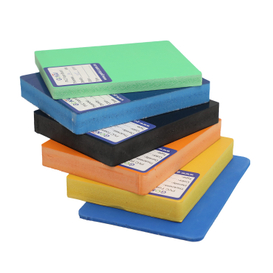
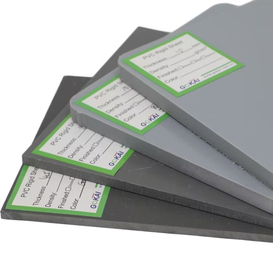
PVC rigid sheets are flat, solid boards available in a wide range of thicknesses, densities, and surface finishes, commonly used for cladding, partition walls, machine guards, printing substrates, and custom fabricated components. Because they are dimensionally stable and easy to thermoform or bond, they have become a go‑to material in construction and industrial manufacturing. [pvc-strip-doors.co]
A clean, accurate cut starts long before the blade touches the material. Below are the basic tools and setup steps that consistently produce better results in the field. [hunker]
You will typically need: [glazingsystems.co]
- Flat, stable workbench or support table
- Tape measure
- Straight‑edge ruler or metal level
- Fine‑tip marker or pen suitable for plastic surfaces
A firm, level support prevents vibration and reduces the risk of chips or wandering cuts, especially with circular saws and oscillating multi‑tools. [youtube]
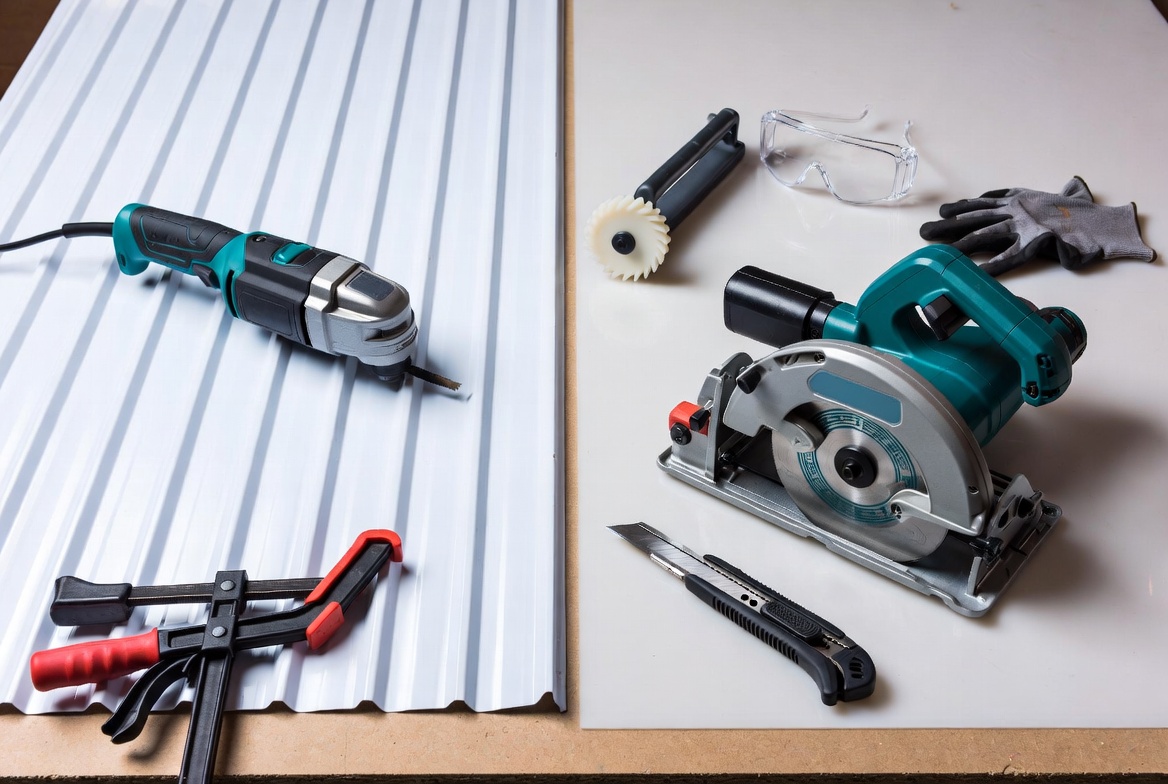
Depending on sheet thickness, corrugation profile, and edge quality requirements, professionals often rely on one or more of these tools: [pvcfoamsheet]
- Sharp utility knife or box cutter
- Dedicated scoring tool for plastics
- Fine‑tooth circular saw (plywood or plastic blade)
- Table saw with fine‑tooth blade for straight panel rips
- Oscillating multi‑tool with semi‑circular fine‑tooth blade
- Handsaw with fine teeth (for small adjustments and cross‑cuts)
- Tin snips for small notches and localized trimming in corrugated panels
For thin corrugated panels and lighter gauge PVC, a sharp knife and scoring technique can be very effective, while thicker PVC rigid sheets usually call for a table saw or circular saw with an appropriate blade. [youtube]
Even experienced installers sometimes underestimate how aggressively plastic shards can fly when cutting corrugated panels or rigid boards. Consistently safe practice keeps projects on schedule and avoids downtime. [acmeplastics]
Always use: [hunker]
- Safety goggles or face shield
- Cut‑resistant gloves
- Dust mask or respirator when making long saw cuts
- Long sleeves and long pants to keep skin covered
These measures limit exposure to fast‑moving chips and fine dust that are typical when cutting PVC and polycarbonate products. [glazingsystems.co]
A dedicated, well‑organized cutting area helps avoid accidental damage to panels and improves accuracy. Aim for: [acmeplastics]
- Plenty of free space around the workbench
- Clear floor with no offcuts where you may trip
- Good lighting to see cut lines and panel orientation
- Clamps or helpers available to hold longer sheets steady
When using power tools, secure the sheet firmly to minimize vibration, which is a primary cause of chipping and blade binding. [youtube]
The basic workflow for cutting corrugated plastic roofing is similar across brands; refinements come from tool choice and panel profile. Below is a method that aligns closely with manufacturer recommendations and roofing contractor practice. [rcaw]
1. Place the corrugated sheet flat on the workbench. [hunker]
2. Measure the required length or width at both edges using a tape measure. [acmeplastics]
3. Mark reference points and connect them with a straight line using your straight‑edge. [hunker]
4. Slide the panel so the marked line is about 1 inch from the bench edge, with offcut material hanging free. [acmeplastics]
If more than about 90 cm to 1 m hangs off the bench, ask a helper to support the offcut end so the panel does not flex while you cut. [glazingsystems.co]
Several methods work well, but each has a preferred use case. [youtube]
- Oscillating multi‑tool with a semi‑circular fine‑tooth blade
- Excellent control, low risk of cracking, ideal for PVC corrugated roofing and brands like Palruf or Suntuf. [youtube]
- Fine‑tooth circular saw
- Effective for long, straight cuts when panels are clamped and well supported, recommended with a carbide or plywood blade. [glazingsystems.co]
- Utility knife and scoring technique
- Best for thinner profiled panels when cutting along the corrugation or trimming width. [youtube]
- Handsaw or tin snips
- Useful for small notches, fitting around posts, or detailed adjustments at the edges. [youtube]
Manufacturers and installers often caution against using coarse‑tooth blades or uncontrolled jigsaws on corrugated plastic sheets due to high vibration and chipping risk. [youtube]
1. Fit a fine‑tooth semi‑circular blade and tighten it securely. [youtube]
2. Set the speed to a higher setting for cleaner cuts. [youtube]
3. Hold the tool at roughly a 45‑degree angle to the sheet, starting from the panel edge. [youtube]
4. Follow your marked line smoothly, letting the blade do the work without forcing it. [youtube]
5. Slow slightly towards the end of the cut to avoid tearing the final section. [youtube]
This method gives excellent control on corrugated PVC and reduces end‑cracking compared with some circular saw approaches. [youtube]
1. Set the saw blade to its full cutting depth. [hunker]
2. Use a fine‑tooth, carbide‑tipped, general‑purpose or plastic‑rated blade. [pvc-strip-doors.co]
3. Hold the blade guard back as you start the cut, then release it once the saw is stable on the sheet. [hunker]
4. Use your free hand or clamps to press the panel firmly against the bench to minimize vibration. [glazingsystems.co]
5. Cut slowly and steadily along the line, continuing just past the panel edge before withdrawing the blade. [glazingsystems.co]
A helper should allow the offcut to drop freely as the cut completes instead of lifting it, which can pinch the blade. [hunker]
After cutting, it is normal to see small burrs or plastic "feathers" along the edge. These can be removed by: [youtube]
- Running a sharp knife lightly along the edge
- Using fine‑grit sandpaper or an emery cloth
- Wearing gloves and gently snapping off loose burrs by hand
Smoother edges are less prone to crack initiation and look more professional on visible roof eaves and fascia transitions. [youtube]
Flat PVC rigid sheets behave differently from corrugated roofing: they support more uniform cuts but can heat up and melt when cut too aggressively. The approach varies by thickness. [pvcfoamsheet]
Before selecting tools, confirm: [pvc-strip-doors.co]
- Nominal thickness (for example, 2 mm, 3 mm, 5 mm, 10 mm)
- Whether the sheet is standard compact PVC or a denser, heavier‑duty grade
- Whether protective film is present on one or both faces
Thin sheets under about 5 mm can often be scored and snapped for straight cuts, while thicker boards are usually cut with a table saw or circular saw. [pvcfoamsheet]
For thin PVC: [pvc-strip-doors.co]
1. Mark your cut line with a fine marker and straight‑edge.
2. Score firmly along the line several times with a sharp utility knife or dedicated plastic scoring tool. [youtube]
3. Position the score line just off the bench edge. [pvc-strip-doors.co]
4. Apply steady pressure to snap the sheet downward along the score. [youtube]
5. Dress the cut edge with fine sandpaper if needed. [youtube]
This method produces clean, chip‑free edges and avoids melted kerfs that sometimes occur with power saws on very thin sheets. [pvc-strip-doors.co]
For thicker PVC rigid sheets: [pvcfoamsheet]
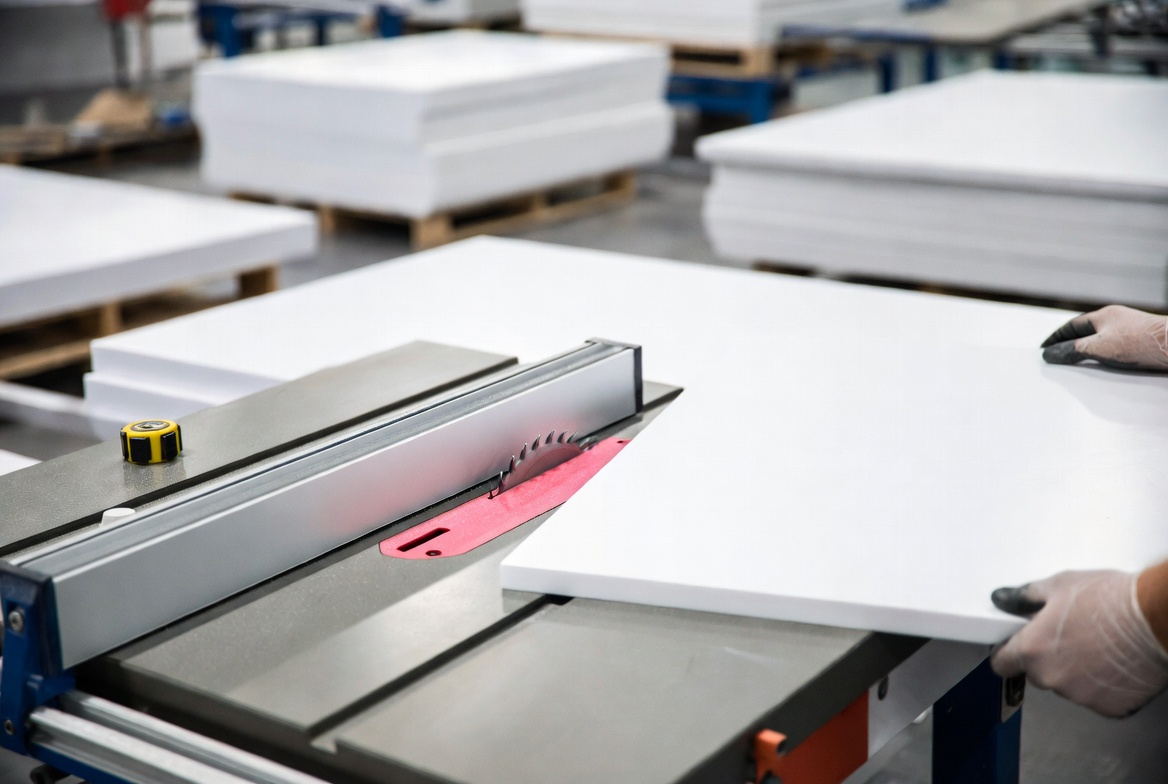
- Table saw
- Ideal for repeatable, straight cuts in production settings. [pvcfoamsheet]
- Circular saw
- Suitable for on‑site trimming and longer cuts where a table saw is not practical. [pvcfoamsheet]
Key techniques:
- Use a fine‑tooth blade designed for plastics or a high‑tooth‑count wood blade. [pvc-strip-doors.co]
- Keep feed speed moderate to avoid excessive heat build‑up and edge melting. [pvcfoamsheet]
- Support the sheet fully to prevent vibration, especially on larger panels. [pvc-strip-doors.co]
When possible, leave the protective film on the sheet faces during cutting to reduce surface scratching near the cut line. [pvcfoamsheet]
On industrial and architectural projects, tolerance on panel size can be tight. To keep cuts accurate: [pvc-strip-doors.co]
- Use a long, rigid fence or guide rail when ripping sheets
- Verify your saw is square before a production run
- Make a test cut on an offcut and measure both diagonals for squareness
A small upfront calibration can prevent misaligned joints and gaps further down the assembly line or during installation. [pvcfoamsheet]
Many issues seen in user feedback on plastic roofing and PVC sheets trace back to a handful of recurring mistakes. Recognizing these failure modes helps you achieve more predictable, professional results. [acmeplastics]
- Cracked panel ends after cutting
- Often caused by coarse‑tooth blades, high vibration, or forcing a jigsaw. Use fine‑tooth blades, oscillating tools, and firm support. [youtube]
- Melted or discolored edges on PVC sheets
- Usually from excessive blade speed or too slow a feed rate that overheats the kerf. Adjust speed, use suitable blades, and allow cooling between long cuts. [pvc-strip-doors.co]
- Wandering cuts and misalignment
- Caused by weak marking, no straight‑edge, or moving panels. Use clear lines, clamps, and guide fences. [acmeplastics]
- Chipping and rough edges
- Linked to vibration, dull blades, or unsupported offcuts. Maintain sharp tools and ensure both sides of the cut are well supported. [youtube]
Thinking in terms of vibration control, heat management, and blade selection will prevent most quality issues with both corrugated and flat PVC materials. [glazingsystems.co]
Real‑world applications often involve more than a simple straight cut. Below are scenarios that frequently arise in carports, pergolas, small industrial shelters, and fabrication workshops. [rcaw]
When cutting corrugated panels to align with rafters or purlins, measure from the centerline of the supporting member and transfer that dimension to your panel. Account for required overhangs at the eave and ridge according to the roofing system guidance. [acmeplastics]
Where a proprietary flashing system is used, some manufacturers recommend cutting at the center of a trough or specific profile location so flashings engage correctly. [youtube]
For posts, pipes, or other penetrations: [hunker]
- Mark the opening on the panel carefully with both width and height.
- Rough‑cut the shape with an oscillating multi‑tool or fine‑tooth handsaw.
- Refine the fit gradually, checking often rather than removing too much material at once.
This approach reduces the risk of stress concentrations that could lead to cracking from tight, sharply‑angled corners. [glazingsystems.co]
In workshops handling small runs of PVC components, consistency matters almost as much as edge quality. Consider: [pvcfoamsheet]
- Creating a dedicated cutting jig or stop blocks on a table saw for repeat parts
- Labeling each sheet face and orientation before cutting to coordinate later machining or printing
- Grouping cuts by thickness so blade setup is optimized for each batch
These practices reduce rework and wasted material, especially when parts must align with CNC‑cut or thermoformed components later in the process. [pvc-strip-doors.co]
The table below summarizes commonly used tools by material type and typical thickness. [youtube]
| Material / Situation | Preferred tool or method | Notes on use |
|---|---|---|
| Thin corrugated PVC roofing, straight length cuts | Oscillating multi‑tool, utility knife | Excellent control, low cracking risk. (youtube) |
| Corrugated roofing, long straight panel reduction | Fine‑tooth circular saw | Clamp well and cut slowly. (acmeplastics) |
| Corrugated roofing, small notches or cut‑outs | Oscillating multi‑tool, tin snips | Ideal around posts and edges. (hunker) |
| PVC rigid sheet under about 5 mm | Scoring with knife and snapping | Clean, chip‑free straight cuts. (youtube) |
| PVC rigid sheet above about 5 mm, straight cuts | Table saw with fine‑tooth blade | Best for repeatable accuracy. (pvc-strip-doors.co) |
| PVC rigid sheet, on‑site trimming without table saw | Circular saw with plastic‑rated blade | Support well and avoid overheating. (pvc-strip-doors.co) |
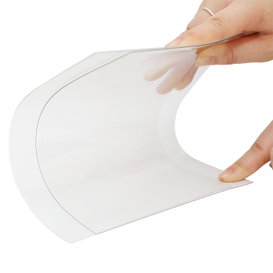
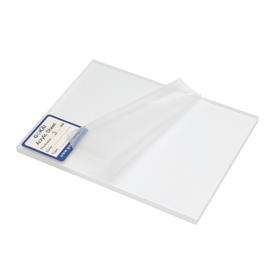
| Mixed plastics (polycarbonate, acrylic, multi‑wall sheets) | Knife scoring, handsaw, oscillating tool | Method depends on profile and thickness. (youtube) |
Once all cuts are complete, a brief inspection pays off during installation. Take a moment to: [acmeplastics]
- Confirm panel sizes against your plan or structure dimensions
- Check that cut edges are free from large burrs or cracks
- Verify that protective films are removed only at the right stage of installation
- Clean off dust and chips, especially near joints and fastener lines
These simple checks help panels seat properly on rafters, purlins, frames, or substrate boards, and reduce the chance of leaks or misalignments later. [hunker]
Q1: What is the easiest way for a beginner to cut corrugated plastic roofing without cracking it?
For most beginners, an oscillating multi‑tool with a fine‑tooth semi‑circular blade and a clearly marked cut line is one of the most forgiving methods because it offers good control and low vibration. [youtube]
Q2: Can a standard wood circular saw blade be used on PVC rigid sheets?
A high‑tooth‑count wood blade can work, but blades designed for plastics or fine plywood usually deliver smoother edges and less heat build‑up, especially on thicker PVC boards. [hunker]
Q3: How do I avoid melting the edge when cutting thick PVC sheets?
Use a sharp, fine‑tooth blade, keep feed speed steady but not too slow, and allow short pauses between long cuts so the material and blade can cool slightly. [pvcfoamsheet]
Q4: Is scoring and snapping reliable for all plastic roofing and sheet types?
Scoring and snapping is reliable mainly for thinner, flat or lightly profiled plastics; heavily corrugated panels and thick boards typically require saws or oscillating tools for consistent results. [youtube]
Q5: Do I need to support the offcut side when cutting long roofing panels?
Yes, supporting the offcut on longer panels reduces flex, lowers vibration, and helps keep the cut straight, especially when using power saws. [glazingsystems.co]
1. Acme Plastics – "How to Cut Corrugated Plastic Roofing (or PVC Roofing)" (accessed 2025‑07‑06) – <https://www.acmeplastics.com/content/how-to-cut-corrugated-plastic-roofing-or-pvc-roofing/> [acmeplastics]
2. Hunker – "How To Cut Corrugated Plastic Roofing" – <https://www.hunker.com/13401186/how-to-cut-corrugated-plastic-roofing/> [hunker]
3. Glazing Systems – "How to Cut Corrugated Plastic Roofing: Expert's Guide" – <https://www.glazingsystems.co.uk/how-to-cut-corrugated-plastic-roofing/> [glazingsystems.co]
4. PVC Strip Doors – "Guide to Cutting PVC Sheets Over and Under 5 mm" – <https://www.pvc-strip-doors.co.uk/news/post/proper-ways-to-cut-pvc-sheet> [pvc-strip-doors.co]
5. Goldensign Industry Co., Ltd. – "How To Cut Thick PVC Rigid Sheets Easily?" – <https://www.pvcfoamsheet.com/How-To-Cut-Thick-PVC-Rigid-Sheets-Easily-id49951536.html> [pvcfoamsheet]
6. Clear Amber – "How to Cut Corrapol Corrugated Plastic Sheets" (video and guide) – <https://www.clearamber.com/news/134/How-to-Cut-Corrapol-Corrugated-Plastic-Sheets.html> [youtube]
7. Sunnyside Outdoor Roofing and Shade – "How to cut plastic roofing with a knife (polycarbonate, acrylic, multi-wall)" – <https://sunnyside.co.nz> [youtube]
8. Cutting PVC roof panels with oscillating tools (user installation video) – <https://www.youtube.com/watch?v=Yrire-bohLA> [youtube]