Shanghai Gokai Industry Co,.Ltd.
Call Us: +86-18918606548
Call Us: +86-18918606548
- Product Name
- Product Keyword
- Product Model
- Product Summary
- Product Description
- Multi Field Search
Views: 268 Author: Gokai Publish Time: 2026-07-16 Origin: Site


Content Menu
● Understanding Acrylic Sheet Before You Cut
● Core Tools and Methods for Cutting Acrylic
>> Straight cuts on thin acrylic (up to about 1/4 inch / 6 mm)
>> Straight cuts on thick acrylic (above 1/4 inch)
● Cutting Curves, Cut‑outs, and Complex Shapes
● Safety and Handling Practices Professionals Don't Compromise On
● Technique Comparison: Choosing the Right Method
● Avoiding Common Acrylic Cutting Problems
● When It Makes Sense to Order Cut‑to‑Size Acrylic
● Best Practices for Finishing and Edge Quality
● FAQs
Cutting acrylic sheet cleanly and safely is absolutely achievable at home, as long as you match the right tool and technique to the thickness, cut type, and project requirements. This guide combines hands‑on fabrication experience with current industry best practices for working with acrylic sheet (often called plexiglass) so you can avoid cracks, melting, and costly waste. [sendcutsend]
Acrylic sheet behaves very differently from wood or metal, and that's the first thing a new DIYer or fabricator needs to internalize. It is a rigid thermoplastic: it is strong and crystal‑clear, but it softens with heat and chips easily if the wrong blade or feed rate is used. [acplasticsinc]
From years of working with signage makers, OEM fabricators, and hobbyists, three factors determine the best cutting method for acrylic sheet:
- Sheet thickness and size. [usplastic]
- Whether you need straight cuts or curves and cut‑outs. [youtube]
- The finish quality required (rough utility edge vs. polished display edge). [edgemills]
For global customers sourcing acrylic sheet from suppliers like Gokai, getting this right means fewer rejected panels, faster assembly, and much lower finishing time on site. [caamatech]

For sheets up to roughly 1/4 inch thick, the most approachable method is a dedicated scoring tool or heavy‑duty utility knife used with a straight edge. This is particularly useful for DIY window panels, small guards, and simple rectangular pieces. [theplasticpeople.co]
Key steps for scoring and snapping:
1. Keep the protective film on the sheet during cutting to avoid surface scratches and chips. [sendcutsend]
2. Clamp the sheet firmly with a metal or wood straight edge aligned exactly along the intended cut line. [theplasticpeople.co]
3. Use a sharp scoring tool (acrylic cutter) or high‑quality box cutter to make multiple passes until the groove is at least 1/8 inch deep. [acplasticsinc]
4. Flip and score from the opposite side for a cleaner break on thicker thin sheets. [sendcutsend]
5. Clamp along the score line and apply firm, even downward pressure to snap the waste piece away. [acplasticsinc]
This method is quiet, low‑cost, and ideal when you have limited tools, but it is best reserved for straight cuts on thinner panels and non‑critical edges. [sendcutsend]
Once you move into thicker sheet for glazing, machine guards, and display construction, the most reliable approach is a table saw or panel saw equipped with the correct blade. Industry suppliers and fabrication shops overwhelmingly use: [usplastic]
- Overhead or below‑table panel saws for large panels. [usplastic]
- Table saws with carbide‑tipped, triple‑chip blades designed for plastics. [edgemills]
Practical guidelines that come directly from production environments:
- Use blades with closely spaced teeth; thin sheets need more teeth per inch than thicker sheets to reduce chipping. [theplasticpeople.co]
- Support the sheet with foam or sacrificial board to reduce vibration, which can cause cracks. [theplasticpeople.co]
- Maintain a steady feed rate: cutting too slowly builds heat and can melt the acrylic, while forcing the cut can chip the edges. [edgemills]
- Avoid using worn blades on acrylic; dull teeth dramatically increase the risk of edge damage and stress cracking. [acplasticsinc]
For OEM customers, this is typically how cut‑to‑size panels are produced before shipment, ensuring consistent fits in assemblies and frames. [caamatech]

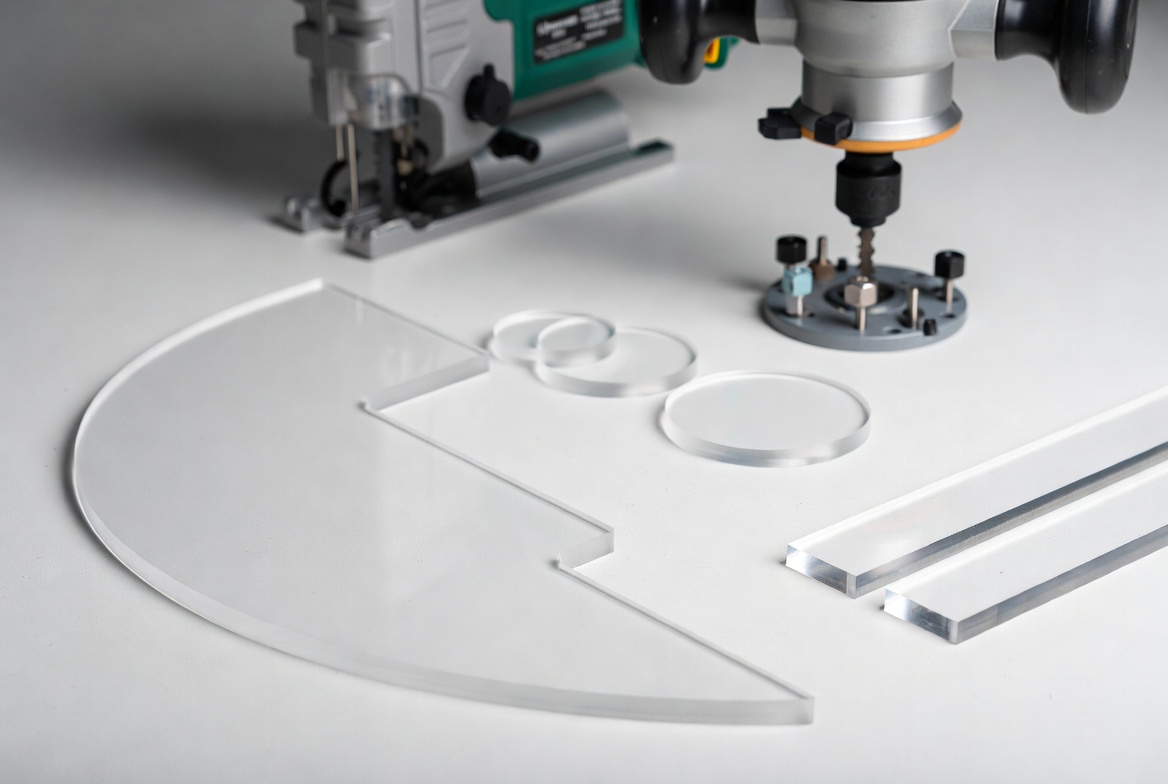
Straight cuts are only part of acrylic fabrication. Circular windows, machine guards, retail fixtures, and decorative elements often demand curved or irregular shapes. [youtube]
Common tools for these applications include:
- Jigsaws with fine, metal‑cutting or dedicated plastic blades for curves in sheets up to ~6 mm. [usplastic]
- Routers for smooth internal cut‑outs, pattern routing, and edge profiling. [acplasticsinc]
- Rotary tools (such as Dremel) and oscillating multitools for tight spaces or field modifications, when used with appropriate plastic‑rated bits. [youtube]
When cutting curves:
- Carefully mark your layout and, where possible, tape along the cut line to reduce chipping. [sendcutsend]
- Clamp the sheet with solid backing to control vibration. [theplasticpeople.co]
- Use a gentle feed and let the blade do the work; twisting or forcing the tool sideways can instantly crack the material. [youtube]
- Allow blades to stop fully before withdrawing from the cut to prevent surface scratches and edge gouges. [edgemills]
For repeated shapes or high‑volume production, many fabricators will rough‑cut on a saw and then finish to final dimension on a router table or CNC router to achieve tight tolerances. [usplastic]
In professional shops, cutting acrylic sheet is treated like any other machining operation: safety and process control come first. Acrylic dust and chips, along with vapor released by friction and heat, can irritate eyes and the respiratory system, which drives several non‑negotiable practices. [youtube]
Essential precautions include:
- Eye protection: safety glasses or face shields when using any power tool, saw, or rotary cutter. [youtube]
- Hearing protection when working with table saws, jigsaws, and routers at prolonged duty cycles. [edgemills]
- Work in a well‑ventilated area to avoid vapors and dust accumulation. [sendcutsend]
- Avoid flammable lubricants or aerosols; use water mist, air, or properly formulated coolants if cooling is required. [theplasticpeople.co]
Professionals are also careful about heat: acrylic begins to soften at relatively low temperatures, so managing friction is crucial. That is why they use appropriate blade geometries, steady feed rates, and coolants when necessary to keep cut edges stable and dimensionally accurate. [usplastic]
To make decisions easier, here is a concise view of typical methods and when they are used in practice. [acplasticsinc]
| Method | Best for | Typical thickness range | Edge quality | Skill level |
|---|---|---|---|---|
| Scoring and snapping | Simple straight cuts, small panels | Up to about 1/4 inch | Functional, may need light sanding | Beginner |
| Table / panel saw | Large panels, precise straight cuts | Thin to very thick sheets | Clean, consistent; can be finished to high quality | Intermediate to professional |
| Jigsaw | Curves, small openings, field work | Up to ~6 mm recommended | Variable; smoother with fine blades | Intermediate |
| Router / CNC | High precision, repeatable parts, profiles | Wide thickness range | Excellent, recommend for finishing | Professional |
| Rotary tool / multitool | Small cut‑outs, tight spaces, DIY modifications | Thin to medium sheets | Localized; good when used carefully | Intermediate DIY |
In OEM contexts, a common workflow is rough‑cutting large sheets on a panel saw and then routing edges or openings to final dimension before packing and shipment. [caamatech]
Based on shop floor experience and documented fabrication guides, most acrylic failures trace back to a handful of causes. Being aware of these issues helps prevent waste and delays. [edgemills]
Frequent problems and their practical remedies:
- Chipped or jagged edges: often caused by blades with too few teeth or worn cutting edges. Choosing fine‑toothed, sharp blades and stabilizing the sheet drastically improves edge quality. [acplasticsinc]
- Cracks propagating from cut edges: usually linked to uncontrolled vibration or excessive mechanical stress during cutting. Solid clamping and backing material minimize this risk. [sendcutsend]
- Melted edges and rough, cloudy surfaces: a sign of excess heat because of slow feed rates, dull blades, or lack of cooling. Adjusting speed, using suitable blades, and adding coolant prevent heat‑related distortion. [theplasticpeople.co]
- Misaligned or out‑of‑square cuts: commonly the result of cutting freehand without guides. Straight edges, fences, and templates are standard in professional shops to achieve repeatable accuracy. [sendcutsend]
For customers who will later glue acrylic edges or fit panels into tight housings, these refinements have a direct impact on assembly time and long‑term durability. [caamatech]
Even experienced fabricators know that not every project is worth cutting on site. Large runs, complex layouts, and parts that must fit critical tolerances are often better sourced as cut‑to‑size acrylic sheet from specialized suppliers. [caamatech]
In practice, choosing cut‑to‑size material can help when:
- You are managing a multi‑site installation and need identical panels for all locations. [caamatech]
- You require polished edges or laser‑quality cuts for display, lighting, or architectural features. [acrylicleasinder]
- Your team lacks access to panel saws, routers, or CNC equipment and would otherwise rely on improvised tools. [youtube]
Suppliers focused on acrylic sheet and OEM support can deliver pre‑cut components that arrive ready for installation or assembly, which is often more economical than maintaining full fabrication capability at every end‑user site. [acrylicleasinder]
After cutting, the difference between a utility panel and a display‑grade part is often in the finishing. Even when using excellent blades, most edges benefit from some refinement. [edgemills]
Common finishing steps:
- Light sanding with fine‑grit sandpaper or sanding blocks to remove minor chips and tool marks. [acplasticsinc]
- Progressive sanding for high‑visibility edges, moving from coarse to fine abrasives. [edgemills]
- Optional polishing via flame polishing or buffing for applications where edge clarity is important, such as displays and illuminated signage. [acrylicleasinder]
Care must be taken to avoid overheating during finishing as well, since concentrated heat can induce stress and micro‑cracking that only becomes visible later in service. [theplasticpeople.co]
Q1. Can I cut acrylic sheet with the same blade I use for wood?
Yes, many wood‑rated blades can cut acrylic, but blades specifically designed for plastics with a triple‑chip grind and tighter tooth spacing provide a cleaner, safer result and last longer when used only on acrylic. [usplastic]
Q2. What is the simplest method for a first‑time DIY user?
For thin panels, scoring and snapping with a dedicated acrylic cutter or robust utility knife guided by a straight edge is the most approachable method and requires minimal equipment. [sendcutsend]
Q3. How do I avoid my acrylic sheet cracking while I cut curves?
Use a fine‑toothed blade in a jigsaw or router, clamp the sheet firmly to reduce vibration, follow marked lines steadily, and avoid forcing the tool through tight turns. [youtube]
Q4. Why does my acrylic sometimes melt and fuse back together behind the blade?
Excess heat from slow feed rates, dull blades, or inadequate cooling can cause the plastic to soften and smear; increasing cutting speed slightly, switching to sharper blades, and using air or liquid coolants where appropriate alleviates this. [theplasticpeople.co]
Q5. When should I ask a supplier for cut‑to‑size acrylic instead of cutting myself?
If you need large numbers of identical parts, high‑tolerance dimensions, or display‑grade edges and do not have access to dedicated panel saws or routers, ordering cut‑to‑size material from a specialist supplier is often more efficient and cost‑effective. [caamatech]
- [How Do You Cut Plexiglass Acrylic Plastic? – Acme Plastics]
- [How to Cut Acrylic Sheets – A&C Plastics]
- [What Do I Use to Cut Acrylic? – U.S. Plastic Corp.]
- [How To Cut Acrylic – The Plastic People]
- [How to Cut Acrylic Sheet Without Cracks or Melting – Edgemills]
- [Ultimate Guide for Cutting Acrylic Sheets – Caamatech]
- [Tools to Cut Acrylic & Shaping Perspex – Acrylicsider]
- [How to Cut Acrylic Sheets Like a Pro – SendCutSend]
- [5 Ways to Cut Acrylic & Perspex Sheets – The Plastic People]
- [Best Tool for Cutting Plexiglass Acrylic Sheets – Tool Test Video]