Shanghai Gokai Industry Co,.Ltd.
Call Us: +86-18918606548
Call Us: +86-18918606548
- Product Name
- Product Keyword
- Product Model
- Product Summary
- Product Description
- Multi Field Search
Views: 222 Author: Gokai Publish Time: 2026-05-28 Origin: Site


When engineers, fabricators, and buyers search for the best clear plastics, they are rarely looking for a single "winner" material. They are balancing impact strength, optical clarity, regulatory requirements, machining options, and total lifetime cost for a specific application. [youtube]
From my work advising global buyers and OEM customers on acrylic sheet (PMMA) and other clear materials, the same pattern repeats: projects succeed or fail not only on design, but on whether the substrate matches the real working environment. This expert guide walks through the strengths and trade-offs of acrylic, polycarbonate, PETG, and clear PVC, then adds practical selection frameworks, real-world examples, and OEM-focused tips to help you make confident decisions for your next project. [yngguang.com]
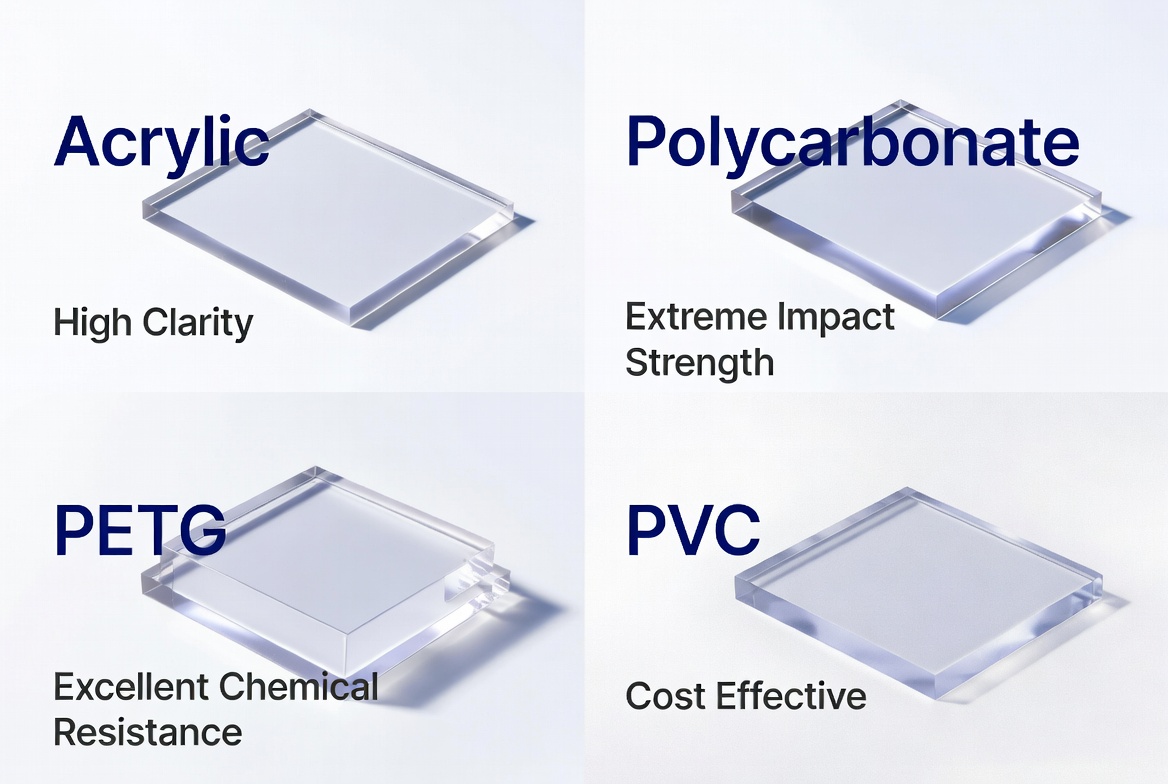
Clear plastics show up in virtually every modern environment: from shopfront glazing and machine guards to medical devices and food processing lines. Choosing properly can: [youtube]
- Enhance design flexibility by allowing bending, thermoforming, and precision machining that would be difficult or dangerous with glass. [youtube]
- Improve visual merchandising through higher light transmission, color stability, and anti-glare options for signage and retail displays. [youtube]
- Support compliance in regulated spaces such as food contact, clean rooms, or flame-rated construction areas. [youtube]
- Reduce maintenance costs via better scratch resistance, chemical resistance, or outdoor weatherability. [youtube]
Acrylic sheet, often known as PMMA or plexiglass, is a rigid, optically clear plastic widely used as a lighter, safer alternative to glass. For signage, displays, and architectural features, it offers a compelling balance of appearance, machinability, and cost. [uvacrylic]
Core advantages of acrylic sheet include: [youtube]
- Outstanding transparency and light transmission, ideal for display cases and illuminated signage.
- Roughly half the weight of glass with far better shatter resistance, helping reduce handling and installation risks.
- Approximately seventeen times stronger than glass in impact strength, while often more cost-effective than specialty glass.
- Excellent UV and moisture resistance, which helps reduce yellowing under outdoor exposure.
- Better surface scratch resistance than polycarbonate in uncoated form.
- Easy to cut, drill, rout, bond, and thermoform, which is invaluable for OEM fabrication.
However, acrylic is more brittle than polycarbonate and can crack under very high impacts or repeated abuse. In harsh industrial or security settings, this limits its use unless properly supported or over-dimensioned. [youtube]
Acrylic's combination of clarity and rigidity makes it a first-choice material in: [youtube]
- Aquariums and large display tanks
- Advertising displays and POS units
- Teller and transaction windows
- Indoor and outdoor signage
- Retail display cases and covers
- Recreational vehicle windshields and canopies
- Office and public-space safety partitions
Key industries that rely heavily on acrylic include sign and graphics, security and safety, building and construction, and transportation. [uvacrylic]
From an OEM and global sourcing perspective, acrylic sheet offers:
- Wide thickness and color ranges suitable for branding and design flexibility. [gokai.com]
- Compatibility with downstream processes such as CNC machining, printing, UV bonding, and thermoforming. [uvacrylic]
- Stable supply from specialized manufacturers who can support OEM and custom-cut services at scale. [yngguang.com]
For example, a retail fixture OEM can standardize on clear cast acrylic for premium display cases, then order cut-to-size panels and custom color runs to align with different global brand programs. [yngguang.com]
Polycarbonate (PC) is known for exceptional toughness and is often selected where failure would be dangerous or extremely costly. It is up to 200 times stronger than glass and about 30 times stronger than acrylic, giving it near-unbreakable performance in many real-world conditions. [youtube]
Key benefits include: [youtube]
- High impact resistance, even at low temperatures and in demanding environments.
- Ability to withstand elevated service temperatures and harsh weather conditions.
- It does not shatter like glass or crack as easily as other plastics under stress.
- Easy to machine and thermoform for complex shapes or protective housings.
- Suitable for applications requiring both visibility and high mechanical strength; coatings can add UV and flame resistance.
Trade-offs you must account for:
- Uncoated polycarbonate is relatively soft and prone to scratching, which can limit its aesthetic life in exposed conditions. [youtube]
- Higher material cost compared with acrylic and PETG. [youtube]
- Requires UV stabilization for long-term outdoor use to avoid yellowing or degradation. [youtube]
Polycarbonate is widely used in: [youtube]
- Skylights and architectural windows
- Safety glazing and machine guarding
- Protective barriers for industrial lines and public facilities
- Medical device housings and protective covers
- Riot shields and security screens
- High-performance outdoor signage and displays
Typical sectors include security and safety, building and construction, and performance glazing for heavy-duty environments. [youtube]
PETG offers a middle ground between acrylic and polycarbonate, combining good clarity with higher impact resistance than acrylic and lower cost than polycarbonate. This makes it attractive for projects that need toughness, thermoforming ease, and regulatory compliance without the highest-level mechanical performance. [youtube]
Key PETG advantages: [youtube]
- Durable with FDA-approved grades, making it appropriate for food contact applications.
- Excellent chemical resistance, crucial for environments with frequent cleaning or chemical exposure.
- Higher impact resistance than standard acrylic at similar thickness.
- Generally more cost-effective than polycarbonate for many OEM parts.
- Very easy to fabricate and thermoform, and it can be cold bent without stress whitening, supporting fast assembly.
- Strong under pressure and less likely to crack during forming or impact.
Consider that PETG:
- Has a softer surface and can scratch more easily than acrylic. [youtube]
- May become tacky during cutting or machining if tooling and feeds are not optimized. [youtube]
- Is less rigid than acrylic, so thicker gauges or structural support might be needed. [youtube]
You will commonly see PETG used for: [youtube]
- Retail display cases and shelving
- Signage and stand-off graphics
- POP displays for consumer goods
- Safety shields and light-duty machine guards
- Food storage bins and dispensers
- Medical components and certain implants
- Transparent packaging materials
Industries favoring PETG include food processing, medical, packaging, and general industrial environments where both clarity and durability are important. [youtube]
Clear PVC is best known as an industrial-grade plastic with strong chemical resistance and good mechanical properties. It is available in both rigid and flexible grades, allowing it to serve in everything from clear tubing to protective curtains. [youtube]
Key advantages of clear PVC: [youtube]
- Durable, lightweight, and typically cost-effective compared with many engineering plastics.
- Excellent resistance to a broad range of chemicals, making it suitable for chemical processing lines.
- Fire and mold-resistant formulations are available for demanding environments.
- Easy to thermoform and shape, including in flexible formats.
- Strong mechanical performance for enclosures, panels, and tubing.
- Can be machined to relatively tight tolerances for industrial parts.
Trade-offs include:
- Lower heat resistance and a relatively low maximum continuous service temperature. [youtube]
- Potential for yellowing over time under strong UV exposure, especially outdoors. [youtube]
> Suggested visual: clear PVC tubing and a transparent enclosure in a laboratory or industrial setting.
Typical applications: [youtube]
- Aquariums and hydroponics systems
- Fluid transfer tubing and hoses
- Protective observation barriers and machine curtains
- Industrial enclosures and covers
- Signage and simple displays
- Packaging, covers, and sleeves
Core industries include industrial processing, building and construction, chemical manufacturing, and medical environments where chemical compatibility is critical. [youtube]
The table below summarises the core property differences between the major clear plastics discussed in this guide. [youtube]
| Property | Acrylic | Polycarbonate | PETG | PVC |
|---|---|---|---|---|
| Impact strength | Moderate youtube | Excellent youtube | Good youtube | Fair youtube |
| Optical clarity | Excellent youtube | Very good youtube | Good youtube | Good youtube |
| Scratch resistance | Excellent youtube | Low unless coated youtube | Fair youtube | Good youtube |
| UV resistance | Excellent youtube | Fair with additives youtube | Fair youtube | Low youtube |
| Temperature range | Medium youtube | High youtube | Low youtube | Low youtube |
| Fabrication | Easy to machine and polish youtube | Easily molded youtube | Easy to thermoform youtube | Easy to cut and thermoform youtube |
| Relative cost | Moderate youtube | High youtube | Moderate youtube | Low youtube |
For most projects, you will narrow down material choice by weighting impact performance, clarity, regulatory needs, and budget against this kind of comparison. [youtube]
Using a consistent framework helps you move from "I need a clear plastic" to a specific material and specification. [chatgpt-undetected]
1. Define primary performance goal
Decide what matters most: impact resistance, optical clarity, chemical resistance, cost, or regulatory compliance. [youtube]
2. List environmental conditions
Note exposure to UV, cleaning chemicals, operating temperature, and mechanical loads. [youtube]
3. Confirm regulatory and safety requirements
Identify required approvals such as FDA food contact, flame ratings, or industry-specific standards. [youtube]
4. Assess fabrication and OEM processes
Align material choice with cutting, machining, bonding, printing, and forming capabilities available in your supply chain. [yngguang.com]
5. Run a cost–lifetime analysis
Compare not only initial material prices but also expected service life, maintenance effort, and replacement costs. [semantecseo]
6. Engage a material specialist early
Bringing in an experienced plastics supplier or OEM partner at the design stage often prevents over-specification and unnecessary redesign. [uvacrylic]
- Retail brand upgrading store fixtures:
They may switch from glass to acrylic sheet for lighter installations and safer handling, while using PETG in high-traffic areas where occasional impact is expected. [uvacrylic]
- Industrial machine builder:
For critical guards near moving parts, polycarbonate is selected for its extreme impact resistance, with clear PVC curtains used around secondary splash zones for chemical protection. [youtube]
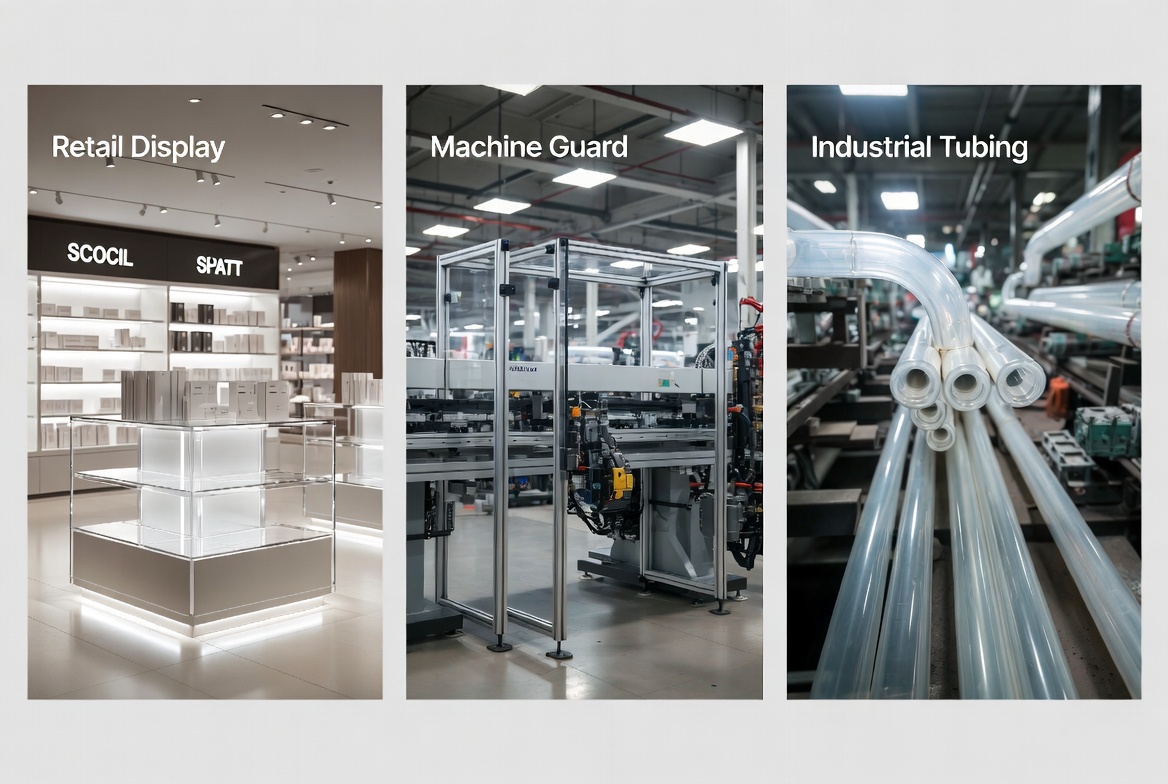
Many clear-plastic projects move beyond standard stock sizes into custom dimensions, colors, or machining requirements. This is where partnering with a dedicated acrylic and plastics OEM supplier becomes essential. [gokai.com]
A specialized OEM partner can:
- Provide cast and extruded acrylic sheets in a wide range of thicknesses, tints, and finishes, tailored to your design brief. [gokai.com]
- Offer integrated machining services such as cutting, bending, polishing, coating, gluing, thermal forming, and CNC machining to deliver finished or semi-finished parts. [uvacrylic]
- Support OEM and ODM projects with engineering input, material selection guidance, and confidentiality throughout the design-to-production cycle. [cnplasacrylic]
- Export reliably to global markets, aligning with local regulations and logistical requirements across Asia, Europe, the Americas, and the Middle East. [yngguang.com]
For buyers managing multi-country rollouts, a single OEM-oriented partner simplifies quality control, documentation, and long-term support. [yngguang.com]

You should involve a plastics specialist or OEM partner early when:
- Your project involves safety-critical glazing, machine guarding, or public-facing barriers. [youtube]
- Multiple materials (acrylic, PC, PETG, PVC) appear viable and you need to understand lifecycle trade-offs. [youtube]
- The application includes complex forming, bonding, or printing requirements that interact with material choice. [semantecseo]
Experienced teams with deep material knowledge can typically reduce design risk, cut prototyping cycles, and suggest cost-saving alternatives that still meet performance requirements. [yngguang.com]
If you are planning a new project or reviewing existing designs, reach out to a dedicated acrylic and plastics OEM supplier to discuss your requirements, drawings, and volume expectations. A brief engineering consultation can quickly confirm whether acrylic, polycarbonate, PETG, or PVC is the best clear plastic for your application and what optimizations may be available in thickness, finish, or fabrication. [gokai.com]
1. Which clear plastic is best for impact resistance?
Polycarbonate offers the highest impact resistance, rated up to 200 times stronger than glass and about 30 times stronger than acrylic in many tests. [youtube]
2. Is acrylic sheet suitable for outdoor use?
Yes, high-quality acrylic has excellent UV and moisture resistance, making it a strong choice for outdoor signage, glazing, and architectural features with good long-term clarity. [youtube]
3. When should I choose PETG over acrylic or polycarbonate?
PETG is ideal when you need better impact resistance than acrylic, easier forming and cold bending, and lower cost than polycarbonate, particularly in displays, guards, and packaging. [youtube]
4. Why is clear PVC popular in industrial environments?
Clear PVC combines good mechanical strength with strong chemical resistance and cost-effectiveness, making it well-suited for tubing, curtains, and enclosures in chemical and industrial settings. [youtube]
5. Can one supplier handle OEM projects across different clear plastics?
Many specialized plastics manufacturers now provide acrylic, polycarbonate, PETG, and PVC along with OEM/ODM machining services, enabling them to support multi-material projects from design through production. [cnplasacrylic]
1. Piedmont Plastics – "A Guide to the Best Clear Plastics" (acrylic, polycarbonate, PETG, PVC properties and comparison table). [Link] [youtube]
2. Yng Guang Acrylic – "Cast Acrylic Sheet Manufacturer – Yng Guang Acrylic Taiwan" (OEM/ODM acrylic sheet positioning, global applications). [Link] [yngguang.com]
3. Gokai – "Acrylic Sheet – All Products" (acrylic sheet supplier information and contact). [Link] [gokai.com]
4. CHINAPLAS – "OEM & ODM Acrylic and ABS Sheets" (OEM/ODM services and custom sheet capabilities). [Link] [cnplasacrylic]
5. UVACRYLIC – "About Us – Global Supplier of Acrylic" (integrated machining, OEM services, and global export experience). [Link] [uvacrylic]
6. SemantecSEO – "Rewrite for Clarity: Make SEO Content Easier to Understand" (guidance on clarity, structure, and user-centric SEO content). [Link] [semantecseo]
7. Kasra Dash – "How I Rewrite Old Content to Hit #1" (SERP-aligned headings and rewrite frameworks). [Link] [youtube]