Shanghai Gokai Industry Co,.Ltd.
Call Us: +86-18918606548
Call Us: +86-18918606548
- Product Name
- Product Keyword
- Product Model
- Product Summary
- Product Description
- Multi Field Search
Views: 222 Author: Gokai Publish Time: 2026-05-30 Origin: Site


Content Menu
● Key Properties of PETG Sheet
>> Mechanical and Thermal Performance
>> Optical and Surface Characteristics
>> Chemical and Food Contact Performance
● PETG Sheet vs Acrylic vs Polycarbonate
● Gokai PETG Sheet Product Profile
>> Standard Sizes and Thickness
● Real‑World Applications of PETG Sheet
>> Protective Guards, Trays and Machine Components
>> Packaging and Medical‑Adjacent Uses
● Processing PETG Sheet: Practical Tips from the Floor
>> Thermoforming and Deep Draw
● Limitations of PETG Sheet and How to Mitigate Them
● How to Specify the Right PETG Sheet for Your Project
>> Step‑by‑Step Selection Checklist
● Why OEM Brands Partner with Gokai for PETG Sheet
● Call to Action – Partner with Gokai for Your Next PETG Sheet Project
>> 1. Is PETG sheet suitable for food contact applications?
>> 2. Can PETG sheet be used outdoors?
>> 3. How does PETG compare to acrylic in impact resistance?
>> 4. What thickness of PETG sheet should I select for a machine guard?
>> 5. Is PETG easy to thermoform for deep trays and complex displays?
As a PETG sheet supplier working with OEM customers worldwide, I have seen PETG move from a "nice alternative" to a strategic material for brands that need clear, tough and easily formed plastic sheet. In this guide, I'll break down how PETG really performs on the production floor, where it outperforms acrylic and polycarbonate, and how you can specify the right PETG sheet for your next project. [lairdplastics]

PETG (Polyethylene Terephthalate Glycol) is a thermoplastic polyester in the PET family that has been modified with glycol to prevent brittleness and crystallization during processing. This seemingly small molecular change gives PETG sheet a rare combination of high impact strength, clarity, chemical resistance and easy thermoforming. [twi-global]
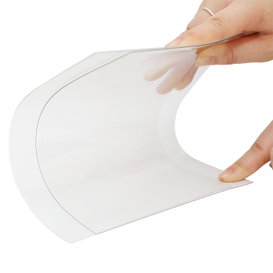
From a processor's perspective, PETG can be vacuum-formed, pressure-formed, heat bent, die cut, routed and drilled without stress whitening or cracking, even in deeper draws. Compared with standard PET, the glycol modification makes the sheet easier to bend and form while maintaining optical clarity and toughness. [lairdplastics]
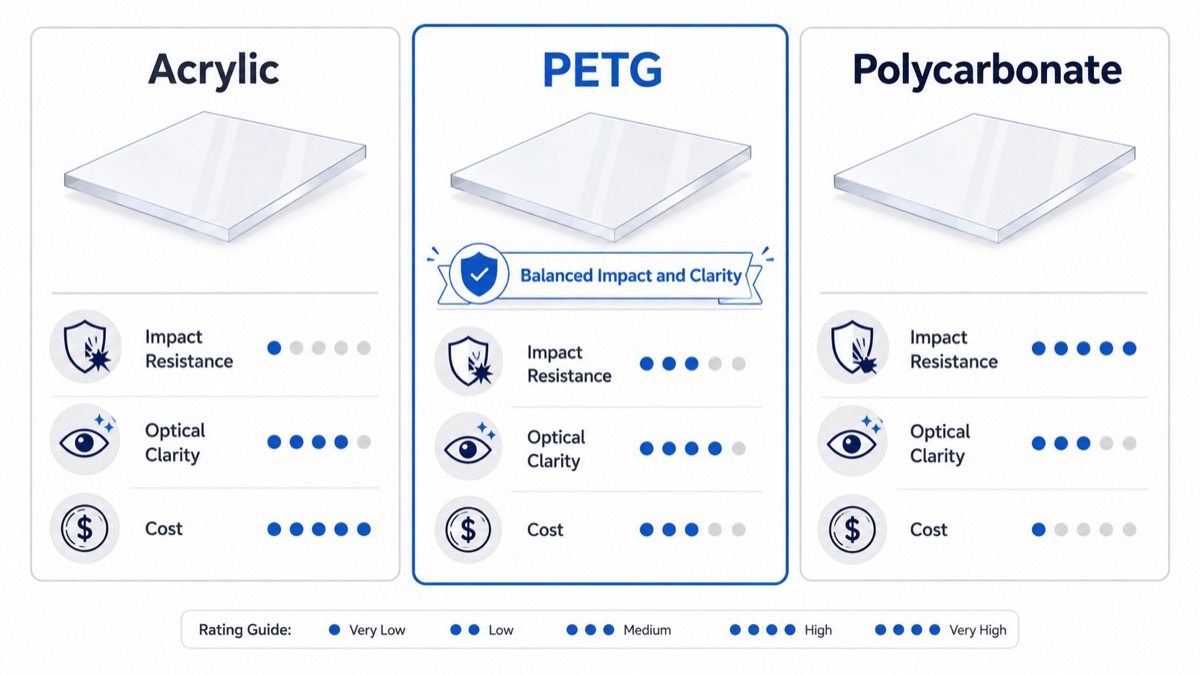
For many projects, PETG sits in the "golden middle" between acrylic and polycarbonate: clearer and less brittle than acrylic, and more cost‑effective and easier to process than polycarbonate for most mid‑impact applications. [lairdplastics]
Well‑selected PETG sheet gives engineers and buyers a predictable, repeatable material. Below are the headline properties you should know when specifying. [lairdplastics]
Independent data from material suppliers and plastics engineers consistently show PETG in the following range: [lairdplastics]
- Tensile strength: around 7,500–9,000 psi, providing solid structural performance.
- Notched Izod impact: typically 2.0–3.0 ft‑lb/in, much higher than standard acrylic. [lairdplastics]
- Flexural strength: high enough for thin‑wall parts, with good resistance to bending under load. [lairdplastics]
- Heat distortion temperature: roughly 70–80°C (at typical testing loads), enough for most indoor and many light industrial uses. [lairdplastics]
PETG's glass transition temperature around 80–85°C means it tolerates warm environments and short‑term exposure to hot water, but is not designed for sustained high‑temperature structural loads like specialty high‑heat polymers.
One of PETG's biggest selling points for OEMs is its balance of clarity and toughness. [lairdplastics]
- Light transmission is typically 85–88%, very close to acrylic and higher than many other engineering plastics. [lairdplastics]
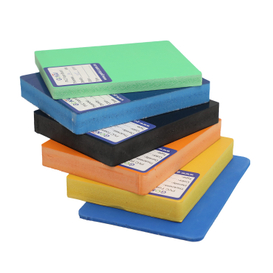
- Gokai PETG sheet is available in clear, transparent, glossy white, matt white, frosted white, black and multiple colors, covering most display and branding needs. [lairdplastics]
- Surface hardness is lower than acrylic, which means PETG is more prone to scratching in high‑contact environments, but it will not shatter the way acrylic can. [lairdplastics]
If long‑term outdoor clarity is critical, clear acrylic with UV stability still has an advantage; for impact resistance and forming flexibility with good clarity, PETG is usually the smarter choice. [lairdplastics]
PETG is widely used in environments where chemical cleaners and food safety matter. [lairdplastics]
- It offers excellent resistance to many common cleaners, diluted acids and bases, and alcohols – an important factor for point‑of‑purchase (POP) displays and machine guards that are wiped down frequently. [lairdplastics]
- FDA‑compliant PETG grades are available for direct food contact, including food trays, clamshells and display containers. [lairdplastics]
- For medical and pharmaceutical uses, specialized medical‑grade PETG can meet biocompatibility and sterilization requirements.
When engineers compare PETG sheet vs acrylic vs polycarbonate, they are usually balancing clarity, impact, cost and processability. [lairdplastics]
| Feature / Property | PETG Sheet | Acrylic (PMMA) | Polycarbonate |
|---|---|---|---|
| Impact resistance | High, approaches PC (lairdplastics) | Low, brittle | Very high |
| Light transmission | ~86–88% (lairdplastics) | ~92% (lairdplastics) | ~87–90% (lairdplastics) |
| Brittleness | Less brittle than acrylic (lairdplastics) | Brittle | Ductile |
| Scratch resistance | Moderate, softer surface (lairdplastics) | High, polishable | Moderate |
| Thermoforming / deep draw | Excellent, low forming temp (lairdplastics) | Moderate | More demanding |
| Outdoor weathering (unmodified) | Fair–moderate (lairdplastics) | Very good UV resistance | Requires UV grades |
| Relative material cost | Midrange (lairdplastics) | Lower–mid | Higher |
| Typical OEM sheet thickness (Gokai) | 0.2–6 mm (lairdplastics) | Similar range | Similar range |
| Ideal use cases | POP displays, guards, trays (lairdplastics) | Long‑term outdoor signs (lairdplastics) | High‑impact safety glazing |
In real projects, PETG is often chosen instead of acrylic where breakage risk and forming complexity are concerns, and instead of polycarbonate where extreme impact performance is not required and budgets are tighter. [lairdplastics]
As a PETG sheet manufacturer, Gokai focuses on stable quality, OEM flexibility and fast lead times for global buyers. [gokai.com]
Gokai PETG sheet range includes: [lairdplastics]
- Transparent PETG sheet / PETG clear sheet for displays, glazing and guards
- Glossy white PETG sheet and matt white PETG sheet for back‑printed graphics and signage
- Glossy black and matt black PETG sheet for light‑blocking applications
- Semi‑transparent and colored PETG sheets (red, green, blue, yellow, etc.) for branded POP and decorative elements
This variety allows OEM clients to design entire retail or industrial systems with a single material family, reducing complexity in inventory and processing. [lairdplastics]
Gokai offers PETG sheet in typical sheet sizes such as 610×610 mm, 700×1000 mm, 915×1220 mm, 915×1830 mm, and 1220×2440 mm, with custom sizes available on request. Thicknesses generally range from 0.2 mm to 6 mm, covering thin packaging through to more robust guards and trays. [lairdplastics]
A representative set of Gokai PETG sheet data shows: [lairdplastics]
- Specific gravity around 1.27 kg/cm³, aligned with standard PETG.
- Moisture absorption about 0.15%, supporting good dimensional stability.
- High elongation at break (over 100%) for toughness in deep draws and forming.
- Heat distortion temperature around 77°C at 0.45 MPa, suitable for indoor guards, trays and POP applications.
These values help engineers cross‑compare Gokai PETG sheet with incumbent materials in existing designs. [lairdplastics]
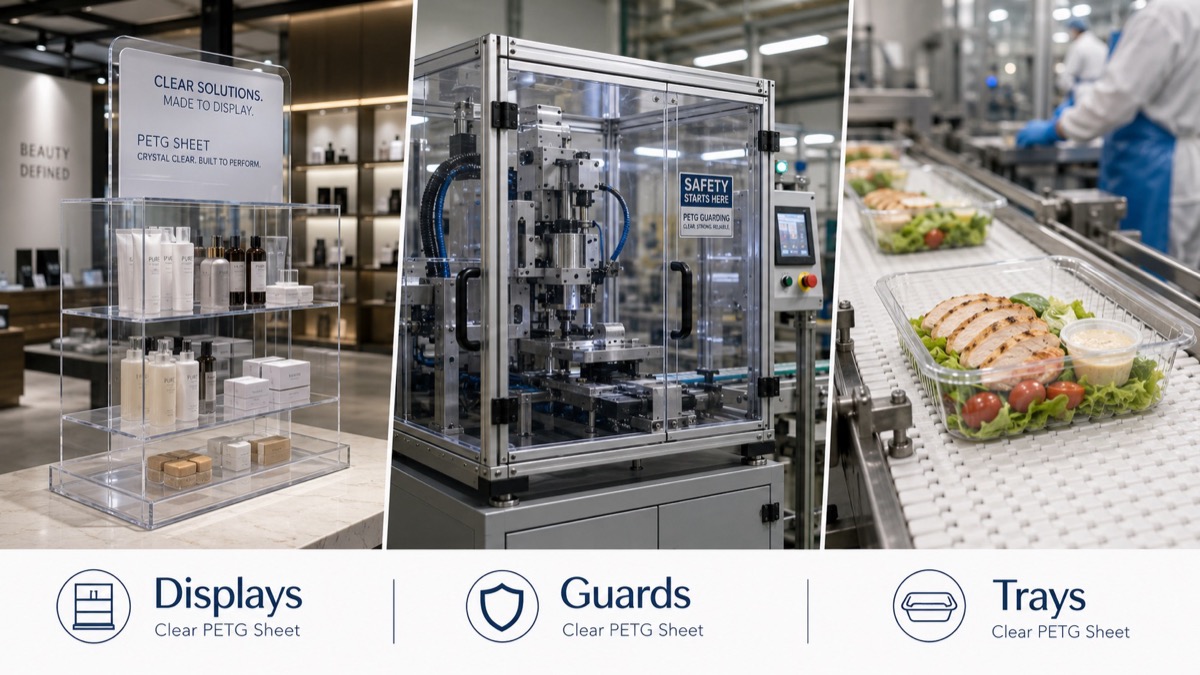
PETG's versatility is most obvious when you look at how it is used across industries – from retail to industrial automation. [lairdplastics]
Retailers and brand owners use PETG sheet widely in: [lairdplastics]
- Point‑of‑purchase displays and merchandisers
- Sign and graphic holders, table‑top displays and table tents
- Product display trays and brochure holders
Here, PETG's good impact resistance, resistance to common cleaners and excellent thermoforming characteristics are key. Staff can clean surfaces frequently, and merchandisers can be vac‑formed into deep curves and pockets without cracking at corners. [lairdplastics]
You can enhance this section visually with photos of clear and colored PETG table‑top displays and POP stands in a retail environment.
In industrial settings, PETG is popular for: [lairdplastics]
- Light‑ to medium‑duty machine guards and safety shields
- Trays and handling fixtures in assembly and packaging lines
- Equipment covers and window panels where impact and visibility both matter
Compared with glass or acrylic, PETG offers a more forgiving, shatter‑resistant solution that is simpler to cut, drill and edge‑finish in‑house. [lairdplastics]
PETG's FDA‑compliant grades make it suitable for: [lairdplastics]
- Food packaging clamshells, trays and containers
- Transparent medical device packaging and laboratory trays
- Pharmaceutical blister packs and protective housings
Because PETG can withstand many chemical disinfectants and some sterilization methods, it fits into hygienic environments without overly complex handling requirements.
One of the biggest advantages that engineers and production managers mention about PETG sheet is how easy it is to thermoform and fabricate compared to other clear plastics. [lairdplastics]
PETG's low forming temperature and excellent melt strength enable: [lairdplastics]
- Deep draws and compound curves without whitening or cracking
- Shorter cycle times than many competing plastics
- Reliable results for vacuum forming and pressure forming
To get consistent parts, processors should carefully control pre‑drying, sheet heating and mold temperature, and avoid overheating that may cause sagging or surface defects. [lairdplastics]
Gokai PETG sheet fabricates well with common plastics processes: [lairdplastics]
- Die cutting and punching for high‑volume 2D parts
- Routing and drilling for precision components
- Heat bending for small‑batch or custom transparent structures
Because PETG is softer than acrylic, proper tooling, moderate feed rates and sharp cutters help to maintain clean edges and avoid burrs. [lairdplastics]
In the field, PETG components must withstand regular cleaning. [lairdplastics]
- PETG resists many common cleaners used on POP displays and machine guards, so routine maintenance is straightforward. [lairdplastics]
- To minimize scratching, we recommend soft cloths and non‑abrasive cleaners, and avoiding dry wiping of dusty surfaces. [lairdplastics]
For users, this translates into longer life for displays and guards and better visual quality throughout the product's service life. [lairdplastics]
No material is perfect, and acknowledging PETG's limits helps you specify it confidently. [lairdplastics]
Standard PETG does not hold up well in long‑term outdoor applications compared to UV‑stable acrylic. [lairdplastics]
- Prolonged exposure to direct sunlight can cause yellowing and embrittlement unless UV‑stabilized grades are used.
- For long‑term outdoor signage, acrylic or specially stabilized PETG and polycarbonate may be more appropriate. [lairdplastics]
If your design requires short‑term outdoor exposure or mainly indoor use near windows, specifying UV‑modified PETG and defining realistic service life expectations can manage this risk.
PETG's relatively soft surface makes it more vulnerable to scratching in high contact environments. [lairdplastics]
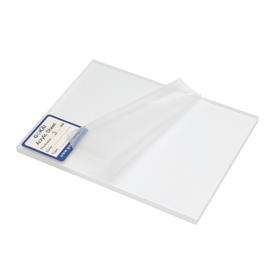
- Protective films during fabrication and transport are essential. [lairdplastics]
- For finished parts, consider anti‑scratch coatings or design solutions (e.g., recessing critical viewing areas behind frames or bezels). [lairdplastics]
In exchange for this, you gain a tough, impact‑resistant sheet that is far less likely to crack or shatter if dropped or hit. [lairdplastics]
Over years of supporting OEM customers, we find that successful PETG projects start with a few clear decisions. [lairdplastics]
1. Define environment and lifetime
- Indoor only, or partial outdoor exposure?
- Service life expectations (campaign display vs long‑term fixture)?
2. Clarify mechanical and impact requirements
- Is the part decorative, structural, or protective?
- Would acrylic's brittleness be a risk under real‑world handling?
3. Set optical and aesthetic targets
- Required transparency or translucency
- Color needs (clear, white, black or custom brand colors) [lairdplastics]
4. Confirm forming and fabrication processes
- Vacuum forming, pressure forming, or simple bending/cutting? [lairdplastics]
- Tolerances and edge‑finish expectations
5. Choose thickness and size
- Light packaging may use 0.2–1.0 mm sheet
- Guards, trays and displays often fall between 2–6 mm [lairdplastics]
- Match to Gokai standard sizes or request custom cut‑to‑size [lairdplastics]
6. Validate regulatory and food contact needs
- Specify FDA‑compliant grades for food or medical‑adjacent use. [lairdplastics]
Working through this checklist with your PETG supplier early in the design process can significantly reduce prototype iterations and tooling changes. [lairdplastics]
Gokai positions itself not only as a PETG sheet manufacturer, but as a long‑term OEM partner for global brands. [gokai.com]
- OEM and ODM support: Gokai provides customized colors, sizes, packaging and labeling so you can ship under your own brand. [gokai.com]
- Consistent quality: Strict quality control, including checks on thickness, color, optical quality and mechanical performance, gives repeatable results from batch to batch. [gokai.com]
- Flexible MOQ and lead times: Typical minimum order quantities start from around 200 pcs or 1 ton, with lead times around 10–15 days after order confirmation, helping you balance inventory and responsiveness. [lairdplastics]
For many buyers, this combination of technical performance, OEM flexibility and reliable delivery is what justifies switching from local distributors to a dedicated PETG sheet manufacturer. [gokai.com]
If you are evaluating PETG sheet for new displays, guards, trays or packaging, partnering with an experienced OEM manufacturer can significantly reduce risk and lead time. [gokai.com]
Gokai's team can help you:
- Select the optimal PETG grade, thickness and color for your environment and budget
- Optimize sheet size and processing method for lower waste and faster throughput
- Develop OEM‑branded PETG sheet programs tailored to your regional markets
You can reach Gokai for technical consultation, samples and OEM quotes via their PETG sheet product page and contact channels. [gokai.com]
Yes, PETG is available in FDA‑compliant grades that are widely used for food trays, clamshells, containers and display packaging. For these projects, you should explicitly specify food‑contact grade material with your PETG supplier. [lairdplastics]
Standard PETG sheet does not perform as well as UV‑stabilized acrylic in long‑term outdoor conditions, as extended UV exposure can lead to yellowing and embrittlement. For outdoor signage or glazing, ask your supplier about UV‑stabilized grades or consider acrylic or polycarbonate depending on impact needs. [lairdplastics]
PETG is less brittle and has significantly better impact resistance than standard acrylic, which can crack or shatter under impact. This is why many OEMs switch to PETG for POP displays, machine guards and trays that see frequent handling. [lairdplastics]
For light to medium‑duty indoor guards, designers commonly specify PETG sheet in the 2–6 mm range, depending on panel size and impact risk. Your supplier can check calculations or recommend adjustments based on span, mounting method and local standards. [lairdplastics]
Yes, one of PETG's key advantages is its outstanding thermoforming characteristics, especially for deep draws and complex shapes. Its low forming temperature and toughness help avoid cracking and reduce cycle times compared to many alternative materials. [lairdplastics]
1. Laird Plastics – "PETG Plastic: Properties, Uses & Advantages [2025 Update]"
<https://lairdplastics.com/resources/petg-plastic-properties-uses-amp-advantages-2025-update/> [lairdplastics]
2. TWI Global – "What is PETG? (Everything You Need To Know)"
<https://www.twi-global.com/technical-knowledge/faqs/what-is-petg> [twi-global]
3. Gokai – "PETG Sheet" product page
<http://www.gokai.com.cn/petg-sheets.html> [gokai.com]
4. Gokai – "Wholesale PETG Sheet from China, OEM ..."
<https://www.gokai.com.cn/petg-sheet.html> [gokai.com]
5. MarketVeep – "Content SEO Strategy in Manufacturing"
<https://www.marketveep.com/blog/4-best-practices-for-your-content-seo-strategy-in-manufacturing> [marketveep]
6. Athena SWC – "SEO for Plastics Manufacturing: Keys to Success"
<https://www.athenaswc.com/resources/blog/seo-for-plastics-manufacturing-keys-to-success/> [athenaswc]
7. Sixth City Marketing – "Manufacturing SEO: Strategy Guide on What Works (and What Doesn't)"
<https://www.sixthcitymarketing.com/2026/02/24/manufacturing-seo-strategies/> [sixthcitymarketing]