Shanghai Gokai Industry Co,.Ltd.
Call Us: +86-18918606548
Call Us: +86-18918606548
- Product Name
- Product Keyword
- Product Model
- Product Summary
- Product Description
- Multi Field Search
Views: 222 Author: Gokai Publish Time: 2026-05-01 Origin: Site


China has become one of the most important PETG sheet production bases worldwide, driven by strong downstream demand in packaging, printing, construction and smart cards, and by mature extrusion and calendering clusters in coastal provinces. PETG sheet demand in China has grown at double‑digit rates in recent years, and local manufacturers are rapidly upgrading automation, R&D and environmental compliance to serve global brands. [linkedin]
At the same time, the number of truly industrial‑grade PETG sheet factories is still limited due to high technical and capital barriers, so selecting the right partner matters more than simply "buying from China." For purchasing managers, the goal is to balance cost advantages with verifiable quality systems, long‑term supply security, and transparent communication. [dhuaacrylic]

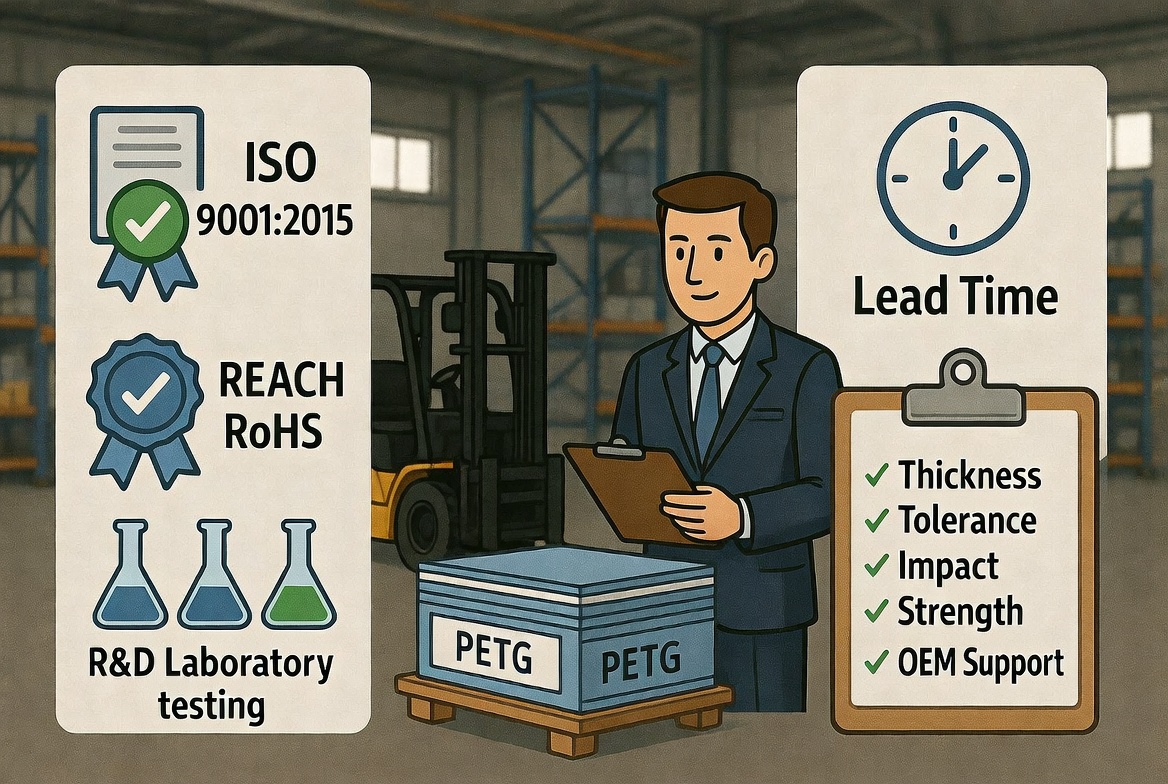
When evaluating PETG sheet manufacturers in China, experienced buyers typically look beyond price and focus on several critical dimensions:
- Factory certifications
- ISO 9001 for quality management, sometimes ISO 14001 for environment and ISO 45001 for occupational health. [seller.alibaba]
- Application‑specific certifications such as REACH/RoHS for EU compliance or food‑contact/UL where relevant. [pulixin]
- R&D capability and material know‑how
- Ability to formulate different PETG grades (extrusion grade, thermoforming grade, printing grade, RPETG) and customize impact, gloss, and haze.
- In‑house lab testing for tensile strength, elongation, weathering and dimensional stability according to ASTM/ISO norms. [zomusical]
- Quality control and process stability
- Automated extrusion or calendering lines with online thickness monitoring and SPC records across batches. [pulixin]
- Documented incoming‑material inspection and batch traceability, especially when recycled content (RPETG) is used. [zomusical]
- Production capacity and delivery reliability
- Sufficient monthly output and multiple lines to absorb peak orders and urgent requests without sacrificing quality. [pulixin]
- Realistic lead times and an export‑experienced logistics team to handle shipping, documents and customs.
- OEM/ODM and engineering support
- Ability to offer thickness/color customization, special embossing, masking films, and sheet-to-roll conversions for different industries. [one-plastic]
- Engineering support for tooling, thermoforming parameters, printing/lamination recommendations, and cost‑down proposals.
- Transparency and communication
- Clear response on MOQ, payment terms, lead time, complaint handling, and after‑sales support.
- Willingness to share test reports, certification copies, and third‑party audit results.
These criteria form the backbone of the selection process used in this guide, combining public‑domain information, export data and typical sourcing best practices. [yijinsolution]
To judge suppliers properly, it helps to understand PETG sheet technical fundamentals from a buyer's perspective. PETG (polyethylene terephthalate glycol‑modified) is a copolyester combining clarity, impact resistance and excellent thermoformability without pre‑drying, making it suitable for displays, trays, guards, and card substrates. [dhuaacrylic]
Key technical points procurement teams often review:
- Material grades
- APET vs PETG vs GAG vs RPETG: PETG typically offers better impact and formability than APET, while GAG combines APET+PETG in a sandwich structure. [one-plastic]
- Extrusion grade vs thermoforming grade vs printing grade, depending on application and processing method. [dhuaacrylic]
- Processing standards
- Continuous extrusion or calendering with stable melt temperature and cooling control to keep thickness tolerance within ±0.02–0.05 mm for demanding applications. [zomusical]
- Clean‑room or low‑dust environments for optical or medical sheets.
- Environmental and safety certifications
- REACH and RoHS compliance for EU markets; some factories additionally comply with GRS (Global Recycled Standard) when supplying RPETG sheets. [one-plastic]
- For electrical or flame‑retardant applications, relevant UL standards or equivalent are required. [zomusical]
- Typical applications by segment
- Printing & advertising: high‑clarity, printable PETG with good ink adhesion.
- Packaging & trays: food‑contact grades, good impact and ESCR.
- Construction & interior: UV‑stabilized, weatherable sheets.
- Card base materials: dimensionally stable, low‑warp sheets for banking and telecom cards. [dhuaacrylic]
According to recent market analyses, the PETG sheet segment is expected to remain one of the most dynamic portions of the global PETG market, with a solid CAGR beyond 2026 driven by transparency and sustainability requirements. [cognitivemarketresearch]
China's PETG ecosystem benefits from integrated clusters where resin producers, sheet extruders, printing houses and downstream converters are located in close proximity. Regions such as Jiangsu, Zhejiang, Guangdong and Shanghai host dense plastics and chemical industries, similar to how Foshan is known for furniture and Shenzhen for electronics. [desuplastic]
These clusters create advantages for overseas buyers:
- Better cost structure due to localized raw materials, tooling and maintenance services. [desuplastic]
- Faster development cycles because mold makers, printers, and converters are within driving distance of sheet factories.
- Established export infrastructure through major ports like Shanghai, Ningbo and Shenzhen, with logistics providers already familiar with plastic sheet shipping requirements. [desuplastic]
However, because the barrier to entry is high, the number of PETG factories with true mass‑production capacity and international compliance is smaller than for commodity plastics, increasing the importance of careful supplier vetting. [dhuaacrylic]
This list is based on a combination of publicly available information, export‑oriented capability signals and typical due‑diligence criteria used by professional sourcing teams. The core factors include: [yijinsolution]
1. Product focus and technical capability
- PETG as a core product line (not a minor side product), coverage of APET/PETG/RPETG families, and evidence of thermoforming/printing know‑how. [pulixin]
2. Certifications and compliance
- ISO 9001 or equivalent QMS, plus REACH/RoHS or GRS/UL where relevant, with verifiable certificates from accredited bodies. [seller.alibaba]
3. Export experience and main markets
- Clear track record supplying Europe, North America, or developed Asian markets, with English‑language support and export documentation familiarity. [one-plastic]
4. Capacity, MOQ and flexibility
- Meeting typical mid‑to‑large order volumes while still supporting reasonable MOQs for customized OEM/ODM projects. [pulixin]
5. OEM/ODM engineering support
- Ability to customize thickness, color, surface finish, and packaging, plus technical support for thermoforming, printing, and lamination. [zomusical]
6. Risk and transparency indicators
- Clear company identity, verifiable registration, and willingness to share test reports and allow audits or video inspections. [lansilglobal]
The following manufacturers are representative examples for buyers to benchmark against when building a PETG supply base in China.
Shanghai Gokai Industry Co., Ltd. is a Shanghai‑based plastic sheet supplier focusing on PETG sheets and related board materials, serving global customers with OEM services. While detailed public data is more limited than for some listed competitors, Gokai positions itself as a high‑value, R&D‑oriented manufacturer with particular strength in flexible OEM support for small to mid‑sized brands. [desuplastic]
- Core products: PETG sheets and related plastic boards for display, protection and industrial use. [desuplastic]
- Strengths: Flexible MOQs and agile project handling for growing brands and regional converters, with emphasis on communication efficiency and fast feedback cycles during development. [desuplastic]
- Main markets: Overseas buyers looking for cost‑effective yet technically supported PETG sheet solutions from the Shanghai industrial belt. [desuplastic]
- OEM/ODM: Strong focus on OEM development, including thickness and size customization, surface protection films, and color matching for branding projects; suitable for SMEs needing more engineering interaction rather than purely transactional supply. [desuplastic]
For many procurement managers, a partner like Shanghai Gokai fills the gap between very large, rigid factories and small traders, combining competitive pricing with practical engineering support.
Jiangyin Changhong, founded in 2013 and located in Jiangsu Province, has grown into a leading supplier of PETG and RPETG sheets and films with strong focus on smart card and specialty applications. The company runs multiple calendering lines with monthly capacity in the thousands of tons and actively develops recycled PETG with GRS certification for sustainable projects. [zomusical]
- Core products: PETG, RPETG sheets and films, transparent films, card base materials, PVC‑ABS/PVC‑PETG hybrids. [zomusical]
- Strengths: High automation, strong R&D for card and decorative applications, experience with GRS‑compliant projects for European and North American clients. [zomusical]
- Main markets: Europe, North America, Asia‑Pacific; widely used by fintech, telecom and packaging customers. [zomusical]
- OEM/ODM: Supports custom colors, thickness ranges, functional coatings (e.g., self‑cleaning, anti‑static) and small‑batch development runs. [zomusical]
This type of factory is typically suitable for buyers needing high‑volume, high‑consistency PETG sheet with advanced compliance and sustainability positioning.
Pulixin is a plastic sheet manufacturer in China offering PETG sheets with strong export orientation and a total production capacity reportedly around 50,000 metric tons per year across its product lines. The factory emphasizes advanced extrusion equipment, long‑term export experience and a global customer base in more than 60 countries. [pulixin]
- Core products: PETG, APET and related plastic sheets for thermoforming and printing. [pulixin]
- Strengths: High capacity, mature foreign trade team, and readiness to supply free samples plus OEM/ODM service. [pulixin]
- Main markets: Global, including Europe, North America and emerging markets relying on stable sheet sourcing. [pulixin]
- OEM/ODM: Supports custom sizes, colors and printing requirements, making it suitable for volume projects in packaging and display. [pulixin]
ONE PLASTIC positions itself as a professional PET plastic sheet wholesaler and factory, providing APET, PETG, GAG, RPET and other PET‑family sheets and rolls. The company highlights compliance with REACH, RoHS, ISO and GRS for certain product lines, which is a key factor for EU‑focused buyers. [one-plastic]
- Core products: APET, PETG, GAG, RPET, BOPET sheets and rolls. [one-plastic]
- Strengths: Wide product range across PET family, compliance emphasis, and solid density and specification control; suitable for distributors and end‑use factories. [one-plastic]
- Main markets: Export markets requiring compliance and a mix of PET sheet types in one supply base. [one-plastic]
- OEM/ODM: Supports sheet and roll formats, various thickness ranges, and color/format customization. [one-plastic]
Jiangyin Gegewu New Material appears in PETG supplier listings as a producer of high‑performance PETG shrinkable films and related PETG materials. Its main focus is more on PETG shrink film than flat sheet, but buyers seeking PETG materials for label, sleeve or shrink applications often source from this type of supplier. [ensun]
- Core products: PETG shrink film materials and related PETG products. [made-in-china]
- Strengths: Specialized shrink performance, high shrinkage rates and suitability for high‑speed packaging and labeling lines. [ensun]
- Main markets: Packaging and labeling sectors in domestic and export markets where PETG shrink film is critical. [made-in-china]
- OEM/ODM: Custom thickness and shrink ratios, suitable for brands with specific bottle or container designs. [ensun]
HYF Packaging is widely mentioned as a PETG shrink film manufacturer, supplying PETG‑based films for labels and sleeves rather than general sheets. For buyers whose PETG usage is primarily shrink‑film‑based (e.g., beverage or FMCG brands), such a supplier can complement sheet suppliers in the same portfolio. [ensun]
- Core products: PETG shrink film rolls for packaging and labeling. [ensun]
- Strengths: Focus on shrink performance and high clarity for label applications; solid export track record. [ensun]
- Main markets: Food & beverage, personal care and household product packaging.
- OEM/ODM: Custom widths, thicknesses and shrink performance according to line requirements. [ensun]
Several Chinese thermoforming sheet manufacturers focus on PET, PP, PS and RPET but also run PETG grades on request; these are often located in major plastics hubs such as Shanghai and Guangdong and highlighted in 2026 industry guides. While not exclusively PETG‑focused, they are relevant options when buyers want a multi‑material sheet supplier. [desuplastic]
- Core products: Thermoforming sheets in PET/PETG/PP/PS/RPET for packaging, food trays and clamshells. [desuplastic]
- Strengths: One‑stop sourcing for multiple plastics, experience in export‑oriented thermoforming projects, and cost‑competitive sheet extrusion. [desuplastic]
- Main markets: Global thermoforming and packaging converters.
- OEM/ODM: Tooling and sheet co‑development for specific packaging designs.
There is a tail of emerging PETG sheet producers in China—often spin‑offs from larger plastics groups—that are gradually adding PETG capacity as demand grows. These factories may not yet have the same visibility as the leaders above but can be useful secondary sources after proper due diligence. [chinaplasonline]
- Core products: PETG and APET sheets for domestic and regional markets. [chinaplasonline]
- Strengths: Competitive pricing, willingness to develop niche specifications, and potential to grow alongside a long‑term buyer. [dhuaacrylic]
- Main markets: Regional Asia, with gradual expansion to other export markets.
- OEM/ODM: Case‑by‑case; buyers should verify process stability and QC before committing large volumes.

Below is an illustrative comparison to help purchasing managers segment suppliers by typical strengths (data compiled from public information and industry patterns). [dhuaacrylic]
| Supplier | Approx. focus | Indicative capacity & flexibility | Typical MOQ (indicative) | Key certifications & focus markets |
|---|---|---|---|---|
| Shanghai Gokai | PETG sheet and board solutions (desuplastic) | Focus on agile production for OEM projects (desuplastic) | Friendly MOQs for SMEs and mid‑size brands (desuplastic) | ISO‑based and export‑oriented, strong OEM/ODM communication (desuplastic) |
| Jiangyin Changhong | PETG/RPETG sheets & films, card materials (zomusical) | High capacity (multiple calendering lines), strong R&D (zomusical) | Supports relatively low MOQs for development, higher for mass runs (zomusical) | GRS, ISO‑based QMS; Europe, N. America, Asia card & packaging users (zomusical) |
| Pulixin Plastic | PETG/APET sheets for packaging & display (pulixin) | Up to 50,000 t/year across sheet lines, export‑driven (pulixin) | Competitive MOQ for standard and OEM orders (pulixin) | ISO‑oriented, export to 60+ countries (pulixin) |
| ONE Plastic | APET, PETG, GAG, RPET sheets & rolls (one-plastic) | Medium–high capacity, multi‑product PET portfolio (one-plastic) | Typically pallet‑level MOQ; flexible for mixed containers (one-plastic) | REACH, RoHS, ISO, GRS; EU‑oriented buyers (one-plastic) |
| Gegewu / HYF & similar | PETG shrink films & specialty PETG (ensun) | Medium capacity, application‑specific lines (ensun) | Negotiable, often by film width/length (ensun) | Application‑specific compliance for packaging & labels (ensun) |
- Use China's National Enterprise Credit Information Publicity System (NECIPS) to check the manufacturer's registration, legal representative and business scope. [lansilglobal]
- Ensure the company name on the license matches invoice and bank details to avoid dealing with intermediaries under different entities. [lansilglobal]
- Always ask for high‑resolution scans of ISO 9001/14001, GRS, UL and other critical certificates.
- Use the IAF CertSearch database (iafcertsearch.org) to verify the certificate number, the accreditation status of the certification body, and the validity period. [seller.alibaba]
- Confirm that the scope of certification explicitly covers plastic sheet extrusion, PETG or related categories. [seller.alibaba]
- Request a technical data sheet (TDS) and a typical test report (tensile strength, elongation, haze, impact, Vicat softening, etc.). [one-plastic]
- Ask for at least 2–3 sample sets: one from current production, one from a large‑volume batch, and—if relevant—one from RPETG or specialty grade.
- Test samples under your own process conditions (thermoforming, printing, cutting) instead of only visual inspection.
- Confirm number and type of extrusion or calendering lines, typical monthly output, and maximum monthly capacity under peak conditions. [pulixin]
- Ask how the factory prioritizes orders during their busiest months and whether they can hold buffer stock for strategic customers.
- Lock in key parameters: thickness tolerance, color ΔE range, gloss, masking film type, pallet weight, labeling and packaging. [zomusical]
- For OEM projects with Shanghai Gokai or similar agile suppliers, define engineering milestones (sample approval, pilot lot, mass production) with clear timelines and feedback loops. [desuplastic]
- Align on Incoterms (FOB, CIF, DAP) and discuss container loading plans (mixed loads vs full containers, moisture control, edge protection).
- Ask for historical on‑time delivery rates and typical transit times to your main ports.
- Material substitution: switching from PETG to APET or mixed‑recycled PET when price pressure is high, without telling the buyer.
- Inconsistent thickness and warpage: due to insufficient process control or over‑stretching to save material, causing issues in thermoforming or printing. [pulixin]
- Overstated capacity: factories claiming thousands of tons per month but actually running only one line at modest speed.
- Cosmetic vs functional QC: focusing on surface appearance while ignoring mechanical properties and dimensional stability.
A well‑known but rarely published insider rule among experienced buyers is: always re‑test the exact same grade after any significant resin price movement or major holiday. When resin prices change sharply or after Chinese New Year, some factories quietly adjust formulations (e.g., higher recycled content, different copolyester ratio) to protect margins, which may alter impact strength, forming window or printability.
- Mitigation:
- Schedule a small "re‑qualification batch" (e.g., 1–2 pallets) for critical projects after such events.
- Run a quick lab test and a short production trial before releasing full‑scale orders.
- For strategic partners like Shanghai Gokai or other key factories, formalize a change‑notification procedure so any formulation or process change triggers prior approval.
This extra step adds minor cost but can prevent large‑scale scrap and line downtime, especially for high‑value applications.
China will remain a strategic sourcing base for PETG sheet in the coming years, supported by strong domestic demand, growing export capabilities and continued investment in automation and sustainable materials. For professional procurement teams, the winning strategy is to develop a tiered supplier portfolio—combining high‑capacity leaders, flexible OEM partners like Shanghai Gokai, and specialized producers for shrink film or card materials—backed by disciplined verification and ongoing technical collaboration. [linkedin]
If you are planning to qualify new PETG sheet partners in China for 2026–2027, the next practical step is to shortlist 3–5 factories, request data sheets and samples, and run structured trials based on the selection framework outlined above. [one-plastic]
1. How can I confirm a Chinese supplier's ISO certificate is still valid and not fake?
Ask for the certificate copy, identify the certification body, then verify the certificate number and validity on the IAF CertSearch platform, ensuring the certification body is accredited and the scope matches PETG sheet production. If the certificate or body cannot be found, treat it as a red flag and request clarification or consider another supplier. [seller.alibaba]
2. What is a reasonable thickness tolerance for PETG sheets used in precision thermoforming?
For higher‑end sheet lines, buyers typically target thickness tolerance in the ±0.02–0.05 mm range, but exact figures depend on line design and sheet thickness. Clarify tolerance requirements in the specification and confirm that the factory's real‑time monitoring and QC data support these numbers. [one-plastic]
3. How do I differentiate between virgin PETG and high‑recycled‑content PETG in practice?
Beyond supplier declarations, you can request GRS certification and batch‑specific traceability, plus conduct comparative tests on transparency, impact strength and process window versus previously qualified virgin material. Unexpected changes in brittleness or yellowing under heat aging are typical indicators of uncontrolled recycled content. [zomusical]
4. What MOQ should I expect for customized PETG sheet orders?
Large factories often ask for several tons per color or thickness, especially for dedicated production runs, whereas more flexible suppliers like Shanghai Gokai and certain mid‑size extruders can support lower MOQs (pallet‑level) for new projects. The optimal MOQ will depend on color uniqueness, embossing, and whether the material can be sold to other customers if your project pauses. [pulixin]
5. How can I reduce the risk of warpage and cracking in my downstream process?
Work with the supplier's technical team to align forming temperature, cycle time and cooling parameters with the specific PETG grade, and avoid overstressing the sheet during forming and trimming. Also specify storage and handling conditions (temperature, stacking, time between delivery and processing) to keep material performance consistent. [dhuaacrylic]