Shanghai Gokai Industry Co,.Ltd.
Call Us: +86-18918606548
Call Us: +86-18918606548
- Product Name
- Product Keyword
- Product Model
- Product Summary
- Product Description
- Multi Field Search
Views: 251 Author: Gokai Publish Time: 2026-07-01 Origin: Site


Content Menu
● What Is Expanded PVC Foam Board?
● Core Material Properties Engineers Care About
>> Density, Weight, and Handling
>> Thermal and Chemical Performance
● Safety, Toxicity, and Environmental Considerations
>> Non‑Toxic Formulation and Compliance
>> Fire, Water, and Biological Resistance
● How PVC Foam Board Is Manufactured (And Why It Matters)
● Rigid vs Flexible PVC: Choosing the Right Type
● Real‑World Resistance: Fire, Weather, and Impact
● Fabrication and Processing: What Shops Need to Know
● Typical Applications Across Industries
● Key Benefits for OEM Buyers and Specifiers
● How to Specify PVC Foam Board for Global Projects
● Common Implementation Mistakes (And How to Avoid Them)
● OEM Collaboration and Customization Opportunities
● Practical Buyer Checklist Before Issuing a PO
● FAQs About Expanded PVC Foam Board
As a supplier that has spent years helping fabricators, sign shops, and builders source PVC foam board for demanding projects, I've seen this material quietly become one of the most versatile plastics in global manufacturing and construction. This guide translates real-world experience into clear, actionable insights so that engineers, purchasing managers, and brand owners can confidently specify expanded PVC sheets and partner with OEM suppliers like Gokai. [sprayfoammarketers]

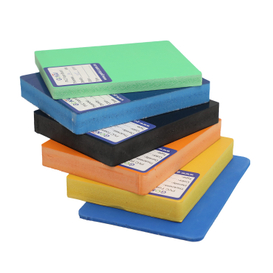
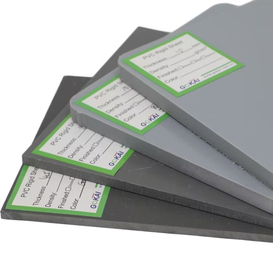
Expanded PVC foam board—also called PVC foam sheet, polyvinyl chloride foam board, or Komatex board—is a lightweight, rigid thermoplastic panel made by polymerizing vinyl chloride and creating a closed‑cell structure. Although it's often grouped with "foam" materials, its feel is closer to a dense, smooth plastic sheet than to soft foam. [sprayfoammarketers]
PVC was first developed in the 19th century, and modern formulations of PVC foam board have been refined to meet today's performance and safety standards, including compliance with key flammability and fabrication requirements. For global OEM projects, this combination of long industrial history and modern testing makes it a reliable, low‑risk choice. [sprayfoammarketers]
PVC foam boards are typically produced in densities ranging from about 3 lb/ft⊃3; to 25 lb/ft⊃3;, giving manufacturers a wide choice between ultra‑light panels and more robust structural sheets. In practice, this means you can tune weight, stiffness, and cost per square meter depending on whether your application is signage, interior panels, or semi‑structural components. [sprayfoammarketers]
From an OEM buyer's perspective, low weight reduces shipping costs and simplifies downstream handling and installation, especially for global projects where logistics can be a significant part of total cost of ownership. Many customers in exhibition, retail, and transport industries specifically choose PVC foam board because a single installer can carry and mount full‑size panels without specialized lifting equipment. [sprayfoammarketers]
Expanded PVC is a thermoplastic, which means it softens when heated above a certain temperature—typically beginning around 149°F (65°C). For most indoor and many outdoor uses, this temperature margin is sufficient, but it's important for engineers to consider in high‑heat environments near ovens, engines, or intense direct sunlight behind glass. [sprayfoammarketers]
Chemically, PVC foam board is highly resistant to moisture and many common chemicals and solvents, making it suitable for environments where occasional splashes, cleaning agents, or humidity would quickly damage wood or paper‑based substrates. In our OEM projects, this chemical resilience is often decisive in applications such as lab cabinetry, food‑service signage, and process control panels in manufacturing plants. [sprayfoammarketers]
Modern expanded PVC sheets are typically formulated with non‑toxic thermoplastic ingredients and are free from heavy metals such as lead, barium, zinc, and cadmium. This aligns with stricter global regulations and corporate sustainability policies, especially for brands exporting to markets with tight environmental standards. [sprayfoammarketers]
From a practical standpoint, PVC foam board can be recycled, and it's considered safe to fabricate and handle when processed with standard industrial health and safety practices. OEM buyers should still verify local recycling infrastructure and any country‑specific compliance requirements, but as a material class, expanded PVC fits well into many sustainability frameworks used by global manufacturers. [sprayfoammarketers]
One of the strongest differentiators of PVC foam board versus wood and paper‑based composites is its resistance profile. Expanded PVC is known for being self‑extinguishing; it does not readily sustain combustion and carries a UL‑94 flame rating used widely in trade show and exhibit environments. This intrinsic flame‑retardant nature is especially valuable in public spaces, transport interiors, and high‑traffic commercial installations. [sprayfoammarketers]
Because of its closed‑cell structure and very low water absorption, PVC foam board is effectively waterproof and highly resistant to mold and mildew, even in humid environments and areas with periodic condensation. In real projects, we've seen it successfully replace traditional trim and panel boards in bathrooms, kitchens, and coastal installations where wood repeatedly failed due to swelling and biological growth. [sprayfoammarketers]
Expanded PVC is produced by polymerizing vinyl chloride monomer in a controlled suspension process to create a rigid, closed‑cell foam sheet. Early production methods relied on sealing vinyl chloride in tubes and exposing it to sunlight, but modern manufacturing uses precise reaction controls and quality checks to achieve consistent density, cell structure, and surface quality. [sprayfoammarketers]
For OEM buyers, understanding this process is useful because it explains why different producers can offer slightly different mechanical and visual characteristics—density ranges, surface smoothness, and color consistency. When specifying material, it's best to request detailed technical data sheets and, for critical projects, run your own in‑house tests on samples from the supplier's current production batch. [sprayfoammarketers]
Industry often talks about "PVC" as if it were a single material, but there are two major types: rigid PVC and flexible PVC, each designed for distinct use cases. Expanded PVC foam board belongs to the rigid category but offers a unique combination of stiffness and lightness. [sprayfoammarketers]
- Rigid PVC is typically used for bottles, curtain rails, window frames, pipes, and structural profiles. [sprayfoammarketers]
- Flexible PVC is common in flooring, roofing membranes, shower curtains, cable insulation, toys, and similar products where bendability is required. [sprayfoammarketers]
When specifiers switch from other substrates to PVC foam board, they are usually solving problems in the rigid category—such as weight, moisture resistance, or surface finish—rather than trying to replace flexible films or cables. Clarifying this early avoids misaligned expectations and ensures that PVC foam board is used where it performs best. [sprayfoammarketers]
Expanded PVC combines multiple resistance properties that matter in everyday use, especially for global OEM deployments where panels must survive shipping, installation, and long‑term exposure.
- Fire resistance: PVC foam board is self‑extinguishing and inherently flame‑retardant; it does not readily catch fire and has a UL‑94 rating widely recognized in trade show and exhibit hall applications. [sprayfoammarketers]
- Weather resistance: Thanks to its closed‑cell structure, it performs well against wind, rain, and prolonged sunlight, making it suitable for outdoor commercial signage and architectural elements. [sprayfoammarketers]
- Mold/mildew resistance: Because it does not absorb moisture and has anti‑shock qualities, it's particularly effective in interior trim and wood‑replacement projects in both residential and professional spaces. [sprayfoammarketers]
In our experience, this combination allows OEM buyers to standardize on one substrate across indoor and outdoor campaigns, simplifying inventory and procurement while maintaining consistent brand appearance.
One of the reasons PVC foam board has become a preferred material in sign shops and fabrication facilities is its workability. Expanded PVC can be cut, machined, nailed, glued, and screwed using methods familiar from wood, metal, and aluminum. [sprayfoammarketers]
Typical processing options include:
- Saw cutting and routing with standard woodworking tools. [sprayfoammarketers]
- Die‑cutting for high‑volume shapes and panels. [sprayfoammarketers]
- Digital and screen printing directly on the smooth surface. [sprayfoammarketers]
- Mounting with cold mounting techniques, avoiding complex thermal or chemical processes. [sprayfoammarketers]
Beyond basic cutting, PVC foam board offers excellent fastening characteristics, including strong screw and staple retention, and stands up well to dents and scratches because of its rigid, yet slightly forgiving, structure. For OEM programs, this means fewer rejects during installation and more flexibility in on‑site adaptation. [sprayfoammarketers]
PVC foam board is one of the most versatile plastic substrates in modern manufacturing, with uses ranging from high‑end retail to industrial infrastructure. Different sectors value different aspects of its performance: [sprayfoammarketers]
- Signage and graphics: Indoor and outdoor signs, store displays, and point‑of‑purchase (POP) materials that demand vivid print quality and dimensional stability. [sprayfoammarketers]
- Stage and set design: Lightweight, durable panels for props and temporary structures that must look premium but transport easily. [sprayfoammarketers]
- Cabinetry and wood replacement: Moisture‑resistant panels for kitchen, bathroom, and utility spaces where traditional wood swells or deteriorates. [sprayfoammarketers]
- Transport and refrigeration: Ceilings and interior panels in cars, buses, and trains, plus refrigerator interiors where cleanliness and moisture resistance are critical. [sprayfoammarketers]
More broadly, PVC foam boards see use in packaging, wires and cables, toys, clothing components, medical and automotive applications, and construction and home improvement projects. For global OEM buyers, this breadth means a single trusted supplier can support multiple product lines and industries with one core material platform. [sprayfoammarketers]
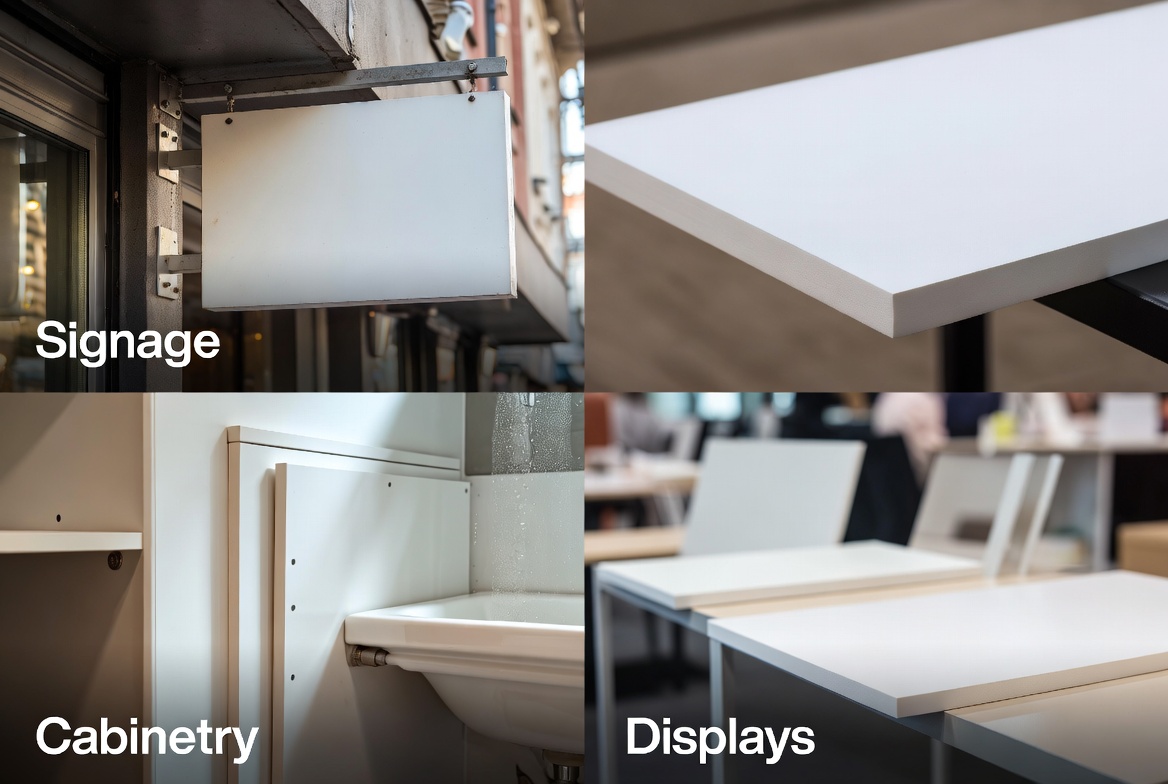
From a purchasing and engineering standpoint, several benefits consistently drive the decision to adopt PVC foam board at scale:
- High strength‑to‑weight ratio, offering tough, rigid sheets that remain easy to handle and install. [sprayfoammarketers]
- Resistance to mold, mildew, water, and many chemicals, significantly reducing maintenance and replacement cycles. [sprayfoammarketers]
- Self‑extinguishing, flame‑retardant behavior that helps meet safety standards for public and commercial environments. [sprayfoammarketers]
- Availability in multiple colors, sizes, and thicknesses, and a smooth matte finish that accepts lamination, paint, and direct printing. [sprayfoammarketers]
Suppliers commonly stock boards from well‑known brands such as Sintra, Kommerling Komatex, Vycom Celtec, and Palram Palight, giving buyers multiple options for performance and price points depending on project requirements. Working with an OEM partner experienced in these brands helps you navigate subtle differences and choose the right sheet specification. [sprayfoammarketers]
When you move from single‑site purchasing to global OEM sourcing, choosing the right PVC foam board becomes a strategic decision rather than just a line item. Based on multiple international projects, a practical approach is:
1. Define performance classes
- Separate applications into indoor decorative, outdoor signage, and semi‑structural use.
- Assign target density ranges and minimum thickness for each class. [sprayfoammarketers]
2. Standardize formats
- Select a small set of standard sheet sizes and colors to reduce SKU complexity.
- Align these formats with your printing, cutting, and logistics capabilities.
3. Align compliance and certifications
- Require UL‑94 or equivalent flame ratings for public‑facing applications. [sprayfoammarketers]
- Check heavy‑metal‑free formulations and recyclability to match corporate sustainability goals. [sprayfoammarketers]
4. Build a repeatable test protocol
- Print, cut, and mount sample boards from your supplier and expose them to typical environmental conditions for several weeks.
- Document any warping, fading, or mechanical damage and use this as a baseline for vendor qualification.
This process not only improves material selection but also strengthens internal communication between design, engineering, and procurement teams.
Even strong materials can underperform if misused. OEM clients and fabricators repeatedly encounter similar issues when first adopting PVC foam board:
- Underestimating heat exposure: Mounting boards too close to high‑temperature sources, exceeding the softening point and causing subtle warping over time. [sprayfoammarketers]
- Over‑tightening mechanical fasteners: Driving screws too aggressively into low‑density boards, which can compress the material locally and reduce holding strength.
- Using incompatible adhesives: Applying glues formulated for porous substrates instead of plastics, leading to weak bonds or surface damage.
To avoid these pitfalls, always validate the installation environment, use fasteners and adhesives recommended for thermoplastics, and request manufacturer guidelines from your supplier before launching large‑scale rollouts. A brief pilot phase can save substantial rework costs later. [sprayfoammarketers]
PVC foam board is not limited to off‑the‑shelf sheets. Experienced OEM suppliers can collaborate on custom specifications that better fit your brand and production workflows. These may include:
- Custom colors and surface textures matched to brand guidelines.
- Pre‑cut panel sizes optimized for your machines and packaging.
- Co‑developed print profiles for consistent color reproduction across regions.
By treating PVC foam board as a platform material rather than a commodity, global buyers can unlock efficiencies in inventory, speed of deployment, and visual consistency, especially for international retail and signage campaigns. This is where supplier experience and technical support become as important as the base material itself. [sprayfoammarketers]
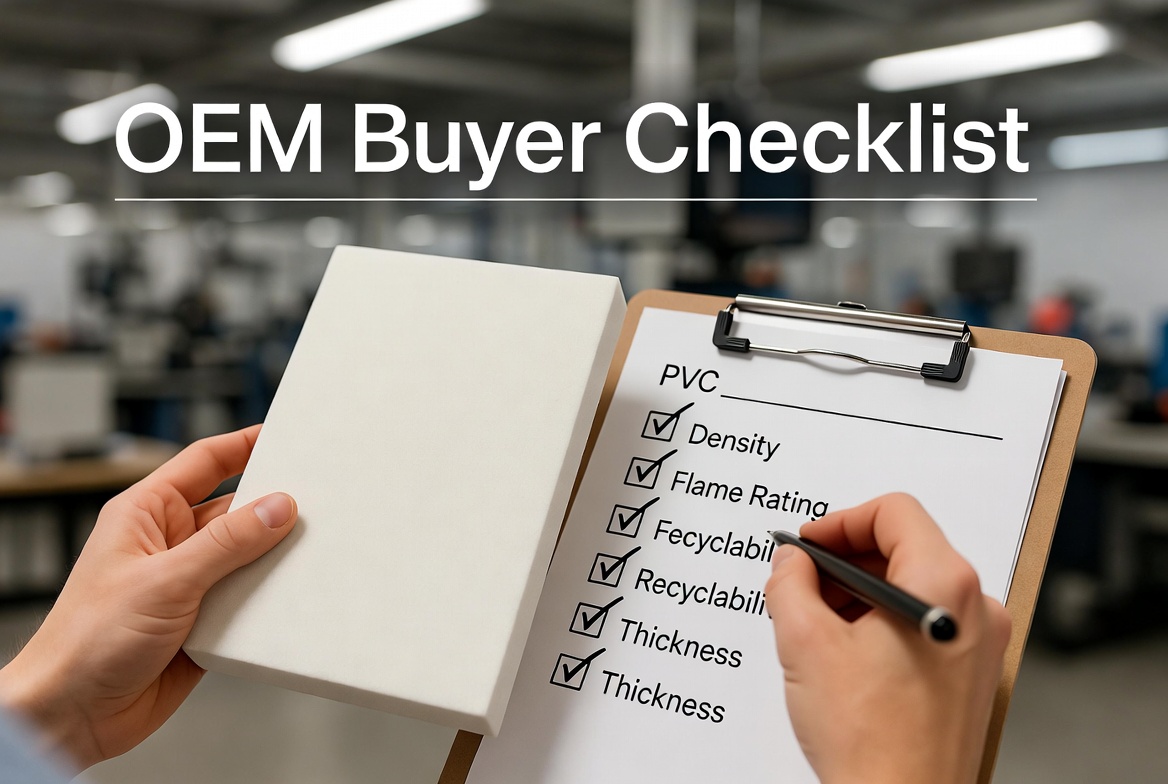
For busy procurement teams, a simple checklist helps streamline decisions:
- Confirm density range and thickness for each application.
- Verify UL‑94 or equivalent flame rating where required. [sprayfoammarketers]
- Check heavy‑metal‑free formulation and recyclability claims. [sprayfoammarketers]
- Request fabrication guidelines (cutting, fastening, printing) from the supplier. [sprayfoammarketers]
- Run a small pilot with real‑world installation and cleaning routines.
Following this checklist ensures that you're not just buying PVC foam board, but integrating a reliable, tested material into your global product ecosystem.
Q1. Is expanded PVC foam board safe for indoor use in public spaces?
Yes. Modern PVC foam boards are formulated without lead, barium, zinc, and cadmium, and are designed to be non‑toxic and recyclable when used and fabricated under standard industrial conditions. [sprayfoammarketers]
Q2. Can PVC foam board be used outdoors for long periods?
Expanded PVC is resistant to wind, rain, and prolonged sunlight thanks to its closed‑cell structure and low water absorption, making it suitable for many outdoor commercial and signage applications. [sprayfoammarketers]
Q3. How does PVC foam board compare to wood in humid environments?
Unlike wood, PVC foam board does not absorb moisture and is resistant to mold and mildew, so it maintains dimensional stability and surface quality in bathrooms, kitchens, and coastal locations. [sprayfoammarketers]
Q4. What fabrication tools are needed to work with PVC foam board?
Most shops can process PVC foam board with existing woodworking equipment—saws, routers, drills—and can fasten it using screws, nails, staples, and appropriate adhesives designed for plastics. [sprayfoammarketers]
Q5. Which industries commonly use PVC foam board?
PVC foam boards are widely used in signage, store displays, POP materials, stage props, cabinetry and wood replacement, transport interiors, refrigerator panels, and broader construction and home improvement applications. [sprayfoammarketers]
1. Acme Plastics. "What is Expanded PVC (Polyvinyl Chloride)?" https://www.acmeplastics.com/content/expanded-pvc-benefits/
2. Google Search Central. "Creating Helpful, Reliable, People-First Content." https://developers.google.com/search/docs/fundamentals/creating-helpful-content
3. LinkBuilder. "Google E-E-A-T: Guide to Creating Expert Content in 2026." https://linkbuilder.com/blog/google-eeat-guide
4. Brand New Copy. "How to Write Content That Meets Google's E‑E‑A‑T Guidelines." https://brandnewcopy.com/content-google-e-e-a-t-guidelines/
5. MonsterInsights. "How to Optimize for E‑E‑A‑T (Proven Strategies That Work)." https://www.monsterinsights.com/how-to-optimize-for-e-e-a-t/