Shanghai Gokai Industry Co,.Ltd.
Call Us: +86-18918606548
Call Us: +86-18918606548
- Product Name
- Product Keyword
- Product Model
- Product Summary
- Product Description
- Multi Field Search
Views: 266 Author: Gokai Publish Time: 2026-10-13 Origin: Site


Content Menu
● Engineering Plastics Comparison at a Glance
● ABS Sheet vs Polycarbonate Solid Sheet: The Main Differences
>> ABS Sheet for Opaque, Thermoformed Components
>> Polycarbonate Solid Sheet for Visibility and Impact Resistance
>> Which Material Offers Better Value?
● How to Interpret Temperature Data Correctly
>> Continuous Service Temperature Is Not Heat Deflection Temperature
>> Why PEEK Does Not Automatically Solve Every Heat Problem
● Chemical Resistance, Outdoor Exposure, and Cleaning
>> Evaluate the Actual Chemical Mixture
>> Specify Weather Protection Rather Than Assuming It
>> Treat Scratch Resistance as a Separate Requirement
● Fabrication Considerations for ABS and Polycarbonate Sheet
>> Thermoforming: Validate the Finished Part
>> Cutting, Drilling, and Assembly
● Three Practical Material Selection Scenarios
>> 1: An Opaque Equipment Housing
>> 2: A Transparent Machine Viewing Panel
>> 3: A Chemical-Exposed or High-Temperature Component
● A Practical OEM Sheet Procurement Checklist
>> Define the Application Before Requesting Prices
>> Establish Evidence and Acceptance Criteria
>> Evaluate Total Delivered Cost
● Working With Gokai on Custom Sheet Requirements
>> Is Polycarbonate Solid Sheet Better Than ABS Sheet?
>> Can ABS Sheet Be Used Outdoors?
>> Does Polycarbonate Sheet Need Drying Before Thermoforming?
>> Is Standard Polycarbonate Sheet Bullet-Resistant?
>> How Should Buyers Compare Technical Data Sheets?
>> What Should an OEM Buyer Send to Gokai?
An engineering plastics comparison should help you choose a material that performs reliably—not simply identify the strongest polymer. For OEM buyers, ABS Sheet and Polycarbonate Solid Sheet often provide practical starting points. Both offer useful toughness and fabrication flexibility, but they serve different priorities in visibility, appearance, temperature performance, and cost.
Nylon, polypropylene, and PEEK become relevant when wear, chemical exposure, or elevated temperatures dominate the specification. However, a higher-performance polymer is not automatically a better purchase.
My recommendation is to start with the finished component: what it must withstand, how it will be manufactured, and which failures would be unacceptable. Then compare the exact sheet grades against those requirements.

The following table provides an initial shortlist. It describes general material tendencies rather than guaranteed specifications.
| Material | Main advantages | Important limitations | Typical applications |
|---|---|---|---|
| ABS Sheet | Toughness, appearance options, easy thermoforming | Usually opaque; outdoor exposure requires suitable protection | Equipment housings, interior panels, formed covers |
| Polycarbonate Solid Sheet | Transparency, impact resistance, dimensional stability | Scratching and chemical compatibility require attention | Viewing panels, protective glazing, machine guards |
| Nylon | Wear resistance, strength, useful sliding performance | Moisture absorption can affect dimensions | Bearings, gears, wear components |
| Polypropylene | Chemical resistance, low moisture absorption, economical material options | Lower stiffness; bonding can be difficult | Chemical equipment, tanks, fabricated containers |
| PEEK | High-temperature capability, chemical resistance, demanding mechanical performance | High material cost | Precision components in severe operating environments |
These materials also belong to different performance categories. PEEK is generally considered a high-performance thermoplastic, while polypropylene is commonly classified as a commodity or industrial plastic.
Comparing them remains useful, provided the application—not the category label—drives the decision.
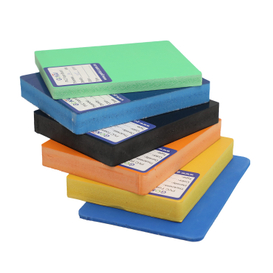
ABS combines acrylonitrile, butadiene, and styrene into a material valued for toughness, stiffness, and processing versatility.
For sheet buyers, its practical appeal is straightforward: it can be formed into useful shapes while supporting different colors and surface textures.
Common applications include:
- Equipment covers and protective housings.
- Appliance panels and interior trim.
- Display components and retail fixtures.
- Thermoformed trays and custom enclosures.
ABS plastic sheet is particularly attractive when the component needs an intentional appearance but does not require transparency.
However, "ABS" does not identify one universal product. General-purpose, fire-rated, weather-resistant, and specialized grades can behave differently. Specify the required grade before comparing quotations.
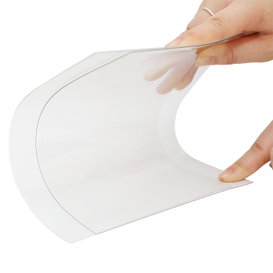
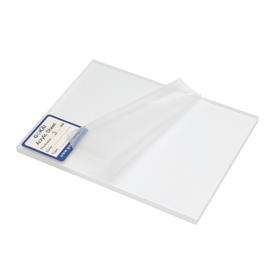
Polycarbonate Solid Sheet combines transparency with substantial impact resistance. It is a strong candidate when users need to see through a panel while maintaining a protective barrier.
Applications include machine viewing windows, equipment inspection panels, partitions, and selected glazing systems.
The key purchasing distinction is between ordinary clear sheet and a grade designed for a specific environment. Outdoor panels may need dedicated UV protection. Frequently cleaned surfaces may benefit from abrasion-resistant coatings.
Impact resistance also does not make every polycarbonate panel suitable for every safety application. Thickness, supports, fasteners, and the complete assembly determine performance.
ABS often makes commercial sense for opaque, formed parts. Polycarbonate can justify additional cost where visibility or impact performance is essential.
Compare the cost of an accepted finished component rather than the price of an unprocessed sheet.
A cheaper sheet can become more expensive if it produces excessive forming scrap, inconsistent appearance, assembly problems, or early replacement.

One of the most important improvements to any plastics comparison is separating temperature measurements that answer different questions.
Continuous service temperature describes suitability for prolonged exposure under defined conditions.
Heat deflection temperature measures deformation under a specified load during a standardized test. It is not a universal operating limit.
For example, one published ABS reference lists:
| Measurement | Published reference value | Practical interpretation |
|---|---|---|
| Maximum continuous service temperature in air | 160°F, approximately 71°C | A grade-specific long-term temperature reference |
| Heat deflection temperature at 264 psi | 177°F, approximately 81°C | A deformation result under a defined test load |
These figures illustrate why a blanket statement such as "ABS works up to 100°C" can mislead buyers.
The correct question is whether the selected grade can withstand the actual temperature, load, duration, and environment.
Published PEEK guidance identifies continuous service temperatures around 250–260°C. That makes it relevant to applications beyond the capabilities of many conventional sheet plastics.
Nevertheless, part design still matters. Creep, stress, dimensional tolerances, and chemical exposure must be evaluated together.
For an ordinary equipment cover, PEEK may add cost without delivering a useful benefit. For a heavily loaded component operating at elevated temperature, its performance may be necessary.
Chemical resistance depends on concentration, temperature, exposure duration, and mechanical stress.
Do not approve a material based only on a statement such as "resistant to chemicals."
Polycarbonate deserves particular attention around solvents and cleaning agents. Incompatible substances can damage the surface or contribute to stress cracking.
ABS also requires compatibility checks where organic solvents are present. Polypropylene may offer a better starting point for certain chemical applications, but it still needs application-specific verification.
For practical screening:
1. List cleaners, oils, adhesives, sealants, and process chemicals.
2. Record concentrations and exposure temperatures.
3. Request compatibility guidance for the selected grade.
4. Test representative samples under realistic conditions.
Outdoor durability is a grade-level requirement.
For polycarbonate, clarify whether the sheet includes one-sided or two-sided UV protection and which face must point outward.
For ABS, confirm whether the formulation or surface construction is intended for weather exposure.
A protective shipping film should not be confused with a permanent UV-resistant layer.
Impact strength and scratch resistance are different properties.
A polycarbonate panel may survive an impact yet lose visual quality through abrasive cleaning. Where repeated wiping, public contact, or dust exposure is expected, discuss suitable coatings and cleaning procedures.
Appearance requirements should therefore include both initial finish and acceptable changes during service.

ABS and polycarbonate are amorphous thermoplastics with useful thermoforming characteristics. However, processing conditions should follow the selected sheet grade and equipment.
Moisture management deserves particular attention. Some sheets require drying before forming; the supplier should provide applicable instructions rather than a generic schedule.
A meaningful forming trial should check:
- Wall thinning at corners.
- Surface quality after heating.
- Dimensional repeatability.
- Trim accuracy.
- Fit with mating components.
Measure the formed part, not just the starting sheet. A nominal sheet thickness cannot describe the thickness distribution after a demanding draw.
Machining quality depends on tooling, feed conditions, support, and heat control.
Poorly finished holes or edges can introduce stress. Overtightened fasteners can also undermine performance.
For assembled panels, review clearance holes, support spacing, edge distances, and allowance for thermal movement. These details become especially important when a large sheet is attached to a rigid frame.
Coated sheets may have additional fabrication restrictions, so confirm suitability before bending or forming.
The following examples are decision frameworks, not customer testimonials or documented Gokai projects.
An OEM needs a colored cover with a textured finish and a formed geometry.
ABS Sheet is a sensible initial candidate because appearance and thermoforming matter more than transparency.
The validation priorities are corner thinning, surface consistency, fastening performance, and the temperature inside the equipment.
If the housing contains electronics, any flame-performance requirement must also be specified for the exact grade and thickness.
A manufacturer needs visibility into equipment and resistance to foreseeable impact.
Polycarbonate Solid Sheet is the stronger initial candidate.
However, the purchasing team must also consider cleaning chemicals, scratches, mounting design, and the relevant guarding requirements.
A successful material sample is only one part of validating the complete protective assembly.
A component encounters aggressive cleaning chemicals, sliding contact, or prolonged heat.
This is where the shortlist may move beyond ABS and polycarbonate.
Polypropylene may be relevant for chemical equipment, nylon for wear-related components, and PEEK for demanding high-temperature service.
The selection should follow documented exposure conditions rather than a preference for a familiar material.
A reliable specification connects material properties with manufacturing and acceptance criteria.
Provide the supplier with:
- Intended use and installation environment.
- Finished dimensions and drawings.
- Thickness and tolerance requirements.
- Operating temperatures and mechanical loads.
- Required color, texture, and transparency.
- Fabrication methods and chemical exposure.
- Applicable safety or regulatory requirements.
This information helps prevent quotations for products that look similar but differ in important ways.
Request the current technical data sheet for the quoted grade.
Where certification matters, check the exact product designation, thickness, test standard, and scope. A resin-level document does not automatically prove that a fabricated panel or complete assembly meets the same requirement.
For incoming inspection, agree on measurable criteria such as thickness variation, dimensions, flatness, surface defects, and color consistency.
Use an approved reference sample where appearance is important.
Include more than the material price:
- Cutting and forming losses.
- Protective packaging.
- Freight and handling.
- Inspection and rework.
- Replacement risk.
- Inventory requirements.
For repeat orders, document the approved specification and any permitted changes. Substituting a grade, coating, or surface finish can affect downstream performance.

Gokai supplies ABS Sheet and Polycarbonate Solid Sheet and offers OEM support for global customers.
Start the discussion with your application, drawings, quantities, and acceptance requirements. Then confirm the available thicknesses, dimensions, colors, finishes, and protection options for the proposed product.
For a new component, my recommendation is a staged approval process: review the specification, assess representative samples, validate fabrication, and then approve production.
Specification is the foundation of a reliable order. A clear purchasing document gives both buyer and supplier a practical basis for evaluating consistency.
Contact Gokai with your project requirements to discuss an appropriate ABS or polycarbonate sheet option and establish a sample-validation plan before bulk purchasing.
It is usually the better starting point when transparency and strong impact resistance are priorities. ABS often offers a more economical solution for opaque thermoformed components. The selected grade and finished design determine suitability.
Yes, when the selected grade or protective construction is suitable for outdoor exposure. Do not assume ordinary ABS sheet provides adequate weather resistance. Confirm UV protection, appearance expectations, and relevant supporting evidence.
It may require drying according to the grade-specific fabrication instructions. Moisture can affect forming quality. Confirm the recommended temperature, duration, equipment, and handling procedure with the supplier before processing.
No. Ordinary sheet should not be described as bullet-resistant without evidence for the relevant tested construction. Ballistic protection depends on a validated system, including material layers, thickness, framing, and the applicable test requirements.
Compare identical test methods, units, conditioning, and specimen conditions wherever possible. Separate continuous service temperature from heat deflection temperature. Treat typical values as selection guidance unless they are explicitly agreed as purchasing guarantees.
Send drawings, application details, dimensions, thickness tolerances, quantities, appearance requirements, and fabrication methods. Include temperature, chemical exposure, and compliance needs. These details support a more relevant quotation and sample plan.
1. Piedmont Plastics. "Contrasting High-Performance Plastics in Modern Applications." September 12, 2024. Original article reviewed for its comparison framework covering polycarbonate, ABS, PEEK, nylon, and polypropylene. This reconstruction adds sheet-specific purchasing guidance and qualifies broad temperature and compliance statements. [piedmontplastics]
2. Curbell Plastics. "ABS Data Sheet." Supports ABS applications, thermoforming characteristics, available grade categories, and the published reference values of 160°F continuous service temperature and 177°F heat deflection temperature at 264 psi. These are reference-material values, not Gokai product guarantees. [curbellplastics]
3. Curbell Plastics. "Polycarbonate." Supports the discussion of transparency, impact resistance, dimensional stability, machining, and thermoforming. Product suitability remains dependent on the selected grade and application. [curbellplastics]
4. Curbell Plastics. "Thermoforming Plastic Sheet Materials." Supports the distinction between general thermoforming suitability and material-specific processing requirements, including the need to determine whether drying is necessary. [curbellplastics]
5. Ensinger. "PEEK Plastic Material." Supports the discussion of PEEK's chemical resistance and published continuous service temperature range around 250–260°C. These values do not replace application-specific design validation. [ensingerplastics]
6. Ensinger. "Thermoplastic Materials." Supports the distinction between engineering plastics and high-performance thermoplastics, helping avoid treating every material in the comparison as belonging to the same performance category. [ensingerplastics]
7. Shanghai Gokai Industry Co., Ltd. "ABS Sheet." Supports Gokai's ABS sheet offering and discussion of available dimensions, colors, and customization. Actual order specifications should be confirmed in the quotation and purchasing documents. [gokai.com]
8. Shanghai Gokai Industry Co., Ltd. "Polycarbonate Sheet." Supports Gokai's solid polycarbonate sheet offering, OEM purchasing support, and customized sizes, thicknesses, and colors. Available grades and options require order-specific confirmation. [gokai.com]