Shanghai Gokai Industry Co,.Ltd.
Call Us: +86-18918606548
Call Us: +86-18918606548
- Product Name
- Product Keyword
- Product Model
- Product Summary
- Product Description
- Multi Field Search
Views: 248 Author: Gokai Publish Time: 2026-10-09 Origin: Site


Content Menu
● Why Source PET Sheet in Russia?
● Supplier Comparison at a Glance
● Six PET Sheet Supply Options
>> 1. Shanghai Gokai Industry Co., Ltd. — International OEM Alternative
>> 2. PolyER — Integrated Thermoforming and Packaging
>> 3. Polymer-Trade Group — PET Rolls and Cut Sheets
>> 4. EKO-PET LLC, Kazan — PET Film and Barrier Structures
>> 5. PALPROM LLC — Rigid Thermoforming and Barrier Film
>> 6. OLPACKETING GROUP — APET/PE Specification Flexibility
● Qualify the Material and Factory
>> Start With an Application-Led Specification
● Verify the Factory Before Approving the Sample
● Compare Coil Position, Not Just Batch Average
● Plan Freight and Compliance Early
● FAQ
>>> 1. How can I tell whether an ISO certificate has expired or covers the correct factory?
>>> 2. Does an FSSC 22000 or ISO certificate prove that PET sheet is safe for my food product?
>>> 3. How do I compare two PET quotations when one includes recycled content?
>>> 4. What should I test before approving APET/PE or APET/EVOH/PE for sealed food trays?
>>> 5. Can I freely import Russian-made PET sheet into any destination market?
This guide is prepared for Shanghai Gokai Industry Co., Ltd. Gokai appears first as a China-based OEM supply option for buyers comparing Russia-focused sourcing routes; it is not a Russian manufacturer. The companies below are selected for documented relevance to PET sheet, rigid APET film, or closely related thermoforming stock—not ranked by independently audited quality. Publicly available figures and certification claims are identified as such, and buyers should verify them before contracting.

For a professional buyer, the question is not simply who sells PET sheet in Russia. It is who can supply the right grade, format, documented compliance, and repeatable production quality for a particular converting line. A food-tray producer may need APET or APET/PE roll stock with tightly controlled gauge and seal performance. A printer may instead need flat, consistently cut PET sheets with a specified surface treatment. Those are different purchasing decisions, even when both products are described online as "PET film" or "PET sheet."
Russia has an established PET packaging and converting base, with relevant suppliers around Moscow and the Yaroslavl region, as well as in Tatarstan. That geographic pattern gives domestic buyers access to extrusion, slitting, thermoforming, and packaging-development capabilities. It should not, however, be mistaken for evidence that every listed company manufactures every PET grade in-house. For example, PolyER describes its PET thermoforming tape and packaging operations, while Kazan-based EKO-PET documents PET-film extrusion, lamination, and thermoforming.
Recent market data also needs careful interpretation. An industry-association estimate reported Russian PET polymer production of roughly 590,000–604,000 tonnes in 2024; that is not a PET-sheet output figure. A separate 2025 forecast expected Russian PET-film consumption to exceed 70,000 tonnes, but "PET film" can include categories that are not interchangeable with rigid APET thermoforming sheet. Likewise, Grand View Research estimated the global PET-films market at USD 40.1 billion in 2025; that broader market figure should not be presented as a Russian rigid-sheet market size.
For buyers outside Russia, local manufacturing capability is only one part of the decision. Destination-country import restrictions, payment routes, transport availability, and counterparty screening may determine whether an otherwise suitable Russian offer is usable. EU guidance explicitly identifies restrictions affecting certain Russian-origin plastics; check the exact product classification and current rules before placing an order.
This shortlist prioritizes verifiable product fit over promotional claims. It includes companies whose own product pages or identifiable industry records describe relevant PET sheet, rigid PET film, thermoforming stock, or PET-based packaging materials. Gokai is included separately as a declared non-Russian alternative serving buyers who want to compare an international OEM quotation.
The screening framework reflects the issues that matter most in a long-term supply relationship:
- Product and process fit: Does the supplier document APET, PETG, rPET, PET/PE, or another clearly identified construction? Does it sell flat sheets, rolls, finished packaging, or PET resin?
- Manufacturing evidence: Is there credible information on extrusion, slitting, lamination, thermoforming, equipment, or plant location?
- Quality control: Can the company provide a current specification, batch-level certificate of analysis, material traceability, and a defined complaint process?
- Development capability: Can its team review a drawing or forming trial, propose a suitable grade, and control changes to an approved formulation?
- Capacity and delivery: Is a published capacity figure relevant to the exact product being purchased? Can the supplier substantiate lead times and replenishment plans?
- Compliance: Can the supplier produce current, scope-matched management-system certificates and application-specific food-contact or other test evidence?
- Commercial fit: Does its MOQ, customization range, communication process, and shipping arrangement suit the buyer's purchasing volume?
A website can establish that a company offers a product; it cannot prove present-day output, on-time delivery, or an active certificate. That distinction shapes the table and profiles below. Where a founding year, MOQ, annual capacity, or current certification could not be verified from the reviewed material, it is marked not publicly verified rather than estimated.

| Supplier | Location and strongest documented fit | Published capacity relevant to this review | Published MOQ | Certification or compliance evidence found |
|---|---|---|---|---|
| Shanghai Gokai Industry Co., Ltd. | China, not Russia; APET flat sheets and PET rolls; custom dimensions and colors | About-us page states 10 production lines across its factory, principally discussing PVC foam board and acrylic—not PET-only capacity | PET MOQ not verified; a separate PETG listing states 200 pieces or 1 tonne, which must not be applied to APET | Current PET-specific certificates and food-contact test reports not verified gokai.com+2 |
| PolyER | Yaroslavl region; PET, PP, and PS thermoforming tape and finished food packaging | An industry profile reports more than 600 tonnes of thermoforming tape per month across materials; not a PET-only figure | Not publicly verified for PET sheet | Website describes ISO 14001:2015; request the current certificate and scope company |
| Polymer-Trade Group | Russia; amorphous PET film supplied in rolls or cut sheets | Company states more than 7,000 tonnes of PET film per year; self-reported | Not publicly verified | Current certificate not verified in the reviewed product information |
| EKO-PET LLC, Kazan | Tatarstan; PET film, PET/PE laminate, and thermoformed packaging | No current comparable annual PET-film output verified | Not publicly verified | Company reports 2025 FSSC 22000 recertification; request a current certificate and scope |
| PALPROM LLC | Moscow; rigid APET-based thermoforming film and barrier structures | Not publicly verified | Not publicly verified | Current certificate not verified in the reviewed product information |
| OLPACKETING GROUP | Moscow; APET/PE film with specified widths, colors, and treatments | Not publicly verified | Not publicly verified | Current certificate not verified in the reviewed product information |
How to use this table: The capacity figures have different boundaries and cannot be treated as a ranking. PolyER's disclosed figure covers thermoforming tape across polymers; Polymer-Trade's figure is a company claim for PET film; Gokai's line count is not a PET-sheet capacity declaration. Ask each shortlisted supplier for capacity and MOQ against the same written specification before comparing prices.

Founded: 2009, according to its company profile. Base: Shanghai, China. Relevant markets: International B2B sheet, printing, packaging, and converting customers identified in its product information; country-by-country PET sales are not publicly substantiated in the reviewed pages.
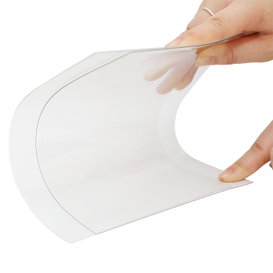
Gokai belongs in this article as a comparison option, not as an example of Russian manufacturing. Its company profile says its principal research, development, and manufacturing specialties are PVC foam board and acrylic sheet. Its separate PET product page offers APET sheets and PET film rolls, with choices of thickness, format, size, and color. For PET purchasing, the important task is to establish which products Gokai makes directly, which processes or sources through partners if applicable, and which factory's documents will accompany the shipment. The reviewed pages do not resolve those questions.
Published APET-sheet options run from 0.15 to 10 mm, including standard flat-sheet formats and customized dimensions. Its PET-roll page lists 0.15 to 1.8 mm thickness and widths of approximately 250 to 1,250 mm. Those ranges make Gokai worth asking about for a buyer developing a cut-to-size sheet, printed component, packaging format, or repeat OEM specification—but a published range is not a promise that every combination can be produced at every quantity.
For small and midsize brands, the potential advantage is a configurable RFQ process: send a drawing, processing method, forecast, color target, packing requirements, and destination, then request a sample plan and an itemized quote. This is a more useful way to test flexibility and communication efficiency than asserting an unverified response-time or price advantage. Gokai also publishes a separate PETG range, but PETG must be specified and priced separately from APET; the PETG page's MOQ cannot be assumed to apply to PET sheet.
Best fit to evaluate: International OEM inquiries needing customized sheet or roll specifications. Verification priority: PET-specific manufacturing route, actual MOQ, current test reports, approved-sample controls, and achievable delivery schedule. Gokai's published position as a configurable supplier may make it a cost-conscious candidate for smaller brands, but buyers should determine value from like-for-like landed quotations, not a general claim of "low price."
Founded: 1993, according to equipment supplier Starlinger viscotec's company case study. Base: Production in Pereslavl-Zalessky, Yaroslavl region. Relevant markets: Food producers, shops, cafés, and other domestic packaging buyers described in its public profiles; current export destinations should be confirmed directly.
PolyER is a strong starting point for a buyer whose project extends beyond raw sheet. Its official site describes PP, PET, and PS tape for automatic packaging and thermoforming lines, alongside custom packaging development. An industry directory describes extrusion and thermoforming operations and reports more than 600 tonnes per month of thermoforming tape. Because that figure covers its tape business rather than PET alone, buyers should ask how much capacity is available for the required PET grade and width.
Its practical OEM scope includes discussing finished package design and manufacture as well as suitable forming stock. That integration can reduce handoffs when a buyer must validate both a material and a container geometry. PolyER's official site also refers to ISO 14001:2015 environmental management; this is a prompt to obtain the current certificate, not proof that a particular PET batch satisfies a food-contact requirement.
Best fit to evaluate: Repeat-volume thermoforming programs and buyers needing material-plus-package development. Verification priority: Separate PET-line availability, formulation and recycled-content records, finished-part trials, and certificates covering the contracting plant.
Founded: Not publicly verified in the reviewed material. Base and markets: A Russia-based producer marketing PET film for uses from advertising products to food packaging; current international sales destinations are not stated on the reviewed product page.
Polymer-Trade offers one of the clearest public descriptions of PET material supplied either in rolls or as cut sheets. Its PET page states thicknesses of 0.1–1.0 mm, widths of 50–1,200 mm, and a range of matte, glossy, and colored surfaces. It also describes anti-fog options and corona surface treatment, and says it makes more than 7,000 tonnes of PET film annually. These are company-published figures, suitable for initial screening but not a substitute for a line-specific audit.
For OEM purchasing, the relevant customization questions are whether it can hold a buyer's exact cut-sheet dimensions, roll winding direction, core specification, surface energy, and appearance standard over repeat batches. Its page describes both virgin PET and material incorporating recycled PET; an RFQ should explicitly state the permitted recycled-content range rather than asking for "standard PET."
Best fit to evaluate: Buyers comparing APET roll stock with converted flat sheets, especially when printing or anti-fog behavior matters. Verification priority: Actual production-versus-available capacity, batch-specific recycled content, cut-size tolerance, and current compliance documents.
Founded: 2006, according to the company history. Base: Kazan, Republic of Tatarstan. Relevant markets: Food-packaging customers; the company's history records development of an export program aimed at the European market, but current export destinations should be confirmed.
EKO-PET's published history is useful because it identifies process development rather than merely listing products. It records the launch of PET-film extrusion and thermoforming in 2008, a second extrusion line in 2011, and later PET/PE lamination capability. Its product information describes PET film, metallized film, and PET/PE structures with optional EVOH barrier, anti-fog, and peel features. Those are materially different constructions and should never be collapsed into one generic "PET sheet" price.
The company website lists a May 2025 FSSC 22000 recertification update. That is useful screening evidence for a food-packaging inquiry, but buyers still need the certificate number, expiry, issuing body, site, and scope. They also need application-specific material declarations and test reports: a food-safety management certificate does not by itself certify that every film structure is suitable for every food, storage period, or destination market.
Best fit to evaluate: Food-tray projects requiring controlled lamination, sealing, anti-fog behavior, or oxygen-barrier performance. Verification priority: Layer structure, barrier test conditions, seal-window trial, current FSSC scope, and batch traceability.
Founded: Not publicly verified in the reviewed material. Base: Moscow contact address. Relevant markets: Its public product information focuses on food applications, including chilled-meat packaging; export markets are not publicly established in the reviewed page.
PALPROM advertises lower rigid thermoforming films based on APET, with APET/PE and APET/EVOH/PE options and an advertised thickness range of 180–900 microns. Its page discusses customized widths and thicknesses, coloring, peel behavior, and the relationship between material gauge and tray draw depth. These details make it a relevant supplier to screen for a project where forming geometry and barrier function must be developed together.
Its site also presents oxygen-transmission ranges for particular barrier categories. Buyers should not copy a general website value into their specification without establishing the exact multilayer structure, test method, humidity, temperature, and finished-part requirement. A value measured on a flat film may not describe the thinned corners of a deep-formed tray.
Best fit to evaluate: Customized bottom-web material for thermoforming and modified-atmosphere-packaging development. Verification priority: Confirm which operations are performed in-house, obtain current plant and certification records, and test formed trays rather than film alone.
Founded: Not publicly verified in the reviewed material. Base: Moscow. Relevant markets: The company lists packaging and converting applications, including thermoforming, blisters, trays, printing, and food packaging; current export markets are not established on the reviewed page.
OLPACKETING GROUP publishes relatively detailed APET/PE product options: 230–1,000 microns thickness, 50–1,000 mm width, 76 or 152 mm cores, and several colors, including customer-specified color options. Its page also mentions anti-block additives and optional corona treatment. Those parameters are practical RFQ inputs for buyers trying to match existing converting equipment or print requirements.
The page offers technical consultation, storage, and logistics options. It does not establish a verified annual capacity, PET-specific MOQ, or current certification in the reviewed material. Buyers should therefore determine the exact manufacturing entity, production location, and quality-document issuer before classifying the company as a direct factory rather than treating its website alone as proof of every production step.
Best fit to evaluate: APET/PE roll-stock inquiries with nonstandard widths, colors, or surface-treatment requirements. Verification priority: Plant identity, trial-run capability, treatment durability, current documentation, and repeat-order lead times.
Important category boundary: Kaliningrad-based Ekopet JSC is an upstream PET-resin producer whose chips are described as suitable for sheet-thermoforming applications. It is not included as a finished PET-sheet manufacturer. It is also a different entity from Kazan-based EKO-PET LLC profiled above. Confusing the two could lead a buyer to audit the wrong company or request the wrong product.
Before requesting prices, identify whether the project calls for APET, PETG, rPET-containing PET, or a laminate such as APET/PE or APET/EVOH/PE. APET sheet for a folding box, PETG sheet for a deeper-formed display component, and a heat-sealable multilayer bottom web cannot be compared on price per kilogram alone. Supplier pages in this shortlist demonstrate how widely the advertised product constructions vary.
Send each supplier one controlled RFQ containing the same information:
- Product use, destination market, and whether direct food contact is intended.
- Material grade and permitted composition: virgin content, pre-consumer regrind, post-consumer rPET, and any prohibited substitutions.
- Flat-sheet size or roll width, nominal thickness, agreed tolerances, color, surface finish, and test methods.
- For rolls: core diameter, maximum outside diameter or roll weight, winding direction, splice policy, and edge quality.
- For converting: printing method, forming depth, target tray geometry, sealing lidding film, storage conditions, and required barrier performance.
- Quantity per shipment, annual forecast, packaging format, delivery location, and requested Incoterms.
- Required documents, including a sample-linked specification, batch certificate of analysis, traceability records, and relevant destination-market declarations.
Do not substitute CE or RoHS claims for application-specific evidence. The European Commission says CE marking applies only where specific EU harmonized rules require it; it should not be used as a generic badge for raw PET sheet. RoHS evidence may matter for a defined electrical or electronic end use, but it is not a universal PET-sheet quality certificate. For EU food-contact use, assess the applicable plastic food-contact requirements under Regulation (EU) No 10/2011; recycled plastic introduces additional requirements under Regulation (EU) 2022/1616. For packaging placed on the Eurasian market, check the applicable requirements under TR CU 005/2011.
Ask who owns and operates the extrusion line, where the specific grade is produced, and which legal entity signs the contract. Request a live or recorded walkthrough that follows a relevant order through raw-material identification, extrusion, thickness monitoring, slitting or cutting, inspection, and packing. A machine photograph without a date, order reference, or material link is weak evidence.
Then request three linked samples: a standard-production sample, a trial made to the proposed specification, and a retained reference from the approved trial. Identify each by material code, date, batch, and process settings. Perform the trial on the buyer's own printing, forming, or sealing equipment. If the first commercial delivery will be produced on another line or with a different recycled-content recipe, require reapproval.
For management-system certificates, compare the legal name, plant address, scope, issue and expiry dates, and certification body. ISO explains that it does not issue certificates itself and recommends checking accredited certifications through IAF CertSearch or directly with the relevant certification or accreditation body. A historic statement that a company "was certified" is not a current validation.

One easily missed source of disputes is approving a beautiful center-of-roll sample while never checking what comes from the edges—or from the beginning and end of a production run. Ask the supplier to label samples by left/center/right across the web and by start/middle/end of the run. Record thickness, appearance, and relevant processing results against each position.
This check matters because a nominally acceptable batch average can conceal variation that appears only during slitting, stacking, printing, or deep drawing. For thermoforming, inspect the formed tray's corners and sealing flange, not only the incoming sheet. Set the sampling positions and acceptance limits in the purchase specification before a dispute occurs. This is a procurement-control recommendation, not a claim that any supplier listed here has such a defect.
- Material substitution: A quotation says "PET" but does not distinguish APET, PETG, recycled-content PET, or PET/PE laminate. Require the grade, layer structure, and approved formulation on both the specification and batch documents.
- Undeclared recycled content: A lower price may reflect a changed formulation. Require source and percentage declarations, appearance limits, and reapproval when the recipe changes; food-contact claims need additional, destination-specific evidence.
- Nominal-gauge pricing: The quoted sheet may be described by nominal thickness while actual variation affects forming yield or purchased mass. Agree on the measurement method, locations, frequency, and tolerance.
- Misleading capacity comparisons: An advertised company-wide line count or multi-polymer tape figure is not available PET-sheet capacity. Ask for the applicable line's output and allocated production window.
- Unproven barrier claims: For a laminate, obtain the complete structure and test conditions, then validate performance on the finished package—not merely on a flat sample.
- A certificate without scope: Match the certificate to the legal entity, production site, process, and current validity. A management-system certificate does not replace a product-specific compliance assessment.
Agree how sheets or rolls will be protected against abrasion, edge damage, compression, and moisture exposure during the intended route. Gokai's about-us page, for example, lists corner-guard bags, cartons, and export wood pallets as packaging options; the buyer should still approve a PET-specific packing drawing rather than assume every listed option is used for every product.
For Russia-origin material, screen the supplier, beneficial owners where appropriate, banks, shipment route, product classification, and destination rules before committing to payment terms. Do not assume a PET product is either prohibited or permitted solely because it is "plastic": the legal outcome depends on the precise goods and transaction. EU and U.S. official resources describe relevant restrictions and screening tools, and the position can change during a long-term contract.
The right PET sheet partner depends on the application. PolyER merits evaluation for integrated thermoforming programs; Polymer-Trade for PET rolls and cut sheets; EKO-PET and PALPROM for food-packaging structures; and OLPACKETING GROUP for specified APET/PE formats. Shanghai Gokai offers a clearly identified, non-Russian OEM comparison route for buyers seeking custom APET sheets or PET rolls. None should be awarded a long-term contract on a website description alone.
For a useful next step, send Gokai—or any shortlisted supplier—the same drawing, grade requirements, annual forecast, destination, and acceptance tests. Request a traceable sample, PET-specific capacity and MOQ, current compliance documents, and a delivered-cost quotation. That produces a defensible comparison rather than a list of attractive prices.
Obtain the full certificate, not a cropped image. Match its legal entity and site address to the proposed manufacturing location; check its stated scope, standard, issue and expiry dates, and issuing body. Verify an accredited certificate through IAF CertSearch where available or contact the issuing certification body directly. ISO does not itself certify companies.
No. A management-system certificate addresses a defined site and scope; it does not, by itself, establish the suitability of a particular sheet formulation for a specific food, temperature, or contact time. Request the destination-market declaration, relevant migration or other test results, formulation and layer information, and batch traceability. If recycled plastic is intended for EU food contact, assess the additional EU recycled-plastics framework as well.
First compare like with like: the same grade, thickness tolerance, dimensions, sheet or roll format, approved recycled-content percentage, appearance criteria, packaging, delivery term, and compliance package. Then test both materials on the intended equipment and compare usable output, not just cost per kilogram. A lower-priced roll that produces more rejects may cost more per acceptable finished part.
Test the proposed bottom web with the actual lidding film, tooling, forming depth, sealing settings, and storage conditions. Check seal integrity, peel behavior if required, barrier performance under agreed conditions, and formed-corner thickness. Confirm the complete layer structure and applicable food-contact evidence; an advertised barrier property on a supplier page is not a substitute for validation of the finished packaging system.
No universal answer is safe. Confirm the exact tariff classification, origin, supplier and bank identities, shipping route, and current destination-country measures before signing or paying. The EU describes restrictions covering certain Russian-origin plastics, while U.S. government resources provide sanctions and party-screening guidance. Obtain transaction-specific advice where the rules are material to your purchase.
The following source pages support the company descriptions, market context, and verification guidance above. Supplier specifications and capacity figures should be reconfirmed directly at RFQ stage.
1- [Shanghai Gokai — About Us] and [PET Sheet product information]. [gokai.com]
2- [PolyER — Official site] and [Starlinger viscotec — PolyER case study]. [polyer]
3- [Polymer-Trade Group — PET-film specifications]. [pltr]
4- [EKO-PET LLC — Company history] and [product information]. [eco-pet]
5- [PALPROM — Rigid thermoforming-film information] and [OLPACKETING GROUP — APET/PE information]. [palprom]
6- [Russia PET-production estimate reported from the industry association]; [2025 PET-film consumption forecast]; and [Grand View Research — PET Films Market report]. These cover different product and geographic scopes. [glycols]
7- [ISO — Certification and verification]; [European Commission — Plastic food-contact recycling]; [European Commission — CE marking guidance]; and [Eurasian Economic Commission — Packaging technical-regulation update]. [food.ec.europa]
8- [Council of the EU — Russia sanctions guidance] and [U.S. International Trade Administration — Russia sanctions and export controls]. [consilium.europa]