Shanghai Gokai Industry Co,.Ltd.
Call Us: +86-18918606548
Call Us: +86-18918606548
- Product Name
- Product Keyword
- Product Model
- Product Summary
- Product Description
- Multi Field Search
Views: 222 Author: Gokai Publish Time: 2026-06-05 Origin: Site


Content Menu
● What Is PVC Foam Board and Why It Matters in 2026
● Key Physical and Mechanical Properties You Should Actually Care About
>> How Density Influences Real‑World Performance
● Main Types of PVC Foam Board (and When to Use Each)
>> Standard PVC Free‑Foam Board
>> Co‑Extruded and Laminated Foam Boards
● Core Applications Across Industries in 2026
>> Signage and Visual Communication
>> Construction and Interior Architecture
>> Furniture, Cabinets, Transport, and Emerging Uses
● PVC Foam Board vs. Other Materials (Quick Decision Table)
● Real‑World Installation and Fabrication Best Practices
>> Cutting, Drilling, and Edge Quality
>> Fastening and Adhesive Bonding
>> Storage, Handling, and Quality Control
● Common Quality Issues—and How Pros Prevent Them
>> Warping, Bowing, and Surface Defects
● Market Outlook and Sourcing Strategy in 2026
● Expert Checklist for Selecting the Right PVC Foam Board
>> Step‑by‑Step Selection Framework
● Why Partner with Gokai for PVC Foam Board OEM Projects
● Call to Action—Turn PVC Foam Board Specs into Reliable Products
● FAQ: PVC Foam Board in Practice
PVC foam board has become the go‑to material for signage, displays, and lightweight construction because it combines rigidity, moisture resistance, and easy fabrication at an attractive cost. As a global OEM supplier, Gokai helps brands turn this versatile material into consistent, scalable products tailored to local markets and application requirements. [gokai.goldsupplier]
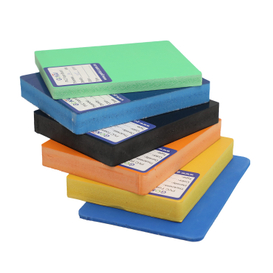
PVC foam board (also called PVC foam sheet, expanded PVC, or foamed PVC board) is a rigid, closed‑cell plastic sheet made from PVC resin, calcium carbonate, foaming agents, and stabilizers. The foamed core dramatically lowers weight versus solid PVC, while smooth surface "skins" keep the board stiff, printable, and easy to machine.
In 2024, global PVC foam board demand exceeded 2.8 million metric tons, led by signage (~35%), construction (~30%), furniture (~15%), transportation (~10%), and other specialty uses. Recent market analyses project the broader PVC foam board market to grow from around 1.8–2.3 billion USD in the mid‑2020s to roughly 3.5 billion USD by 2030–2033, driven by lightweight construction, retail branding, and transport applications. [verifiedmarketreports]
For engineers, buyers, and fabricators, the numbers are what turn "good material" into reliable specification.
- Typical density: 0.45–0.80 g/cm³ (vs. ~1.4 g/cm³ for solid PVC).
- Tensile strength: 1.5–8 MPa; flexural strength: 3–15 MPa depending on density and grade.
- Moisture absorption: <0.5% (24 h), which is crucial for outdoor and wet‑area performance.
- Service temperature: about -20°C to +60°C for continuous use.
- Thermal conductivity: roughly 0.035–0.045 W/m·K for useful insulation.
- Fire behavior: typically B1/B2 per DIN 4102, with some formulations achieving higher fire ratings.
PVC foam board is usually sold in three density "bands":
- Low density (0.45–0.55 g/cm³): Very light, ideal for temporary or indoor signage, models, and craft projects where handling and cost matter more than long‑term stiffness.
- Medium density (0.55–0.65 g/cm³): The industry's workhorse grade, balancing weight, strength, and cost for most signage, displays, construction panels, and furniture components.
- High density (0.65–0.80 g/cm³): Used where impact resistance, edge quality, and outdoor longevity are critical, such as architectural signage, transportation interiors, and marine panels.
From a Gokai OEM perspective, density selection is usually one of the first technical decisions we refine with customers during project scoping.
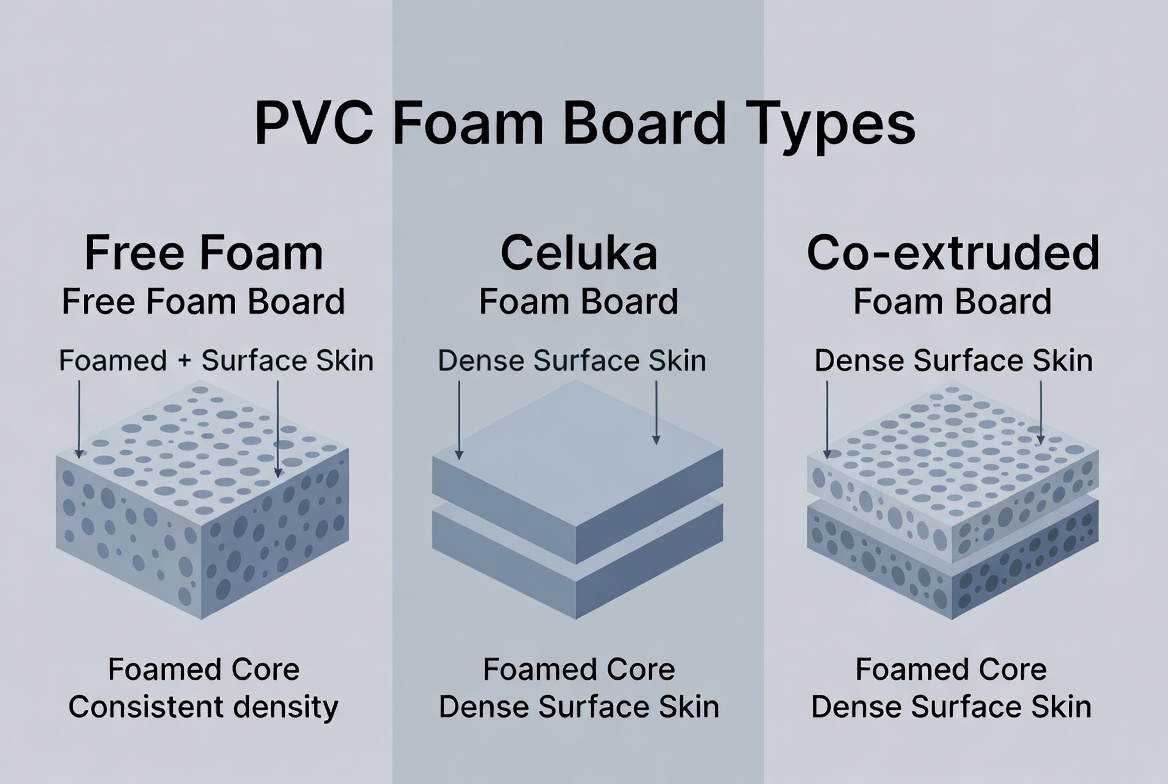
Different manufacturing routes produce distinct surface quality and performance.
Free‑foam boards expand freely during production, creating a uniform closed‑cell structure through the thickness. They offer a matte surface, good printability, broad color ranges, and the lowest unit cost.
- Best for: indoor/outdoor signage, POP displays, basic exhibition panels, craft and model making.
- Typical thickness range: 1–30 mm.
Celuka boards cool quickly at the surface, forming a denser outer skin over a foamed core. This gives a harder, smoother surface and crisper edges for routing or engraving.
- Best for: high‑end signs, engraved panels, architectural detailing, display fixtures.
- Trade‑off: 15–25% cost premium versus standard free‑foam in many markets.
Co‑extruded boards sandwich a foamed core between solid PVC skins for maximum surface hardness, weatherability, and screw‑holding strength. Laminated boards add decorative or functional films (woodgrain, metallic, protective coatings) on a foam core for ready‑finished panels.
- Best for: marine and RV interiors, exterior architectural panels, premium retail fixtures, pre‑finished cabinet fronts.
- Key benefit: they often eliminate secondary finishing, cutting labor and lead time.
As a flexible OEM, Gokai tailors board type to each program—standard free‑foam for cost‑sensitive signage runs, co‑extruded for demanding transportation or architectural jobs. [gokai.com]
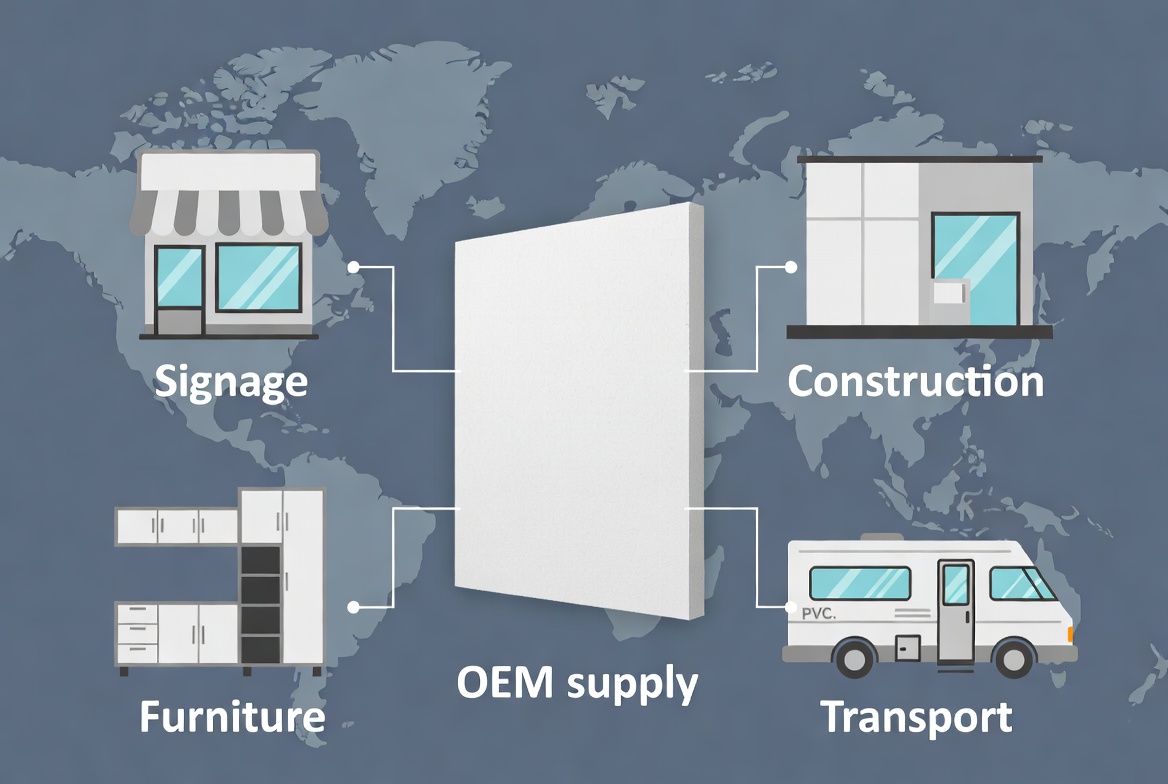
PVC foam board dominates several application clusters because it blends light weight, moisture resistance, and easy processing. [alandsplastic]
Signage remains the single largest market segment for PVC foam board.
Common use‑cases include:
- Retail POS and POP displays, aisle markers, and promotional posters.
- Indoor wayfinding and corporate branding walls.
- Trade show graphics and lightweight exhibition panels that must travel.
- Outdoor storefront, yard, and construction site signs needing weather resistance.
Medium‑density white boards (0.55–0.65 g/cm³) are the default choice for digital print houses and sign fabricators, thanks to their smooth surface and predictable cutting behavior.
In construction and interiors, PVC foam board is used wherever moisture or cleaning frequency would destroy wood products. [cn.fushiwoodgroup]
Typical applications:
- Interior wall panels, wainscoting, and ceiling panels.
- Bathroom and kitchen wall cladding in wet zones.
- Soffits, fascia, window trim, and exterior decorative elements.
- Insulation backers and tile backer boards in damp areas.
Its thermal performance (roughly R‑1.0 per inch) and low water absorption make it attractive for hybrid insulation and lining solutions.
- Furniture and cabinets: cabinet doors, shelving, decorative panels, and commercial casework that must resist humidity and cleaning agents.
- Transportation: RV and trailer sidewalls, interior linings, marine bulkheads, and vehicle cabinetry where weight and corrosion resistance are critical.
- Emerging: agricultural panels, industrial enclosures, machine guards, and packaging inserts for sensitive equipment.
For export customers, Gokai often combines PVC foam board with CNC routing, lamination, and edge finishing to ship semi‑finished or ready‑to‑install components. [gokai.goldsupplier]
| Factor | PVC Foam Board | Wood / MDF | Aluminum | Solid PVC Sheet |
|---|---|---|---|---|
| Weight (4'×8'×1/2") | 15–20 lb (very light) | 65–85 lb (heavy) | 50–65 lb | 110–130 lb |
| Moisture resistance | Excellent, <0.5% absorption | Poor unless sealed | Excellent but can corrode | Excellent |
| Machinability | Woodworking tools, clean edges | Easy but dusty | Needs metal tools | Harder to cut |
| Outdoor durability | 3–15 years depending on grade | Low without coatings | Good but may oxidize | Very high, heavier |
| Fire performance | Self‑extinguishing, B1/B2+ | Combustible | Non‑combustible | Self‑extinguishing |
| Print/graphics | Excellent surface | Needs priming | Needs coating | Good surface, heavy |
| Installed cost | Low‑to‑medium | Low materials but high upkeep | High | Medium‑high |
This is why many designers now specify PVC foam board instead of plywood or MDF for any application that must survive cleaning cycles, humidity, or outdoor exposure.
End‑user feedback and professional installer experience consistently highlight the same success factors: tooling, layout planning, and environmental control. [yingchuangplastic]
- Use sharp carbide woodworking blades or router bits to avoid melting and chipping. [yingchuangplastic]
- For very clean edges, a fine‑tooth circular saw blade and CNC routing are preferred. [yingchuangplastic]
- Pre‑drilling is often not required in thinner boards, but pilot holes help avoid localized crushing in thicker, high‑density sheets.
Gokai's OEM lines routinely supply pre‑cut, CNC‑routed panels, eliminating variability at the job site for global customers.
- Boards can be mechanically fastened with corrosion‑resistant screws and washers to distribute load. [yingchuangplastic]
- Solvent cements and structural adhesives are commonly used; follow adhesive manufacturer guidelines for open time and curing. [yingchuangplastic]
- On large installations (walls, cladding), combining adhesive with strategic mechanical fixing dramatically improves long‑term flatness. [yingchuangplastic]
For critical outdoor applications, it is good practice to maintain small expansion gaps between panels to accommodate thermal movement. [yingchuangplastic]
- Store sheets flat, fully supported, and out of direct sunlight to prevent warping.
- Keep protective films or interleaving in place until fabrication to avoid scratches and dents.
- Inspect incoming material for uniform cell structure, surface defects, and thickness consistency, especially for print‑critical jobs.
Reputable manufacturers maintain ISO‑based quality systems to control density, thickness, cell size, and color consistency from batch to batch.
Even good material can fail if wrong grade is selected or storage and fabrication are poor.
Standard white board will gradually yellow in direct sun after several years. UV‑stabilized formulations and higher titanium dioxide content can extend outdoor life to 7–10+ years, especially when combined with protective films or printed vinyl.
Warping can result from uneven storage support, thermal cycling, or asymmetrical lamination. Large foam cells or surface pits are typically manufacturing issues and should be caught during incoming inspection.
Prevention checklist:
- Always specify grade (density, type, UV level) appropriate to the environment.
- Store flat and let material acclimate to site temperature before installation.
- For laminated panels, keep laminate layers balanced on both sides where flatness is critical.
Gokai works with long‑term partners to tune formulas and QC criteria for each OEM program, reducing on‑site surprises for downstream customers. [gokai.com]
Recent market research indicates PVC foam board revenues are forecast to grow from roughly 1.8 billion USD in 2024 to around 3.5 billion USD by 2033, with a CAGR in the high‑single‑digit range. Regional studies show particularly strong growth in Europe (for example, Germany is projected to see PVC foam board demand grow around 5.7% annually from 2026 to 2033). [linkedin]
Price trends in 2026 appear stable to slightly upward, mainly due to feedstock costs and energy pricing, but not as volatile as some other plastics (such as acrylic). For OEM and brand buyers, this environment rewards: [pvcfoamsheet]
- Multi‑year sourcing partnerships to stabilize quality and pricing. [pvcfoamsheet]
- Technical collaboration to optimize density, thickness, and grade so that you are not over‑specifying (and over‑paying) for the end‑use.
- Consolidating SKUs to gain better volume pricing from manufacturers like Gokai that can supply multiple PVC board families and related sheet products. [gokai.goldsupplier]
To avoid over‑engineering—and under‑performing—projects, decision‑makers can follow this simple selection framework, based on both lab data and field feedback. [alandsplastic]
1. Define environment.
Indoor, outdoor, or wet area? UV exposure hours per day? Required service life (3, 5, or 10+ years).
2. Clarify structural demands.
Will the panel be self‑supporting, mechanically loaded, or purely decorative? This drives density and thickness decisions. [alandsplastic]
3. Specify surface performance.
Is it for high‑resolution printing, engraving, or lamination? Choose standard free‑foam for most print work, celuka or co‑extruded for premium edges and high wear.
4. Check compliance and safety.
Confirm fire rating, chemical resistance, and any building or transport regulations (e.g., interior transport standards).
5. Optimize cost vs. lifetime.
Compare low‑density vs. medium‑density options and consider total cost of ownership, including maintenance and replacement cycles.
Gokai's technical team commonly walks new buyers through this framework during the initial RFQ stage, then validates candidate specs through test runs and application‑specific samples. [gokai.com]
Shanghai Gokai Industry Co., Ltd. focuses on researching, developing, manufacturing, and distributing PVC foam board, PVC rigid sheet, PVC flooring, and acrylic sheet, and provides flexible OEM services to global customers. As an OEM‑ready producer, Gokai can: [gokai.goldsupplier]
- Customize density, color, and grade (standard, celuka, co‑extruded) to match specific market regulations and brand requirements. [gokai.goldsupplier]
- Deliver cut‑to‑size, printed, or laminated panels for signage, construction, furniture, or transport applications, reducing downstream processing. [gokai.goldsupplier]
- Support multi‑market sourcing strategies, helping distributors and brands consolidate volumes and simplify supply chains for PVC‑based panels. [gokai.com]
For distributors, fabricators, and brand owners building long‑term PVC product lines, a specialist OEM partner like Gokai offers technical depth beyond what purely trading‑focused suppliers can provide. [gokai.com]

If you are planning a new signage program, lightweight construction solution, or moisture‑resistant furniture line, PVC foam board gives you a powerful balance of performance, processing ease, and cost. The fastest way to move from idea to repeatable, manufacturable product is to work directly with a dedicated PVC foam board OEM that can align material grade, processing route, and quality standards with your market needs. [alandsplastic]
Whether you need private‑label boards, pre‑fabricated components, or complete panel solutions, Gokai can help you validate specifications, optimize cost, and scale supply across regions.
Q1: Is PVC foam board really waterproof enough for bathrooms and outdoor signs?
Yes. Its closed‑cell structure keeps water absorption below about 0.5%, so it does not swell, warp, or rot in wet or humid environments, making it suitable for bathrooms, kitchens, and outdoor signage.
Q2: How long will PVC foam board last outdoors before it yellows or becomes brittle?
Standard grades typically offer 3–5 years before noticeable color shift, while UV‑stabilized or coated boards can deliver 7–10+ years of service life under normal outdoor exposure, especially when printing or laminates shield the surface.
Q3: Can PVC foam board replace plywood or MDF for interior panels and furniture?
In many moisture‑exposed or frequently cleaned environments, yes. It provides similar or better rigidity at much lower weight, and it resists water and many cleaning chemicals better than wood‑based panels, reducing maintenance and replacement costs. [alandsplastic]
Q4: Is PVC foam board safe from a fire and toxicity perspective?
Most foam boards are self‑extinguishing and meet B1/B2 or better fire classifications, and specialized fire‑rated grades can achieve Class A ratings; as with any PVC product, local codes and test data should be reviewed for critical applications.
Q5: What should I look for when choosing a PVC foam board manufacturer or OEM partner?
Check for specialization in PVC sheet products, consistent density and color control, documented quality systems, the ability to supply multiple board types and densities, and proven support for OEM customization in your target application segment. [gokai.com]
1. Laird Plastics. "PVC Foam Board Guide: Properties, Uses & Types [2025 Update]."
2. Verified Market Reports. "PVC Foam Board Market Size, Growth Trends, Share & Forecast." [verifiedmarketreports]
3. LinkedIn / Regional report. "Market Dynamics of Germany PVC Foam Board with 5.7% Growth from 2026–2033." [linkedin]
4. Polyflute. "PVC Foam Board vs PVC Board: Key Differences in Weight, Strength, Cost and Use." [polyflute]
5. Alands Plastic. "How to Choose the Right PVC Foam Sheet for Your Project." [alandsplastic]
6. Installation guide article. "PVC Foam Board Installation: Step‑by‑Step Guide." [yingchuangplastic]
7. GoldenSign / industry analysis. "Will PVC Foam Board Prices Rise in 2026? Cost Structure and Market Trends." [pvcfoamsheet]
8. Shanghai Gokai Industry Co., Ltd. Company and product overview. [gokai.com]
9. Fushiwood / LVL. "Uses and Advantages of PVC Foam Boards in Industries." [cn.fushiwoodgroup]