Shanghai Gokai Industry Co,.Ltd.
Call Us: +86-18918606548
Call Us: +86-18918606548
- Product Name
- Product Keyword
- Product Model
- Product Summary
- Product Description
- Multi Field Search
Views: 241 Author: Gokai Publish Time: 2026-06-24 Origin: Site


Content Menu
● Introduction: Why Automotive Plastics Matter More Than Ever
● From Bakelite to High‑Performance Plastics
● Why OEMs Prefer Plastics Over Metals
● How Automotive Plastics Are Qualified
● Overview of Common Automotive Plastics
● Acrylic vs ABS vs Polycarbonate: What Automotive Buyers Compare
>> Quick Material Snapshot for Automotive Use
● Polycarbonate Sheet: Impact‑Driven Performance
● ABS Sheet: Interior Durability and Design Flexibility
● Acrylic Sheet: Clarity and Brand Experience
● Real‑World Sheet Quality Challenges (And How We Solve Them)
● 7 Practical Steps to Select the Right Sheet Material
● Emerging Trends in Automotive Plastics (2026 and Beyond)
● Why OEM Buyers Partner with Gokai
● Call to Action: Plan Your Next Automotive Plastics Project
● FAQs About Automotive Plastics Sheets
Automotive manufacturers now rely on plastics for exterior panels, interior trims, and under‑the‑hood components to reduce weight, improve fuel efficiency, and enhance safety. As electric vehicles (EVs) and stricter emission standards reshape the industry, the choice of acrylic, ABS, and polycarbonate sheet has become a strategic decision for OEMs and Tier‑1 suppliers, not just a cost line item. [thebusinessresearchcompany]
In this guide, I will walk you through how automotive engineers and buyers evaluate key plastic sheet materials and share what we see at Gokai when supporting global OEM projects with custom acrylic sheet, ABS sheet, and polycarbonate solid sheet solutions. [gokaiplastic]

Early vehicles used Bakelite, a lightweight, heat‑resistant plastic, in instrument panels and control surfaces as far back as the early 1900s. Today, Bakelite has been replaced by advanced plastics that combine durability, heat resistance, and design flexibility for modern interiors, exteriors, and functional parts. [mordorintelligence]
This evolution means automotive plastics are no longer "secondary" materials; they are engineering enablers that support lightweighting, safety, and distinctive design language across global vehicle platforms. [openpr]
Plastics have become the default choice in many vehicle systems because they deliver a combination of performance and cost advantages that metals rarely match. [tme]
Key reasons include:
- Weight reduction: Lower vehicle mass improves fuel economy and extends EV range while supporting stringent emission and efficiency targets. [mordorintelligence]
- Design flexibility: Plastics enable complex shapes, integrated features, and modular assemblies that simplify production and enhance aesthetics. [openpr]
- Corrosion and weather resistance: Many plastics resist moisture, chemicals, and salt, extending component life in harsh environments. [tme]
- Cost efficiency: Tooling and part consolidation can reduce total system cost compared with metal stamping or casting.
Market research shows the automotive plastics market is projected to grow strongly through 2031, driven by lightweighting, EV adoption, and demand for high‑performance interior and exterior plastics. [mordorintelligence]
Before any plastic is used in a vehicle program, it must pass a rigorous material qualification process defined by OEM and industry standards. [openpr]
Typical qualification steps include:
1. Mechanical and impact testing (tensile strength, flexural properties, impact resistance).
2. Thermal performance evaluation (heat deflection, dimensional stability, thermal aging).
3. Chemical and UV resistance testing for fuels, cleaners, and outdoor exposure. [tme]
4. Flammability and smoke performance checks for interior parts.
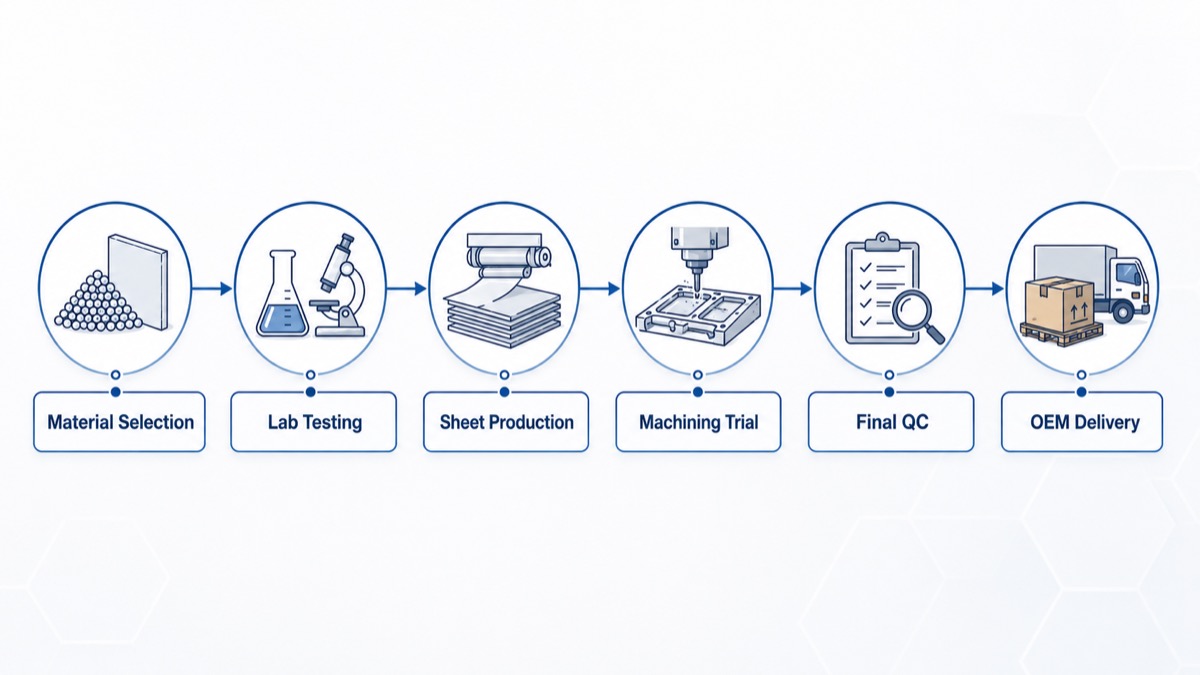
5. Process capability assessment at the converter or sheet supplier to ensure consistent quality.
For OEM buyers, this qualification phase is where partnering with a sheet supplier who offers batch testing, certificates, and full traceability becomes critical. [gokai.com]
Several plastics dominate modern automotive manufacturing, each chosen for specific performance and cost profiles.
Key materials include:
- Polypropylene (PP): Widely used in bumpers, trims, and interior components thanks to a balance of low cost, chemical resistance, and processability. [mordorintelligence]
- Polycarbonate (PC): Known for excellent impact resistance and clarity; used in headlamp lenses, exterior parts, and transparent covers. [gokai.com]
- PVC: Often used in interior skins, dashboards, and door panels because it can be made flexible or rigid and has an attractive surface finish.
- ABS: Common in instrument panels and steering column covers where stiffness, impact resistance, and surface appeal are crucial. [openpr]
- Polyethylene and Nylon: Applied in fuel systems, under‑bonnet components, and coatings where moisture resistance and wear performance matter. [openpr]
For OEMs and Tier‑1s, the real challenge is not just knowing these materials but choosing the right sheet for a specific application, environment, and budget.
When we support automotive projects at Gokai, engineers typically start by comparing acrylic sheet, ABS sheet, and polycarbonate solid sheet across a set of practical criteria. [gokaiplastic]
- Impact resistance and safety
- Optical clarity and surface quality
- Heat and UV resistance
- Weight and thickness options
- Processing methods (vacuum forming, CNC, bonding)
- Cost and long‑term durability [tme]
| Criterion | Acrylic Sheet (PMMA) | ABS Sheet | Polycarbonate Solid Sheet |
|---|---|---|---|
| Impact resistance | Higher than glass, lower than PC; suitable for non‑critical exterior and interior glazing. (gokai.com) | Good; used in interior trims, housings, and dashboards. (openpr) | Excellent; often chosen for headlamps and protective covers. (gokai.com) |
| Optical clarity | Outstanding clarity and gloss; ideal for premium appearance. (gokai.com) | Opaque or colored; smooth decorative surfaces. | High clarity with superior toughness. (gokai.com) |
| Heat & UV resistance | Good with proper formulation and UV‑stable grades. (gokai.com) | Good heat resistance; needs proper stabilization outdoors. (openpr) | Very good heat and UV resistance; used in demanding environments. (mordorintelligence) |
| Weight | Much lighter than glass; supports vehicle lightweighting. (gokai.com) | Lightweight; supports fuel efficiency. (openpr) | Lightweight compared with glass; slightly heavier than acrylic. (gokai.com) |
| Typical automotive uses | Light covers, decorative trims, interior panels, displays. (gokai.com) | Dashboards, pillar trims, interior panels, steering covers. | Headlamp lenses, protective shields, exterior trims. (gokai.com) |
| Cost level | Competitive; often lower than polycarbonate in similar clarity specs. (gokai.com) | Cost‑effective for structural interiors. (openpr) | Higher than acrylic; chosen when impact strength is critical. (gokai.com) |
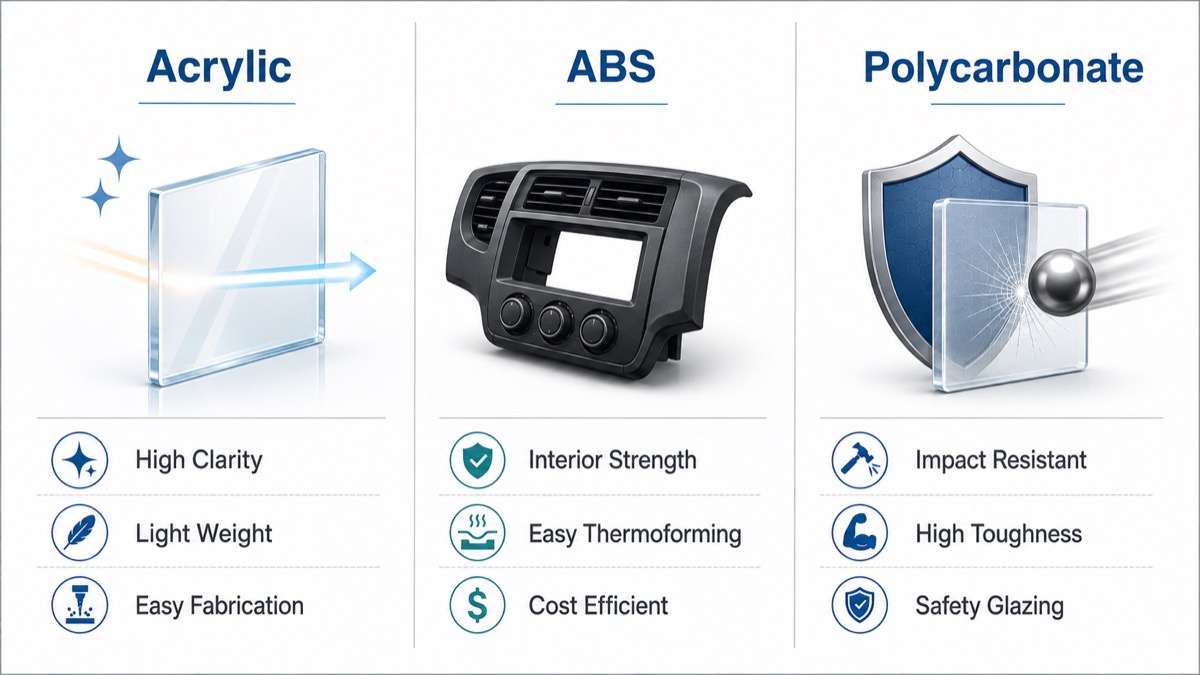
Polycarbonate sheet is often the material of choice where impact resistance, safety, and optical performance are non‑negotiable. Automotive manufacturers use polycarbonate for: [gokai.com]
- Headlamp lenses and light covers that must withstand stone chips and thermal cycles.
- Transparent guards and shields in specialty vehicles and commercial fleets.
Because polycarbonate combines toughness with relatively low weight, it supports both crash safety and efficiency goals in EVs and conventional vehicles. Modern formulations are optimized for UV stability, dimensional accuracy, and compatibility with coatings and adhesives used in automotive assemblies. [gokai.com]
ABS sheet gives automotive designers a reliable balance of rigidity, impact resistance, and surface aesthetics for interior components. It is widely used for: [openpr]
- Instrument panels and dashboards where a smooth, uniform finish and stable geometry are required.
- Console and pillar trims, steering covers, and interior housings that must handle daily wear and temperature variations. [openpr]
ABS performs well in crash‑relevant zones because it can absorb and redistribute impact energy, contributing to passenger safety in carefully engineered assemblies. When combined with high‑quality tooling and consistent sheet production, it delivers minimal warpage and excellent color matching across multiple parts.
Acrylic sheet (PMMA) stands out where appearance, clarity, and perceived quality are key to the automotive brand experience. You often see acrylic in: [gokai.com]
- Decorative exterior trims, logos, and light diffusers that require high gloss and accurate color.
- Interior design elements, dealer fixtures, and illuminated panels around vehicle displays and control areas. [gokai.com]
A European luxury retailer working with Gokai faced yellowing, edge cracking, and color inconsistency in bulk acrylic sheets due to recycled content and incorrect processing by a previous supplier. By switching to 100% virgin acrylic material, adding annealing, and optimizing cutting and polishing, the defects were eliminated, and light transmittance stabilized to meet stringent visual standards. This type of corrective project illustrates how material selection plus process control directly shape the final customer experience. [thebusinessresearchcompany]
Beyond datasheets, automotive and related OEM projects often struggle with hidden defects in plastic sheets that only appear in mass production. [thebusinessresearchcompany]
Two typical issues we encounter:
- Internal stress and cracking: Inconsistent foaming or cooling can lead to micro‑cracks during CNC machining or thermoforming.
- Density variation and surface defects: Low or uneven density may cause chipping, poor edge quality, and high scrap rates. [tme]
For example, a furniture factory using 20 mm PVC foam boards experienced severe chipping and cracking because of uneven foaming and low density supplied by another vendor. By upgrading to high‑density, uniform boards and stabilizing sheet quality, scrap rates dropped below 2%, allowing stable production and repeat orders. These lessons transfer directly to automotive interior and body applications, where sheet consistency is critical for yield and appearance. [thebusinessresearchcompany]
From an OEM buyer and engineer perspective, selecting the correct sheet for an automotive application is a structured process rather than a single decision. [tme]
1. Define the application and risk level
- Interior decorative, semi‑structural, or safety‑critical?
- Exposure to impacts, weather, chemicals, or high temperature?
2. Set performance priorities
- Rank impact strength, clarity, surface quality, heat resistance, and weight for your project. [mordorintelligence]
3. Choose candidate materials
- For high‑impact visibility: consider polycarbonate sheet.
- For interior structural aesthetics: consider ABS sheet.
- For glossy, high‑clarity visuals: consider acrylic sheet. [gokai.com]
4. Specify thickness, density, and tolerances
- Define minimum and maximum sheet thickness variation based on forming and machining requirements.
- Ensure flatness and density are appropriate for deep‑draw vacuum forming or tight‑tolerance CNC work. [tme]
5. Review certifications and test data
- Ask for material data sheets, internal lab reports, and third‑party certifications where required by OEM standards. [tme]
6. Run forming and machining trials
- Validate behavior in your actual process: bending, thermoforming, cutting, and bonding.
7. Lock in quality control and traceability
- Agree on batch testing, color and gloss tolerances, and documentation so each delivery is production‑ready. [gokai.com]
This systematic approach helps teams move beyond "price per sheet" and align material decisions with long‑term cost, reliability, and brand positioning.
Recent market reports show that the automotive plastics market is expanding as EV production increases and regulations favor lightweight and recyclable materials. [thebusinessresearchcompany]
Key trends shaping procurement and engineering decisions include:
- Lightweighting for EV range: Reducing mass is one of the most direct ways to extend EV range, pushing more applications from metals to plastics. [thebusinessresearchcompany]
- Advanced engineering plastics: High‑temperature, high‑strength polymer systems are being introduced for interior and under‑bonnet components. [thebusinessresearchcompany]
- Focus on recyclability and circular design: OEMs are gradually integrating more recyclable plastics and designing components for easier end‑of‑life processing. [openpr]
For sheet buyers, this means increasing demand for consistent, high‑quality acrylic, ABS, and polycarbonate sheets with documented environmental and performance credentials. [mordorintelligence]
As an OEM‑oriented sheet supplier based in China, Gokai focuses on global projects that require reliable acrylic sheet, ABS sheet, and polycarbonate sheet with strong technical support and customization. [gokaiplastic]
What automotive and industrial customers typically value includes:
- OEM customization: Thickness, color, size, and surface finishing tailored to specific parts and assembly methods.
- Strict quality control: Batch testing, material certification, and process optimization to eliminate cracking, yellowing, and density defects. [gokaiplastic]
- Application‑level consulting: Helping engineers and buyers compare sheet options (e.g., acrylic vs polycarbonate) and select the right grade for their design. [gokai.com]
By combining material expertise with OEM project experience, suppliers like Gokai support faster validation cycles and more predictable launches in demanding automotive programs. [gokai.com]
If you are planning a new automotive interior, exterior, or specialty vehicle project, now is the right time to review how you select and qualify your plastic sheet materials. Whether you are comparing acrylic, ABS, or polycarbonate for a new platform or solving defects in an existing supply chain, early collaboration with a specialized sheet supplier can save significant time and cost in later stages. [gokaiplastic]
Reach out to Gokai's technical team to discuss your drawings, performance targets, and OEM requirements so we can recommend the right sheet solution and prepare tailored samples for validation. [gokai.com]
1. Which plastic sheet is best for automotive headlamp covers?
Polycarbonate solid sheet is usually preferred for headlamp covers because it offers exceptional impact resistance, good optical clarity, and reliable performance under heat and UV exposure. [gokai.com]
2. When should I choose acrylic sheet instead of polycarbonate?
Acrylic sheet is ideal when you prioritize high gloss, excellent clarity, and a premium visual finish in non‑critical impact areas such as decorative trims, logos, and illuminated panels. [gokai.com]
3. Is ABS sheet suitable for exterior automotive parts?
ABS sheet is widely used for interior components, but UV‑stabilized and properly coated ABS can also be used for certain exterior parts, depending on the OEM's durability and weathering requirements. [openpr]
4. How can I reduce cracking and chipping when machining thick plastic sheets?
Choose sheets with uniform density and tight thickness tolerance, verify appropriate grades for your machining process, and work with a supplier who can adjust foaming, cooling, and annealing parameters for your application. [thebusinessresearchcompany]
5. What documentation should I request from a sheet supplier for automotive programs?
Ask for detailed material data sheets, batch test reports, certificates of conformity, and information on UV, thermal, and mechanical performance relevant to your OEM standards. [tme]
1. Automotive plastics market outlook and insights report 2026 – The Business Research Company. https://www.thebusinessresearchcompany.com/report/automotive-plastics-global-market-report
2. Common plastics used in automotive manufacturing – Piedmont Plastics blog. https://www.piedmontplastics.com/blog/automotive-plastics
3. Automotive plastics market size, trends & forecast – Mordor Intelligence. https://www.mordorintelligence.com/industry-reports/automotive-plastics-market
4. Automotive plastics market growth and recent developments – DataM Intelligence (OpenPR summary). https://www.openpr.com/news/4361717/automotive-plastics-market-to-reach-significant-growth-at-4-5
5. Plastic sheets – a practical guide for buyers – TME. https://www.tme.eu/en/news/library-articles/page/72204/plastic-sheets-a-practical-guide-for-buyers/
6. Gokai official site – OEM PVC foam board, acrylic sheet, and polycarbonate sheet manufacturer. https://www.gokai.com.cn
7. Gokai product and company overview – Acrylic sheet and related solutions. https://www.gokaiplastic.com