Shanghai Gokai Industry Co,.Ltd.
Call Us: +86-18918606548
Call Us: +86-18918606548
- Product Name
- Product Keyword
- Product Model
- Product Summary
- Product Description
- Multi Field Search
Views: 222 Author: Gokai Publish Time: 2026-06-01 Origin: Site


Content Menu
● Why Plastics Matter in Today's Architecture
● PVC Foam Board in Architectural Design
>> Key Benefits for Architects and Fabricators
>> Applications of PVC Foam Board in Architecture
● Aluminum Composite Panels (ACP/ACM): Facade Workhorses
>> What Are Aluminum Composite Panels?
>> Performance Advantages in Building Envelopes
● Foam Board and Paper Foam Board: The Designer's Canvas
>> The Role of Foam Board in Architecture
● Sustainability, Safety, and Emerging Standards
>> Environmental Considerations and 2026 Trends
● Practical Design and Fabrication Tips from the Field
● Where to Use Which Panel: A Quick Guide
● How Gokai's OEM Services Support Global Projects
● Call to Action: Specify Smarter Panels for Your Next Project
● Frequently Asked Questions (FAQ)
Plastics have moved far beyond "cheap" applications; they now sit at the core of high‑performance facades, interiors, and signage systems in contemporary architecture. As a supplier of PVC foam board, aluminum composite panel (ACP/ACM) and paper foam board, Gokai works daily with architects, fabricators, and brand owners who rely on these materials to balance aesthetics, durability, and cost on real projects worldwide. [m.boardwaybuilding]
Architects are under pressure to deliver buildings that are visually distinctive, energy efficient, and cost‑controlled—often on very tight timelines. Plastic‑based sheet materials help achieve that by combining low weight, high strength, and excellent weatherability with an almost unlimited design vocabulary. [keyplastics]
Compared with traditional materials like solid metal, glass, or wood, engineered plastic panels can reduce structural loads, simplify installation, and unlock new forms such as curves, folds, and large uninterrupted surfaces. At the same time, advances in recycling, fire performance, and composite design are addressing long‑standing concerns about safety and environmental impact. [hzpluswin]

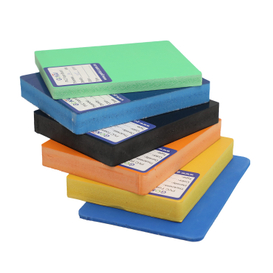
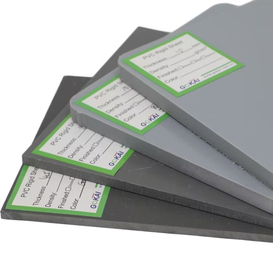
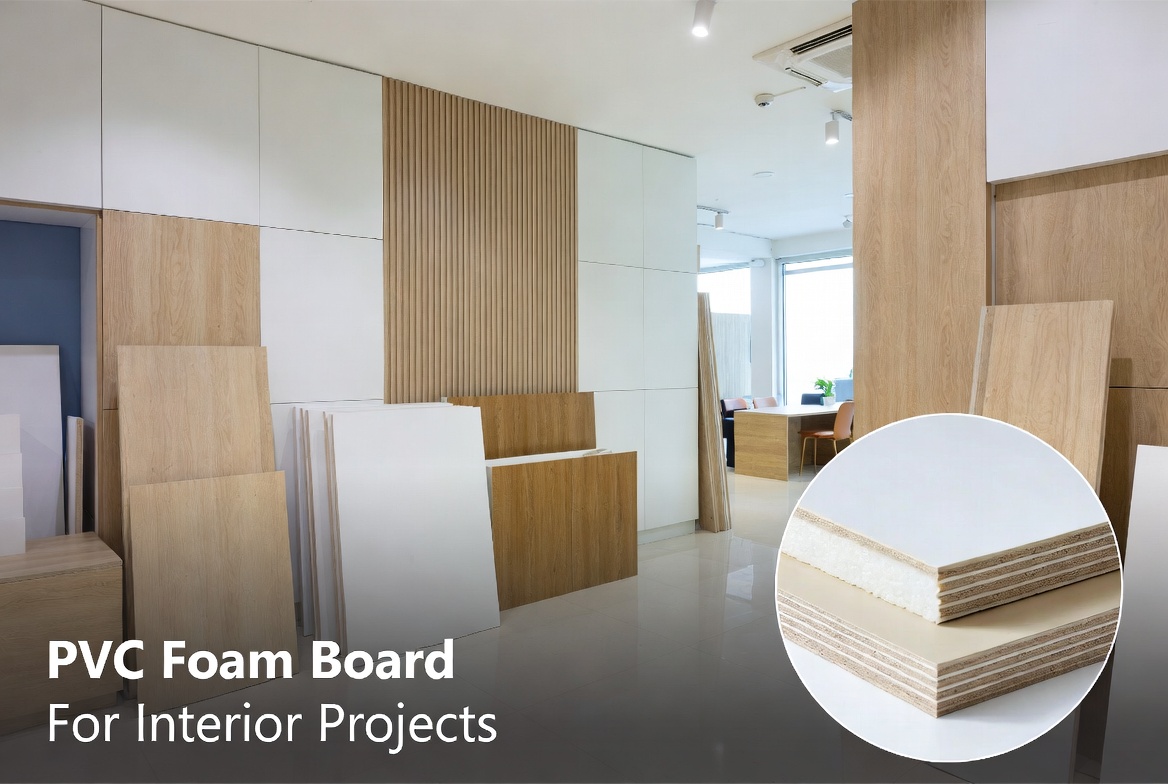
PVC foam board (expanded polyvinyl chloride) is a rigid sheet with a closed‑cell foam core and smooth skin layers, produced from PVC resin and foaming agents. This structure makes the board surprisingly stiff yet very lightweight, and it can be cut, routed, or thermo‑formed using standard woodworking tools. [acrylicsheet12.wixsite]
Unlike wood or MDF, PVC foam board is 100% waterproof, termite‑proof, and corrosion‑resistant, so it remains dimensionally stable in humid or outdoor environments. Because it accepts printing, laminating, and coating well, it doubles as both a structural and decorative substrate. [adidworld]
- Lightweight but rigid – Reduces sub‑framing and simplifies handling on site. [m.boardwaybuilding]
- Moisture and chemical resistance – Performs reliably in kitchens, bathrooms, labs, and signage exposed to weather. [acrylicsheet12.wixsite]
- Easy fabrication – Can be sawn, CNC‑routed, bonded, or heat‑formed without specialized equipment. [m.boardwaybuilding]
- Consistent surface – Ideal for paint, digital printing, and decorative laminates. [adidworld]
- Cost‑effective – Competitive material cost and faster installation lower total project budgets.
As a supplier, Gokai often sees PVC foam board selected not only for its performance, but also because contractors can work with it using familiar tools and processes, minimizing learning curve and risk on tight schedules. [m.boardwaybuilding]
PVC foam board has evolved from a niche sign material into a multi‑purpose architectural panel. [adidworld]
Typical uses include:
- Interior wall and ceiling panels in commercial and hospitality spaces.
- Cabinetry, shelving, and built‑ins in wet or high‑humidity areas. [m.boardwaybuilding]
- Exhibition backdrops, retail displays, and brand walls that require frequent reconfiguration.
- Wayfinding, outdoor signage, and information boards with direct digital printing. [adidworld]
- Decorative slats, trims, and feature elements that mimic wood or stone textures through lamination. [acrylicsheet12.wixsite]
In many of our OEM projects, PVC foam board is also combined with aluminum trim or acrylic overlays to create hybrid systems that meet both structural and branding requirements in a single assembly.
Aluminum composite panels (also called ACM) consist of two thin aluminum sheets bonded to a mineral‑filled thermoplastic core, forming a balanced "sandwich" with exceptional stiffness‑to‑weight ratio. This configuration delivers the visual quality of metal cladding while significantly reducing panel weight and installation complexity. [stacbond]
Because the panels can be fabricated into cassettes, folds, and curves, they have become a standard solution for modern building envelopes. [stacbond]
- High impact and wind resistance for exterior cladding and high‑rise facades. [stacbond]
- Weather and corrosion resistance even in coastal or industrial atmospheres. [nortem]
- Smooth, flat surfaces for premium architectural finishes and brand colors. [stacbond]
- Formability for curves, reveals, and three‑dimensional details without losing integrity. [stacbond]
- Fast installation using cassette or tray systems that integrate with common sub‑framing. [nortem]
With the right core selection and system engineering, ACP/ACM can meet demanding fire and code requirements while maintaining the clean lines that contemporary architecture expects. [stacbond]
- Ventilated rain‑screen facades and recladding of outdated building envelopes. [nortem]
- Corporate identity fronts for car dealerships, retail chains, and showrooms. [nortem]
- Soffits, canopies, and column covers where clean joints and low weight are critical. [stacbond]
- Interior feature walls and branded reception areas that must match exterior finishes. [stacbond]
At Gokai, OEM clients frequently specify ACP for global roll‑outs of branded storefronts, relying on consistent color, gloss, and flatness from one region to another. [nortem]
Traditional foam board—typically a lightweight foam core sandwiched between paper or plastic liners—has long been the go‑to material for architectural models and presentation mock‑ups. Its ease of cutting, low weight, and low cost allow design teams to prototype quickly and iterate before committing to full‑scale construction.
Common uses include:
- Physical massing models and interior mock‑ups for client presentations.
- Event signage, directional graphics, and temporary branding elements.
- Interior decorative panels and acoustic elements when laminated or perforated. [adidworld]
Paper foam board extends this concept with a stronger focus on printability and sustainability, using paper liners over a foam core engineered for digital printing and easy recycling in many markets. For designers and brand owners, it offers a smooth, bright surface that reproduces graphics with high color accuracy. [adidworld]
Typical architectural and commercial applications:
- Retail POP displays and window installations that refresh seasonally. [adidworld]
- Exhibition graphics and museum panels where low glare and vivid color are important. [adidworld]
- Short‑term interior partitions and branded backdrops for events and launches. [adidworld]
For global customers, Gokai's OEM service often combines paper foam board with custom‑sized, pre‑printed kits, reducing on‑site labor and ensuring consistent brand execution across multiple locations.
Sustainability has become a core evaluation criterion for plastic materials in construction. Industry‑wide, manufacturers are shifting away from a linear "take‑make‑dispose" model toward a circular economy that emphasizes recycled content, design for disassembly, and material reuse. [linkedin]
Key trends shaping specifications:
- Growing use of post‑consumer recycled (PCR) content and bio‑based polymers. [linkedin]
- Upgrades to production processes to reduce energy consumption and carbon footprint. [keyplastics]
- More stringent producer responsibility schemes and waste‑management regulations. [linkedin]
When advising architects, we recommend looking at full life‑cycle performance—durability, maintenance, and recyclability—rather than only initial material origin, especially when comparing plastics against heavily processed conventional materials. [keyplastics]
Fire performance is a frequent concern whenever plastics are specified in building envelopes. Modern ACP systems with mineral‑filled cores, as well as fire‑retardant PVC formulations, are designed to comply with stringent regional codes and test standards. [stacbond]
Best practices we see on successful projects include:
1. Choosing core types and formulations that meet the highest applicable local fire classification.
2. Using tested and certified panel systems, not just compliant raw sheets.
3. Coordinating with facade engineers to manage joints, cavities, and fire stops holistically.
By integrating material selection into early design phases, architects avoid costly redesigns and ensure that aesthetics, performance, and compliance align from the start. [stacbond]
Drawing on day‑to‑day collaboration with fabricators and sign makers, several practical guidelines consistently improve project outcomes:
- Define panel sizes and module grids early to minimize cutting waste and optimize sheet yield.
- Standardize thicknesses across PVC foam, ACP, and foam board where possible to simplify hardware and handling.
- For exterior work, specify UV‑stable coatings and inks to protect color and surface performance. [nortem]
- Coordinate fixing details with sub‑framing to prevent oil‑canning and ensure long‑term flatness on large facades. [nortem]
- Prototype critical junctions (corners, reveals, transitions) in foam board or PVC foam before committing to final ACP fabrication.
These steps help convert design intent into buildable solutions that perform reliably over the life of the building or branded environment.
| Use scenario | Recommended material | Why it fits |
|---|---|---|
| Exterior facade / rain‑screen | Aluminum composite panel | High durability, flatness, and formability for cladding. (stacbond) |
| Wet‑area cabinetry & interior panels | PVC foam board | Waterproof, rot‑free, easy to fabricate. (acrylicsheet12.wixsite) |
| Retail POP & short‑term displays | Paper foam board | Lightweight, printable, and cost‑efficient. (adidworld) |
| Architectural models and concept studies | Foam board / paper foam board | Very light, easy to cut, ideal for mock‑ups. |
| Branded exterior signage and wayfinding | PVC foam board or ACP | Print‑ready surfaces and structural stability outdoors. (adidworld) |
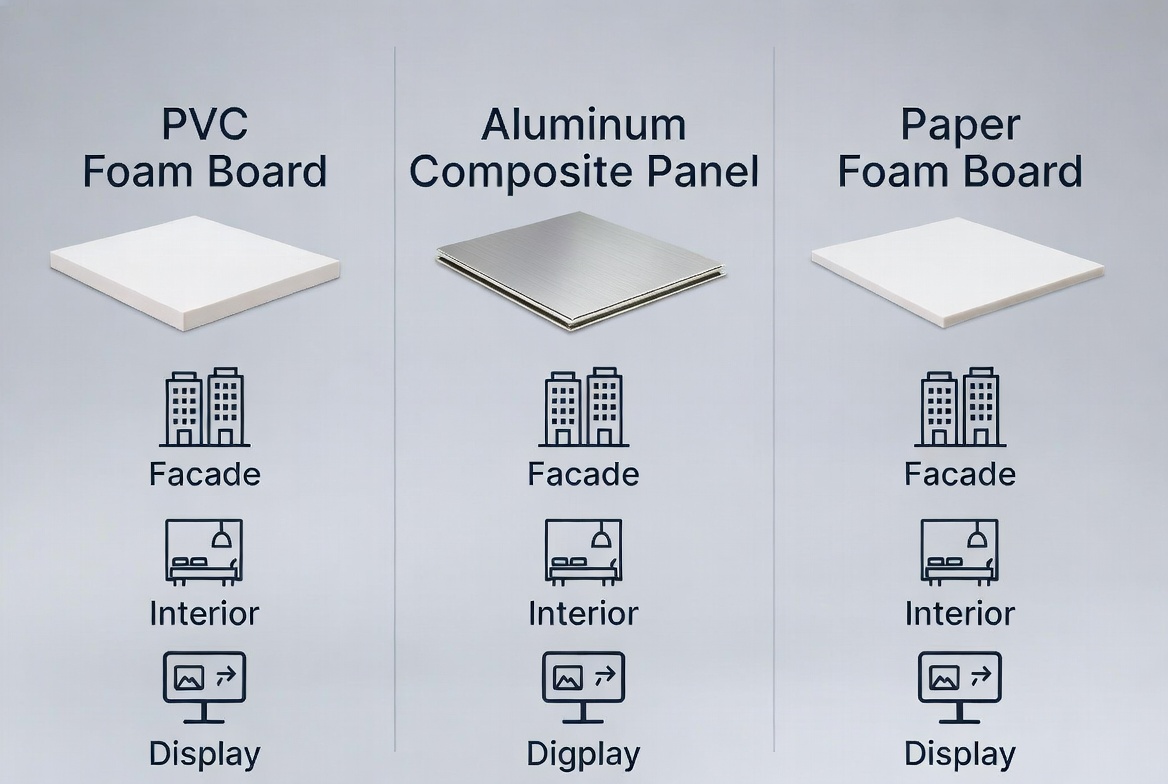
In many global OEM programs, we combine these materials—ACP for the exterior identity, PVC foam board for interior brand elements, and paper foam board for seasonal campaigns—to deliver a coherent yet flexible material system.
Because we operate as a specialized panel supplier and OEM partner, our role typically begins long before installation. We work with international clients in three main ways:
- Material consulting – Matching performance requirements and budgets with the optimal combination of PVC foam board, ACP, and paper foam board for each project phase.
- Customized formats and finishes – Supplying pre‑cut, pre‑laminated, or pre‑printed panels that align with global brand standards and regional regulations.
- Supply chain coordination – Supporting multi‑country roll‑outs with consistent materials, stable lead times, and documentation for local approvals.
For architects, signage integrators, and brand owners, this translates into fewer variables to manage and smoother project delivery, especially when replicating the same concept across multiple markets.
If you are planning a new facade, interior fit‑out, or branded environment, the material decisions you make today will shape performance and perception for years. By combining PVC foam board, aluminum composite panel, and paper foam board, you can balance aesthetics, durability, sustainability, and cost across every layer of your project envelope. [m.boardwaybuilding]
Contact the Gokai team to discuss your next specification, request OEM‑ready panel samples, or collaborate on a tailored panel system that aligns with your design language, code requirements, and rollout timelines.
1. Are PVC foam boards suitable for long‑term architectural applications?
Yes. Properly specified PVC foam boards are moisture‑proof, corrosion‑resistant, and dimensionally stable, which makes them well suited for interior panels, cabinetry, and some protected exterior uses. [acrylicsheet12.wixsite]
2. How do aluminum composite panels compare to solid aluminum sheets?
ACP offers similar visual impact with significantly lower weight, better flatness on large formats, and easier forming into complex facade geometries, often at a lower installed cost. [nortem]
3. Can paper foam board be considered a sustainable choice?
Paper foam board uses paper liners and is optimized for digital printing; in many regions, this improves recyclability compared with fully plastic substrates, especially for short‑term displays and seasonal graphics. [linkedin]
4. What should architects look for regarding fire performance?
Always review core type, local code requirements, and certified system tests—not just base material data—and collaborate with facade engineers to ensure overall assembly compliance. [stacbond]
5. How can Gokai support global brands and multi‑site projects?
Gokai provides material matching, OEM customization (sizes, finishes, printing), and coordinated logistics so that each site receives consistent panels that meet both design and regulatory requirements.
1. Laird Plastics – "Plastics in Architectural Design".
2. Boardway – "Applications of PVC Foam Board in Construction and Building Materials". [https://m.boardwaybuilding.com/n1915388/Applications-of-PVC-Foam-Board-in-Construction-and-Building-Materials.htm] [m.boardwaybuilding]
3. Stacbond – "What is the aluminium composite panel? Advantages, characteristics and main uses". [https://stacbond.com/en/blog/what-is-the-aluminium-composite-panel-advantages-characteristics-and-main-uses/] [stacbond]
4. Acrylicsheet Blog – "Why PVC Foam Board Is the Ultimate Choice for Modern Furniture Design". [https://acrylicsheet12.wixsite.com/acrylicsheet/post/why-pvc-foam-board-is-the-ultimate-choice-for-modern-furniture-design] [acrylicsheet12.wixsite]
5. Key Plastics – "What are the Plastic Manufacturing Trends for 2026?". [https://www.linkedin.com/pulse/what-plastic-manufacturing-trends-2026-key-plastics-ltd-d4ekf] [linkedin]
6. Industry article – "Why PVC Foam Panels Are Redefining Modern Architecture". [https://www.hzpluswin.com/blog/lightweight-revolution-why-pvc-foam-panels-are-redefining-modern-architecture] [hzpluswin]
7. Nortem – "ACM Panels | Supply, Fabrication & Installation". [https://nortem.ca/product/aluminum-composite-panel/] [nortem]
8. Hangzhou Jiuhui – "展现多功能性:压花PVC 泡沫板革命". [https://cn.foamboardfactory.com/news/industry-news/unveiling-the-versatility-the-embossed-pvc-foam-board-revolution.html] [cn.foamboardfactory]
9. ADID – "PVC发泡板的发展空间". [http://www.adidworld.com/news/detail/id/1039] [adidworld]