Shanghai Gokai Industry Co,.Ltd.
Call Us: +86-18918606548
Call Us: +86-18918606548
- Product Name
- Product Keyword
- Product Model
- Product Summary
- Product Description
- Multi Field Search
Views: 222 Author: Gokai Publish Time: 2026-06-11 Origin: Site


Content Menu
● Why Acrylic Needs a Different Gluing Approach
● Choosing the Right Adhesive for Acrylic-to-Acrylic Bonding
>> Common Adhesive Options for Acrylic Sheet
● Expert Surface Preparation: Where Strong Acrylic Bonds Begin
>> Step 1: Inspect and Machine the Edges
>> Step 3: Control Environment and Moisture
● Positioning and Fixturing Acrylic Sheets Before Gluing
● Professional Application Technique: Capillary Action Bonding
● Curing Time and Handling: When Is the Bond Really Strong?
● Advanced Techniques: Avoiding Bubbles, Blushing, and Stress Cracks
>> Minimizing Air Bubbles in the Joint
>> Preventing Blushing (Milky White Edges)
>> Controlling Stress and Crazing
● OEM Perspective: Designing Joints for Production and Long-Term Reliability
>> Design Considerations for Acrylic Assemblies
● Safety and Environmental Best Practices
● When to Partner With an OEM Acrylic Sheet Supplier
● Practical Example: From Prototype to Production-Ready Display Box
● Gluing Acrylic Sheet to Acrylic: Quick Checklist
● Call to Action: Plan Your Next Acrylic Project With OEM Support
● Frequently Asked Questions (FAQ)
>> 1. What is the best glue for acrylic sheet to acrylic sheet?
>> 2. Can I use super glue on acrylic?
>> 3. How long should I wait before handling glued acrylic parts?
>> 4. Why do my glued acrylic joints turn cloudy or white?
>> 5. Do I need special equipment to glue acrylic sheet professionally?
Gluing acrylic sheet to acrylic looks simple from the outside, but in professional fabrication it is one of the most common sources of failures, returns, and costly rework. As an OEM-focused acrylic sheet supplier, Gokai has seen both perfect, bubble‑free joints and expensive disasters—often caused by small mistakes that are easy to avoid. [acmeplastics]
In this guide, I will walk you through how to glue acrylic sheet to acrylic sheet using proven, industrial best practices, and share practical tips from an OEM perspective so your joints stay clear, strong, and production‑ready.
Acrylic sheet does not behave like wood, paper, or ceramic when you glue it. Instead of "sticking" two surfaces together with a thick glue line, professional fabricators chemically weld acrylic using solvent cements. [cutmy.co]
- Solvent cements (e.g., acrylic cement) temporarily soften the acrylic surfaces so they fuse into one continuous piece when the solvent flashes off. [acplasticsinc]
- Standard super glues and epoxies may hold in the short term, but they typically dry cloudy, can cause stress cracking, and are unsuitable for clear or load‑bearing acrylic structures. [acmeplastics]
From an OEM standpoint, this difference matters because:
- Your customers expect optically clear edges on displays, light boxes, and enclosures. [ttplasticland]
- Poorly chosen adhesives can yellow, craze, or fail under load after a few months in service. [weetect]
Key takeaway: For most acrylic‑to‑acrylic joints, choose a solvent‑based acrylic cement or a specialized acrylic bonding adhesive designed for capillary action bonding. [cutmy.co]
From my experience working with fabricators, adhesive choice is where many projects succeed or fail. The "best" glue depends on your clarity requirements, load, and production speed. [chemical-concepts]
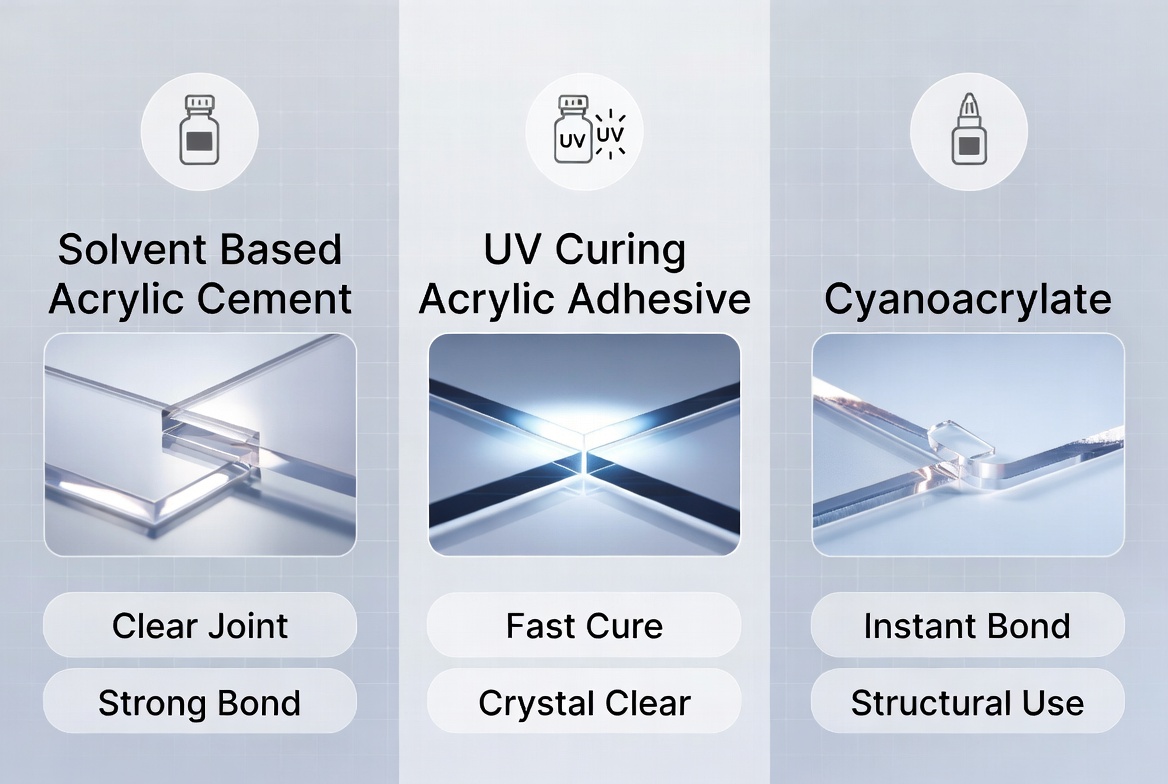
- Solvent-based acrylic cement
- Creates a clear, nearly invisible joint. [acplasticsinc]
- Ideal for boxes, covers, display cases, and architectural details. [ttplasticland]
- Requires tight, well‑machined joints and controlled application.
- Cyanoacrylate (super glue)
- Useful for quick fixtures or non‑visible joints. [cutmy.co]
- Often dries cloudy and can cause stress cracking in some acrylic formulations. [chemical-concepts]
- Better for small, opaque parts than for large, clear panels.
- UV-curing acrylic adhesive
- Enables precise positioning before cure and excellent optical clarity when cured with UV light. [weetect]
- Suitable for high‑end displays, lighting, and electronics housings where aesthetics are critical. [weetect]
- Silicone adhesive (for acrylic mirrors)
- Used when gluing mirror‑backed acrylic to substrates to protect the reflective coating. [ttplasticland]
- Provides flexibility and helps avoid delamination and mirror damage. [ttplasticland]
When Gokai supports an OEM project, we normally start with a simple checklist:
- Is the joint visible and must it stay crystal clear? If yes, use solvent‑based cement or specialized clear acrylic adhesive. [acmeplastics]
- Is the part structural or load‑bearing? Consider using thicker‑bodied cements or designed structural acrylic adhesives with proper testing. [chemical-concepts]
- Is speed more important than optical perfection? Cyanoacrylates can be used for fixtures or non‑critical joints. [cutmy.co]
Every strong acrylic joint starts with perfect surfaces. Most failures we see as a supplier can be traced back to poor edge quality, contamination, or moisture. [turboplastic]
Before you think about glue, inspect each acrylic edge:
- Look for chips, saw marks, and micro‑cracks. [acmeplastics]
- Avoid heavily rounded or polished edges where solvents cannot bite effectively. [ko.huaaoplastics]
For imperfect edges:
- Use a router or fine‑grit sandpaper (around 400–600 grit) to square and smooth the edge without rounding it. [ttplasticland]
- Keep the edge flat and straight to ensure intimate contact and minimal gaps. [acplasticsinc]
Acrylic attracts dust, fingerprints, and machining oils—all of which weaken bonds and trap bubbles. [turboplastic]
- Wipe bonding surfaces with a lint‑free cloth and isopropyl alcohol or acrylic‑safe cleaner. [turboplastic]
- Allow surfaces to dry completely before continuing. [turboplastic]
- Work in a clean, dust‑controlled area with good ventilation (solvent fumes can be strong). [weetect]
- Avoid high humidity, which can promote blushing (milky white edges) in some solvent cements. [weetect]

Professional results depend on stable, stress‑free fixturing while the adhesive flows and cures. [acplasticsinc]
- Use clamps, jigs, or wooden blocks to hold sheets in their final position. [acmeplastics]
- Ensure joints are flush with no visible gaps; solvent cements are thin and rely on capillary action, not gap filling. [cutmy.co]
- Avoid overtightening clamps, which can distort panels and squeeze out too much cement. [acplasticsinc]
A simple OEM tip: when we prepare samples for customers, we often use temporary right‑angle fixtures and low‑tack masking tape so the load on the joint stays minimal during the first 30–60 minutes. [ttplasticland]
Most clear acrylic bonding is done with a thin, water‑like solvent cement and a needle‑tip applicator. [acmeplastics]
1. Transfer cement to an applicator bottle
- Fill only about 75% full to keep good control and avoid air spurts. [acmeplastics]
- Fit a fine needle tip for precise dispensing. [ttplasticland]
2. Vent the bottle and test flow
- Gently squeeze to expel air, then invert and test a small amount on scrap to confirm a steady, controllable flow. [acmeplastics]
3. Apply cement along the joint
- Place the needle at one end of the seam and draw it steadily along the joint. [ttplasticland]
- Capillary action will pull the cement between the sheets, so you do not need to force large amounts into the seam. [cutmy.co]
4. Maintain a continuous movement
- Avoid starting and stopping; pauses can create pools, streaks, or bubbles in the joint. [ko.huaaoplastics]
- Use consistent speed and pressure for an even glue line. [acmeplastics]
5. Do not wipe spills immediately
- If cement floods or runs onto a visible surface, do not wipe it while wet—this will permanently mar the surface. [ko.huaaoplastics]
- Let the solvent evaporate, then carefully clean or polish later if needed. [ko.huaaoplastics]
One of the most misunderstood aspects of gluing acrylic is curing time. Many fabricators move parts too early, leading to micro‑cracks or misalignment. [acplasticsinc]
Typical solvent cement behavior:
- Initial set: 5–30 minutes
- The joint becomes firm enough to remove hand pressure or some light fixturing. [acplasticsinc]
- Handling strength: a few hours
- Parts can usually be moved cautiously, but not stressed. [acplasticsinc]
- Full cure: 24–48 hours
- The acrylic–acrylic weld reaches maximum strength and chemical resistance. [acplasticsinc]
For OEM production, the safest practice is to:
- Plan your workflow so that bonded assemblies are not mechanically loaded, packaged, or shipped before a full 24–48 hour cure. [acmeplastics]
- Communicate this curing requirement clearly to downstream teams to avoid invisible damage before the product reaches the customer. [weetect]
Once you master basic gluing, the next step is optimizing optical quality and long‑term durability. Here are expert‑level considerations we commonly discuss with Gokai's OEM partners.
Bubbles are usually caused by gaps, dust, or uneven flow. [cutmy.co]
- Ensure tight, well‑machined joints with full edge contact. [cutmy.co]
- Keep the applicator angle low so cement flows gently, instead of injecting air into the seam. [ttplasticland]
- Do not over‑squeeze the bottle; excess force drives air into the joint. [ttplasticland]
Blushing often appears when:
- The environment is humid, or
- Too much solvent is applied at once. [weetect]
To reduce blushing:
- Work in a low‑humidity environment where possible. [weetect]
- Apply cement in controlled, thin passes instead of flooding the seam. [weetect]
Stress crazing—fine, spider‑web like cracks near the joint—can result from:
- Residual stress in cut or bent acrylic. [weetect]
- Excess solvent or aggressive cleaners after bonding. [chemical-concepts]
Best practices include:
- Using proper annealing for heavily formed parts before bonding. [weetect]
- Avoiding strong, incompatible chemicals on freshly bonded joints. [chemical-concepts]
Beyond the workshop, OEM projects must consider repeatability, throughput, and lifecycle performance. [formlabs]
- Joint geometry:
- Edge‑to‑edge, mitered, and tongue‑and‑groove joints each behave differently under load. [formlabs]
- Where possible, design joints so that the bonded area is large and stresses are distributed.
- Load direction and service conditions:
- Consider whether the joint will see impact, vibration, UV exposure, or chemicals. [chemical-concepts]
- For harsh environments, validate adhesive choice with sample tests before committing to production. [chemical-concepts]
- Process integration:
- Choose adhesives that fit your existing equipment, curing times, and quality checks. [chemical-concepts]
- For high‑volume lines, UV‑curing or fast‑setting acrylic adhesives can shorten cycle times while maintaining clarity. [cutmy.co]
As an acrylic sheet supplier, Gokai can support this process with material selection, sample bonding, and stability testing, ensuring that the glue system, sheet grade, and joint design work as a unified system. [formlabs]
Professional bonding is not just about appearance; it is also about safe and compliant operation. [ttplasticland]
- Always work in a well‑ventilated area and follow the adhesive manufacturer's safety data sheet (SDS) guidelines. [ttplasticland]
- Wear appropriate personal protective equipment such as safety glasses and chemical‑resistant gloves. [chemical-concepts]
- Store solvents and adhesives in approved containers away from heat sources and dispose of waste according to local regulations. [weetect]
For OEM customers who sell into multiple regions, it is crucial to select adhesive systems that can meet local VOC and safety regulations while still delivering the desired optical and mechanical performance. [formlabs]
If you are scaling from prototypes to regular production, working alone with hardware‑store adhesives quickly reaches its limits. At that point, partnering with an OEM‑experience supplier like Gokai can unlock better results.
Here is how an OEM‑capable acrylic sheet supplier can help:
- Material and adhesive matching:
- Aligning acrylic grade (cast vs. extruded, UV‑stabilized, impact‑modified) with the most compatible adhesive chemistry. [formlabs]
- Process optimization:
- Advising on edge preparation, fixturing strategies, and curing workflows that suit your specific volumes and quality goals. [chemical-concepts]
- Consistency across batches:
- Supplying dimensionally consistent sheet reduces rework and improves bond uniformity, especially for automated assembly lines. [formlabs]
If you are designing a new acrylic product or upgrading an existing line, Gokai can provide OEM‑ready acrylic sheet plus technical guidance so your bonding process is robust from day one.
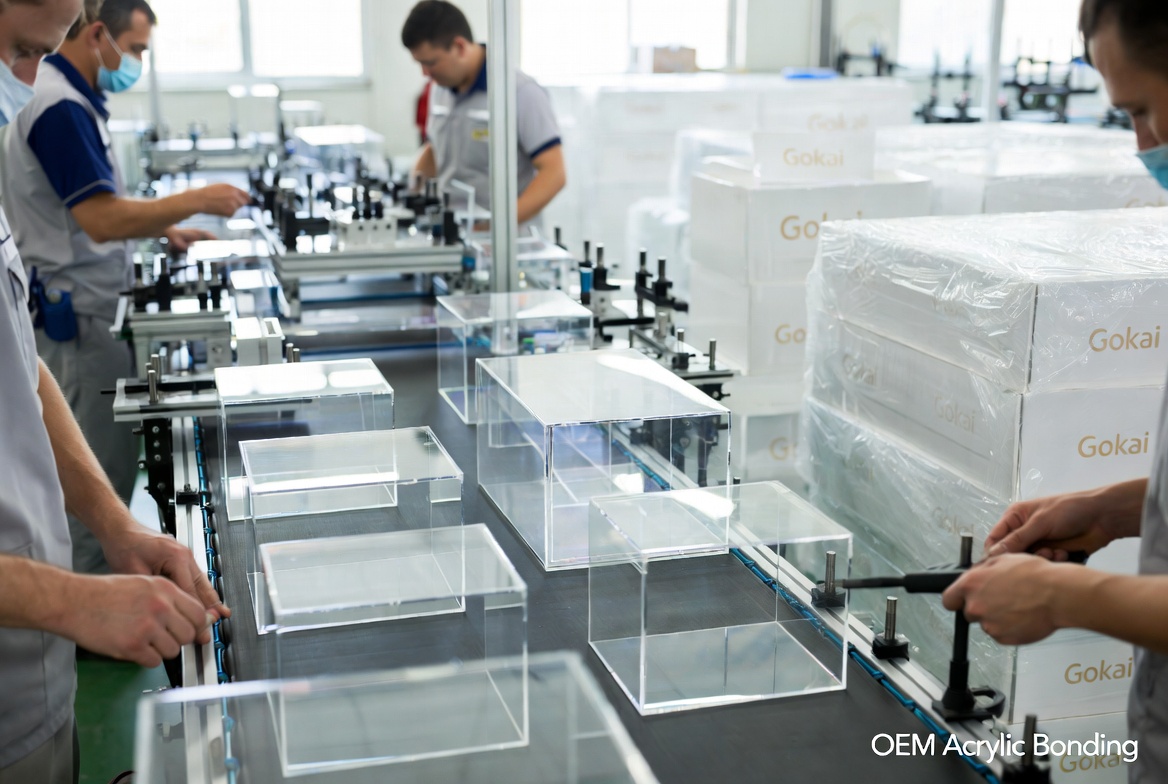
To illustrate how these principles work in practice, imagine you are developing a clear acrylic display box for a global retail customer.
1. Prototype stage
- You start with cast acrylic sheet, hand‑cut on a table saw, and use solvent cement with a simple needle bottle. [cutmy.co]
- Minor bubbles and slight misalignment are acceptable.
2. Pre‑production
- You switch to CNC‑cut panels for perfectly square edges and test several cements for clarity and cure speed. [formlabs]
- Fixturing is upgraded to dedicated jigs for repeatable 90‑degree joints. [acplasticsinc]
3. Full OEM production
- With support from an acrylic supplier, you standardize on a specific acrylic grade and cement, define exact curing times, and document the full bonding process as an SOP. [formlabs]
- Quality checks include regular inspection of joints for bubbles, blushing, and crazing before shipping. [chemical-concepts]
This is the evolution path we often see for Gokai's OEM customers: from simple, manual gluing to a documented, scalable bonding process that can support international orders reliably.
Use this quick checklist as a reference on the shop floor:
- Before gluing
- Check edges for chips and saw marks; machine or sand to square. [acmeplastics]
- Clean surfaces with acrylic‑safe cleaner or isopropyl alcohol and let dry. [turboplastic]
- Set up a clean, ventilated workspace and appropriate fixturing. [ttplasticland]
- Gluing
- Position acrylic sheets and clamp gently with no gaps. [acplasticsinc]
- Use a needle‑tip applicator and thin solvent cement; apply steadily along the joint. [acmeplastics]
- Do not wipe spilled solvent; let it evaporate naturally. [ko.huaaoplastics]
- Curing
- Hold parts still for at least 15–30 minutes for initial set. [acplasticsinc]
- Avoid stress on joints for 24–48 hours to reach full strength. [acmeplastics]
If you are planning a new acrylic enclosure, display, or industrial assembly and want clear, strong, and repeatable joints, it is worth aligning your design, adhesive, and material choice from the start.
As an experienced acrylic sheet supplier, Gokai can:
- Recommend sheet types and thicknesses optimized for your bonding method. [formlabs]
- Provide OEM‑grade acrylic sheets and support trial bonding runs. [formlabs]
- Help you document a repeatable gluing process that fits your production goals. [chemical-concepts]
Get in touch with our team to discuss your drawings, performance requirements, and target markets, and we will help you build an acrylic bonding workflow that scales with your business.
For most clear acrylic‑to‑acrylic joints, a solvent‑based acrylic cement is the best choice because it chemically welds the surfaces and creates a nearly invisible bond. For specialized cases—such as high‑end displays or complex geometries—UV‑curing acrylic adhesives can also deliver excellent clarity and precision. [cutmy.co]
You can use cyanoacrylate (super glue) for small, non‑visible, or non‑critical joints, but it is not recommended for large, clear panels because it often dries cloudy and can contribute to stress cracking in some acrylic types. For professional, optically clear joints, solvent cements are a much better choice. [cutmy.co]
Most solvent cements provide an initial set in 15–30 minutes, allowing you to carefully remove clamps or hand pressure. However, you should wait 24–48 hours before putting acrylic assemblies under significant mechanical load, packaging pressure, or shipping conditions. [acplasticsinc]
Cloudiness or a milky white appearance, often called blushing, can result from high humidity, excessive solvent, or contamination in the joint. Improving surface preparation, controlling environment humidity, and applying a thinner, more controlled solvent bead usually reduces this issue. [weetect]
You can start with simple tools—a needle‑tip applicator, clamps, and a flat, clean workspace—but for OEM production, dedicated jigs, CNC‑cut edges, and controlled curing areas significantly improve consistency. Partnering with an experienced acrylic supplier can help you decide which equipment upgrades will have the biggest impact for your volume and budget. [formlabs]
1. Acme Plastics – "A Guide to Gluing Acrylic Plastic to Plastic"
<https://www.acmeplastics.com/content/a-guide-to-gluing-acrylic-plastic-to-plastic/> [acmeplastics]
2. TT Plastic Land – "How to Glue Acrylic Together: A Complete Guide"
<https://www.ttplasticland.com/blogs/news/how-to-glue-acrylic-together-a-complete-guide> [ttplasticland]
3. Cut My Plastic – "How To Glue Acrylic: A Comprehensive Guide"
<https://www.cutmy.co.uk/ideas-advice/how-to-glue-acrylic/> [cutmy.co]
4. AC Plastics – "How to Glue & Weld Acrylic Sheeting"
<https://www.acplasticsinc.com/informationcenter/r/gluing-acrylic-sheeting> [acplasticsinc]
5. Weetect – "Bonding Acrylic: The Ultimate Guide"
<https://www.weetect.com/bonding-acrylic/> [weetect]
6. Chemical Concepts – "The Ultimate Guide to Bonding Plastic"
<https://www.chemical-concepts.com/the-ultimate-guide-to-bonding-plastic/> [chemical-concepts]
7. Turbo Plastic – "Transparent Acrylic: Gluing Guide and Best Adhesives for Acrylic Sheet"
<https://turboplastic.com/zh-TW/blog/how-to-glue-acrylic-sheet/> [turboplastic]
8. Formlabs – "Guide to Manufacturing Processes for Plastics"
<https://formlabs.com/blog/guide-to-manufacturing-processes-for-plastics/> [formlabs]
9. Huaaoplastics – "A Guide to Gluing Acrylic Plastic to Plastic"
<https://ko.huaaoplastics.com/resources/a-guide-to-gluing-acrylic-plastic-to-plastic.html> [ko.huaaoplastics]